15 Oct 2026
SEBI Registered Name - Kotak Mahindra Mutual Fund
SEBI Registered Number - MF/038/98/1
In October 2024, the Nobel Prize in Chemistry was awarded for breakthroughs in protein design and protein structure prediction. AlphaFold, an AI model, helped address the long-standing scientific challenge of predicting complex protein structures, which had puzzled researchers for over 50 years.
The award was more than recognition of a scientific achievement. It signalled a broader shift in how artificial intelligence is transforming scientific research. For decades, determining protein structures experimentally often required several years of laboratory work for a single protein, with particularly challenging targets such as membrane proteins sometimes taking 5-10 years or longer. Today, AI systems such as AlphaFold can generate structural predictions in hours or days, enabling researchers to explore biological questions at an unprecedented scale. AlphaFold has already predicted the structures of more than 200 million proteins, creating a valuable resource for scientists worldwide.
Source: https://www.nobelprize.org/prizes/chemistry/2024/summary/
Drug discovery stands to be one of the biggest beneficiaries of this transformation.
Source: Acro, PPD.com
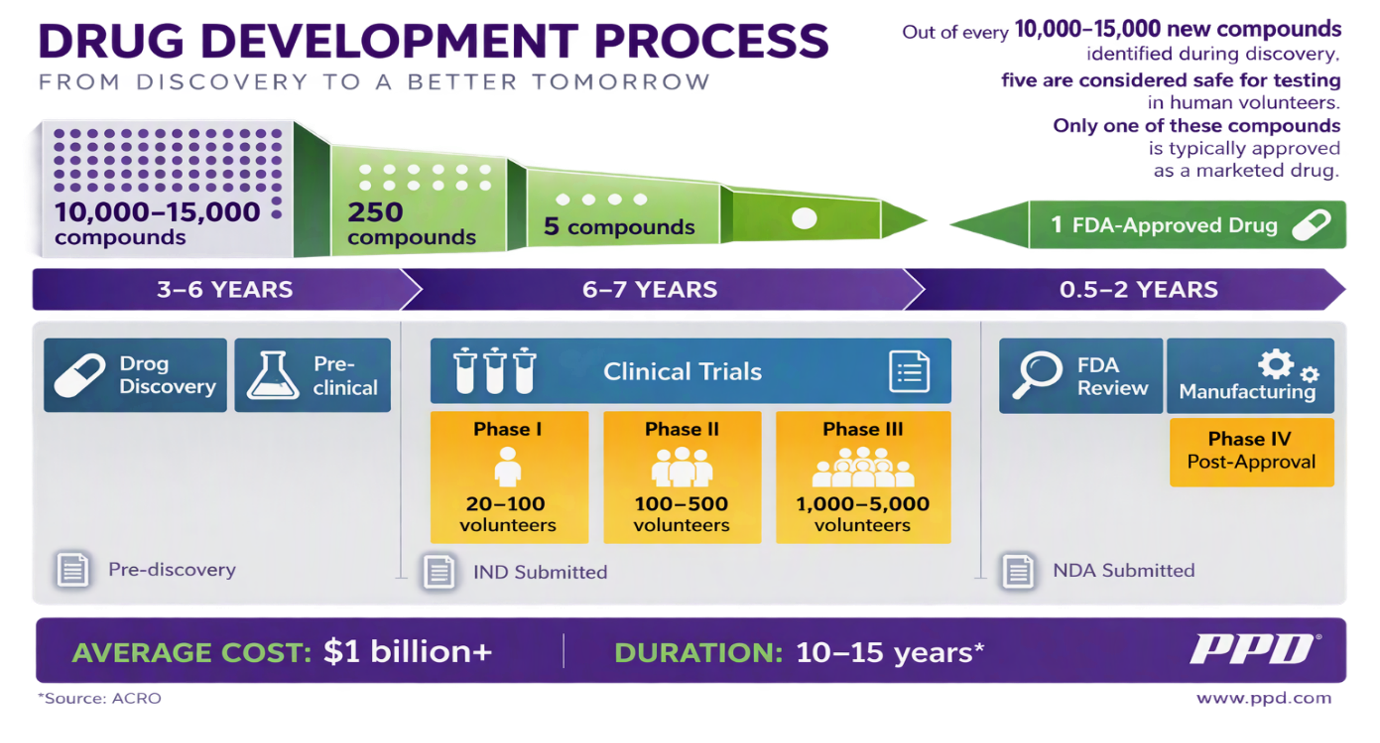
Before looking at where AI creates efficiencies, it is useful to first understand how the drug discovery process typically works. Developing a new medicine is not a single-step exercise; it is a long, multi-stage journey that begins with identifying the right biological target and moves through compound screening, preclinical testing, clinical trials, regulatory approval and eventually manufacturing. At each stage, companies must make difficult decisions on which candidates to advance, which to modify and which to discard.
The journey from identifying a disease target to receiving regulatory approval often takes a long time. Developing a new medicine takes 10-15 years and costs more than USD 2 billion before it reaches patients. During this process, thousands of compounds are screened, tested, and discarded before a single therapy reaches patients.
Source: NIH
Another challenge is the success rate. Only about 1 in 250 compounds entering preclinical testing eventually reaches the market, highlighting the enormous amount of scientific effort that never translates into an approved therapy. Even after it enters human trials the success of the drug is far from guaranteed. Only 10 to 20% of the drugs entering clinical trials ultimately receive regulatory approvals.
Source: Intuitionlabs
The cost is equally significant. A study published in the Journal of the American Medical Association (JAMA) estimated the average capitalized R&D investment required to bring a successful drug to market at approximately US$1.3 billion, with development costs in therapeutic areas such as oncology reaching nearly US$2.8 billion.
Source: Journal of American Medical Association, NIH
Thus, traditional drug discovery has therefore been characterized by three major challenges:
- Long development timelines
- High research costs
- Low success rates
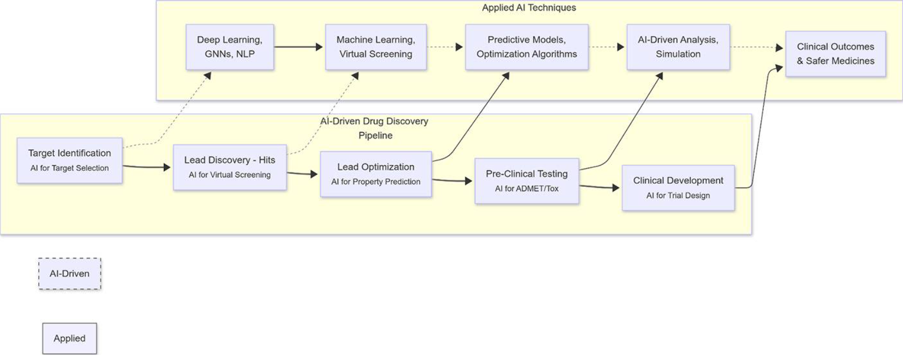
Drug discovery has traditionally been time-consuming, expensive and uncertain and why AI’s ability to improve decision-making across the pipeline can be so meaningful.
From Years of Research to Minutes of Analysis
Source: NIH
The scientific possibilities involved in discovering a medicine are difficult to comprehend.
A researcher looking for a new drug target may need to examine scientific papers, genomic data, disease pathways, protein interactions and results from earlier experiments. The scale of this search has become too large for traditional methods alone. Genentech, for instance, works with a scientific universe that includes around 38 million biomedical publications on PubMed, ~20,000 human genes and internal datasets containing hundreds of millions of cells across hundreds of diseases. The number of possible drug-like small molecules is estimated at an almost unimaginable 1060.
This is where AI can turn data overload into a research advantage. Genentech partnered with Amazon Web Services to develop the gRED Research Agent, a generative AI platform designed to help scientists search, connect and synthesise biomedical information across multiple sources at once. The system can analyse PubMed, public biological databases and Genentech’s internal research repositories, and then provide cited, traceable findings for researchers to examine. According to AWS, tasks that previously took scientists weeks can now be completed in minutes. Genentech estimates that the platform could automate more than 43,000 hours of manual biomarker-validation work equivalent to nearly five years of cumulative effort across therapeutic areas.
This matters because biomarkers play a critical role in tracking disease progression, identifying suitable patients for clinical trials and assessing whether a medicine is producing the intended effect.
Source: https://aws.amazon.com/solutions/case-studies/genentech-generativeai-case-study/
But, can AI do more than retrieve information? Can it help identify a biological target, design a molecule against it and move that molecule into human testing?
One of the most advanced examples is rentosertib, an investigational medicine developed by Insilico Medicine for idiopathic pulmonary fibrosis, a progressive lung disease. Given the encouraging Phase 2a results, Rentosertib is expected to advance to Phase 2b or Phase 3 trials to confirm efficacy and safety in a broader patient population.
Using its AI platform Pharma.AI, the company identified a target and designed a drug candidate for Idiopathic Pulmonary Fibrosis (IPF) in approximately 18 months and reached initial human testing in 30 months, a process that traditionally may have taken several years.
Source: https://insilico.com/pipeline
Another compelling example is of Recursion Pharmaceuticals. It uses AI to analyze billions of biological and chemical relationships simultaneously. Its AI-enabled platform helped advance REC-4888, a treatment candidate for Familial Adenomatous Polyposis, a rare genetic disorder associated with cancer risk.
This approach illustrates how AI can uncover biological relationships that may be difficult to identify through traditional research methods alone.
Source: Recursion Pharmaceuticals: https://www.recursion.com/ , Company pipeline updates on REC-4888
Aurigene, a wholly owned subsidiary of Dr. Reddy’s Laboratories, has developed Aurigene.AI, an AI-assisted platform for small-molecule drug discovery.
The platform combines generative AI, predictive AI, computer-aided drug design and physics-based simulations. Its curated database contains approximately 180 million compounds and 1.6 million validated bioassay data points. The platform also includes 11 generative AI models, four predictive AI models and eight computational or computer-aided drug-design models. Aurigene also operates Aurimine, a virtual database containing more than 12 billion compounds, expanding the chemical universe available for computational screening and molecular design. According to Dr. Reddy’s Laboratories, an internal case study found that Aurigene.AI reduced the cycle time from chemical design to synthesis and testing by approximately 35%.
Source: Dr.Reddys Website
As the process for drug discovery fastens, the cost for pharma companies would also reduce.
Why India Could Be a Major Beneficiary?
The impact of AI in drug discovery extends beyond global pharmaceutical companies.
As drug discovery becomes faster and more efficient, the number of molecules progressing through clinical development could increase. India already occupies an important position in the global pharmaceutical supply chain and is one of the largest providers of pharmaceutical manufacturing services worldwide.
As more drug candidates progress through the pipeline, Indian companies could benefit from increased outsourcing of development and manufacturing activities.
AI and the Indian Pharmaceutical Ecosystem
The adoption of AI in pharmaceutical research is not limited to global biotechnology companies. A number of Indian pharmaceutical, biotechnology and contract research organizations have also been exploring the use of AI, machine learning and advanced analytics across areas such as drug discovery, target identification, clinical research, process optimization and manufacturing.
Additionally, several Indian CDMO and CRAMS companies are increasingly incorporating digital technologies, automation and advanced analytics to improve research and manufacturing efficiency. AI adoption in India is also extending beyond molecule discovery. Jubilant Ingrevia is applying digital technologies to areas such as AI-enabled route design, process control and predictive maintenance. Such applications can help CDMOs improve manufacturing reliability, optimise production processes and reduce development bottlenecks.
As AI improves the efficiency of drug discovery globally, it may influence multiple parts of the pharmaceutical value chain, including contract research, clinical development, manufacturing and commercialization. Given India's established presence in these segments, the broader ecosystem could participate in the increased research and development activity that may result from faster drug discovery processes.
Note: CDMO = Contract Development and Manufacturing Organization, CRAMS = Contract Research and Manufacturing Services.
Mr. Dhananjay Tikariha, Senior Vice President, Equity Research at Kotak AMC, adds: “AI has the potential to make the journey of drug discovery smarter, faster, and more targeted. From identifying new treatment pathways to optimizing clinical development, it is empowering researchers to innovate more efficiently. Ultimately, the greatest value of AI lies in its ability to help bring life-changing medicines to patients sooner and at a lower cost.”
Disclaimers:
KMAMC is not guaranteeing/offering/communicating any indicative yield/returns on investments. The stocks/sectors mentioned in this slide do not constitute any recommendation and Kotak Mahindra Mutual Fund may or may not have any future position in these sectors/stocks. Companies mentioned don’t constitute recommendation, brand name affiliation disclaimer & companies mentioned for illustrative purpose only. Use of the company brand names does not imply any affiliation with or endorsement by them or any of its holding companies, subsidiaries or affiliates and are used for illustrative purpose only.
Mutual Fund investments are subject to market risks, read all scheme related documents carefully.