27 Aug 2026
SEBI Registered Name - Kotak Mahindra Mutual Fund
SEBI Registered Number - MF/038/98/1
Most of us think of airports as transportation infrastructure. A place to check in, clear security, grab a coffee and board a flight.
But airport operators think differently.
To them, an airport is part transportation hub, part shopping mall, part logistics gateway and part real-estate project. The aircraft may be the most visible part of the airport, but for airport operators, the real value is often created inside the terminal and around the airport ecosystem.
Understanding airports becomes much easier when we start with a simple question:
Why are so many investors willing to commit billions of dollars to airport infrastructure?
The answer lies in a powerful combination of demographics, economics and consumer behaviour.
India’s Aviation Opportunity is just taking off
India has the world's largest population, one of the fastest-growing economies and one of the lowest air-travel penetration rates globally. But India records only about 0.2 air trips per person annually, compared with over 2 trips per person in the US and 3 trips per person in the UAE. The gap points to a large pool of potential first-time flyers as incomes rise and air travel becomes more accessible.
India’s Untapped Aviation Opportunity
| Country | 2025 | 2015 |
|---|---|---|
| UAE | 3.1 | 2.7 |
| USA | 2.1 | 2.0 |
| France | 1.4 | — |
| China | 0.5 | 0.3 |
| India | 0.2 | 0.1 |
Source: Navi Mumbai International Airports Presentation
The opportunity is already reflected in airline expansion plans. Indian carriers have placed orders for 1,880 aircraft, signalling confidence in the country's long-term air-travel demand. And every new aircraft needs the infrastructure to support it i.e. runways, gates, terminals and baggage-handling capacity.
| Airline | Aircraft Ordered |
|---|---|
| IndiGo | 931 |
| Air India | 530 |
| Akasa | 200 |
| SpiceJet | 140 |
| Others | 79 |
| Total | 1,880 |
Source: Adani Airports Holdings Ltd Presentation
For airport operators, the opportunity is clear. More aircraft can mean more flights, more passengers and ultimately, more opportunities to monetise every traveller passing through the terminal.
Even more revealing is the delivery schedule.
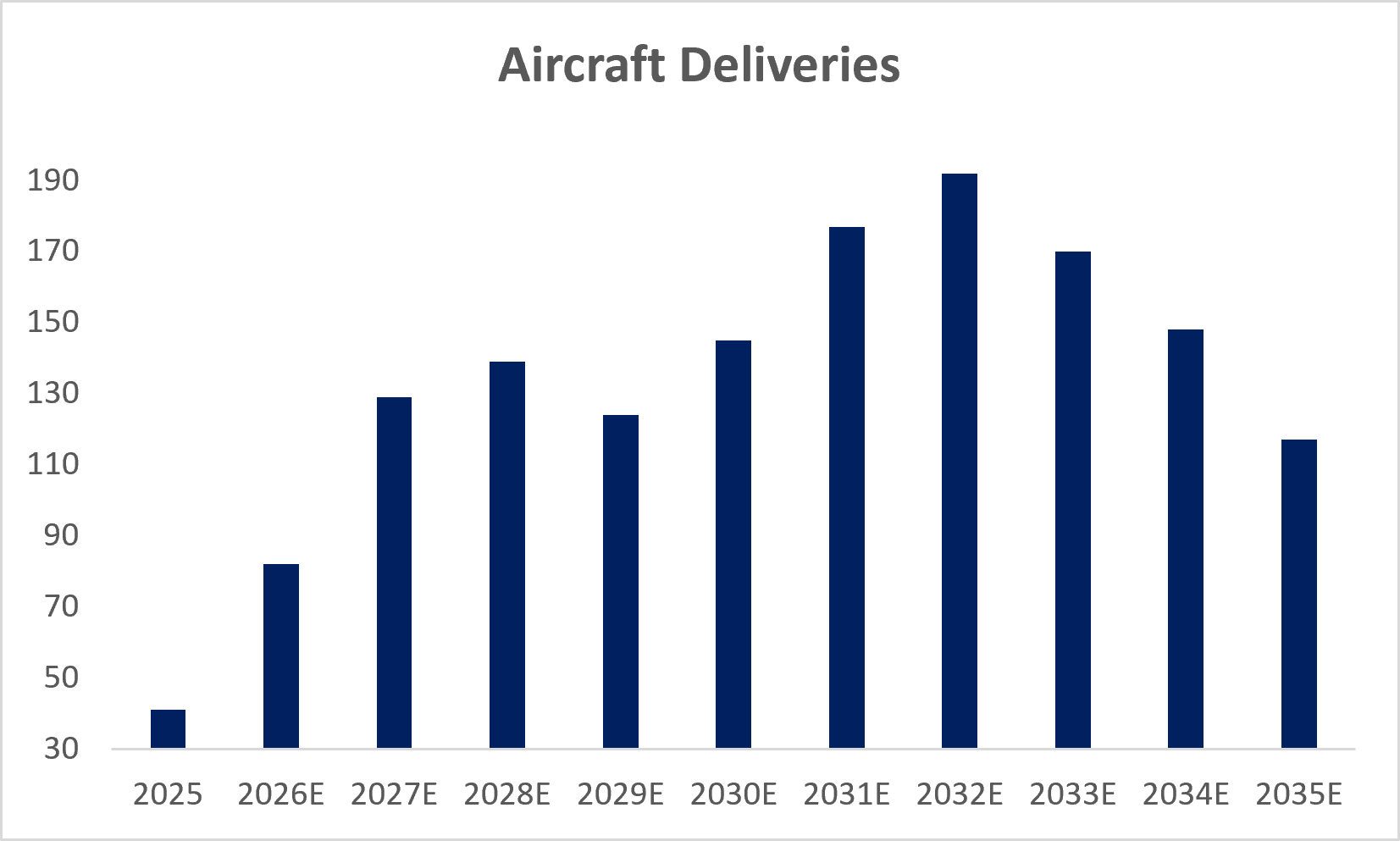
Source: NMIA Presentation, E- Estimates
This brings us to the most misunderstood aspect of airport businesses.
Most people think airports make money from planes. They don't. At least not primarily.
What We Think Airports Earn From

VS
What Airports Actually Earn From
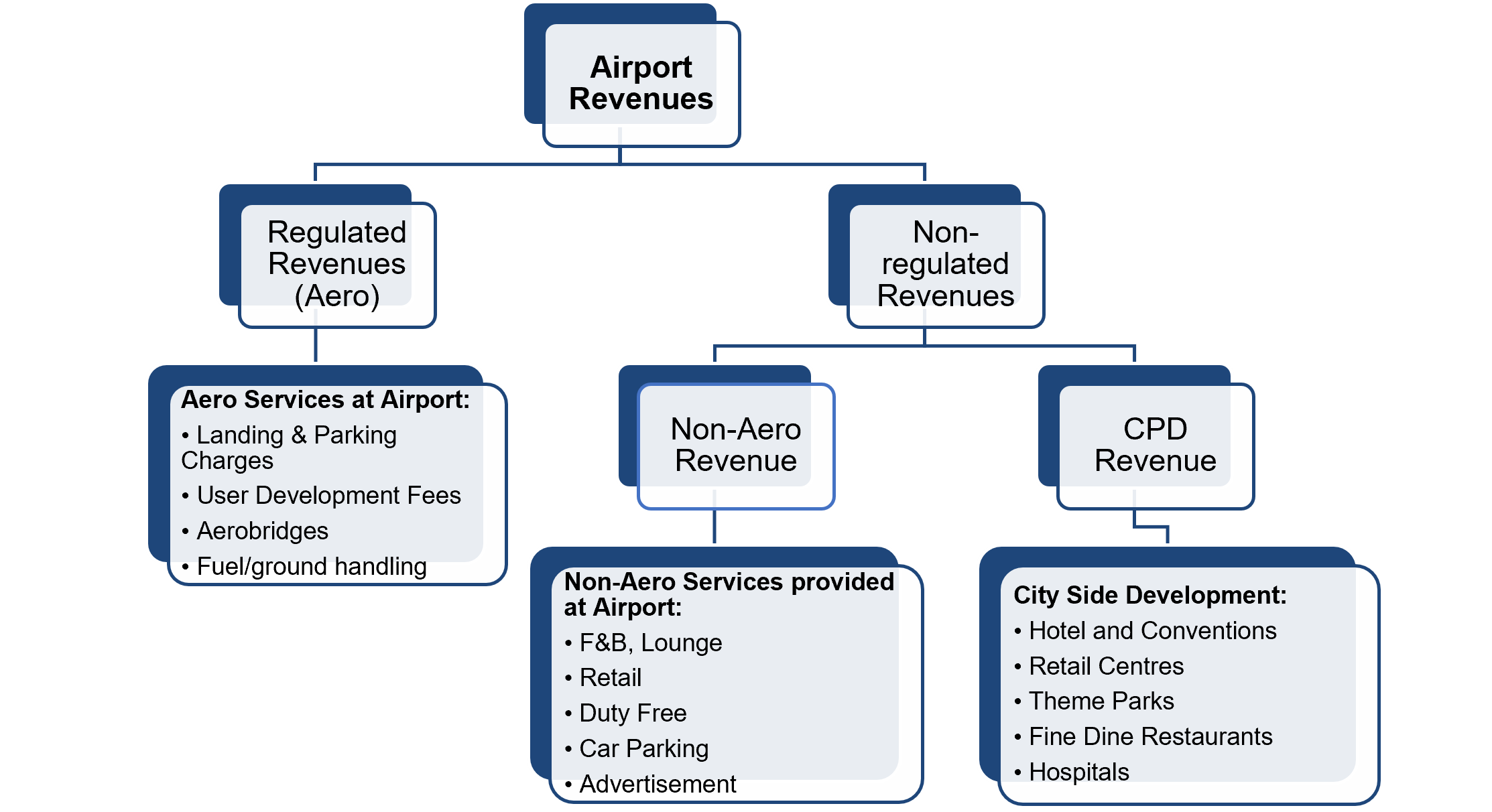
Source: ICICI Securities Report, AERA (Airports Economic Regulatory Authority of India) framework and airport industry reports
The aeronautical side of the airport business is regulated by the Airports Economic Regulatory Authority of India (AERA). But regulated does not mean that revenues remain frozen. Airport tariffs are reviewed periodically through defined control periods (generally in the block of 5 years under Multi Year Tariff Framework), allowing the regulatory framework to reflect changes in the airport's costs, investments and traffic assumptions. During the period of higher capital expenditure or lower passenger traffic; the airport operators are compensated with higher tariff in the subsequent control period and in the period of higher-than-expected traffic growth/lower capital expenditure the tariff generally gets adjusted in the subsequent control period.
Delhi Airport offers a good example. For its fourth control period, AERA approved a nominal aeronautical yield of ₹360 per passenger, compared with around ₹145 per passenger earlier. The revised tariff order came into effect on 16 April 2025 and is applicable through the fourth control period ending March 2029
In other words, the regulated part of the airport business provides a structured revenue base such that the airport operators generate fair Rate of Return on the capital expenditure.
If the aeronautical business is the regulated foundation, the bigger opportunity to influence growth lies beyond the runway. Every passenger who enters an airport becomes a potential customer; buying a meal, visiting a lounge, shopping at retail or duty-free outlets, parking a car or simply spending more time inside the terminal.
This is why airport operators track Spend Per Passenger (SPP). Passenger growth increases the number of potential customers, while higher spending per passenger increases the value of each customer.
More passengers × higher spend per passenger = stronger non-aero revenue
For example, at AAHL, non-aeronautical revenue accounted for 65% of revenue in FY26, compared with 26% from aeronautical operations and 10% from cargo. In other words, the revenue generated beyond the core aeronautical business can be substantially larger than the regulated airport charges themselves.
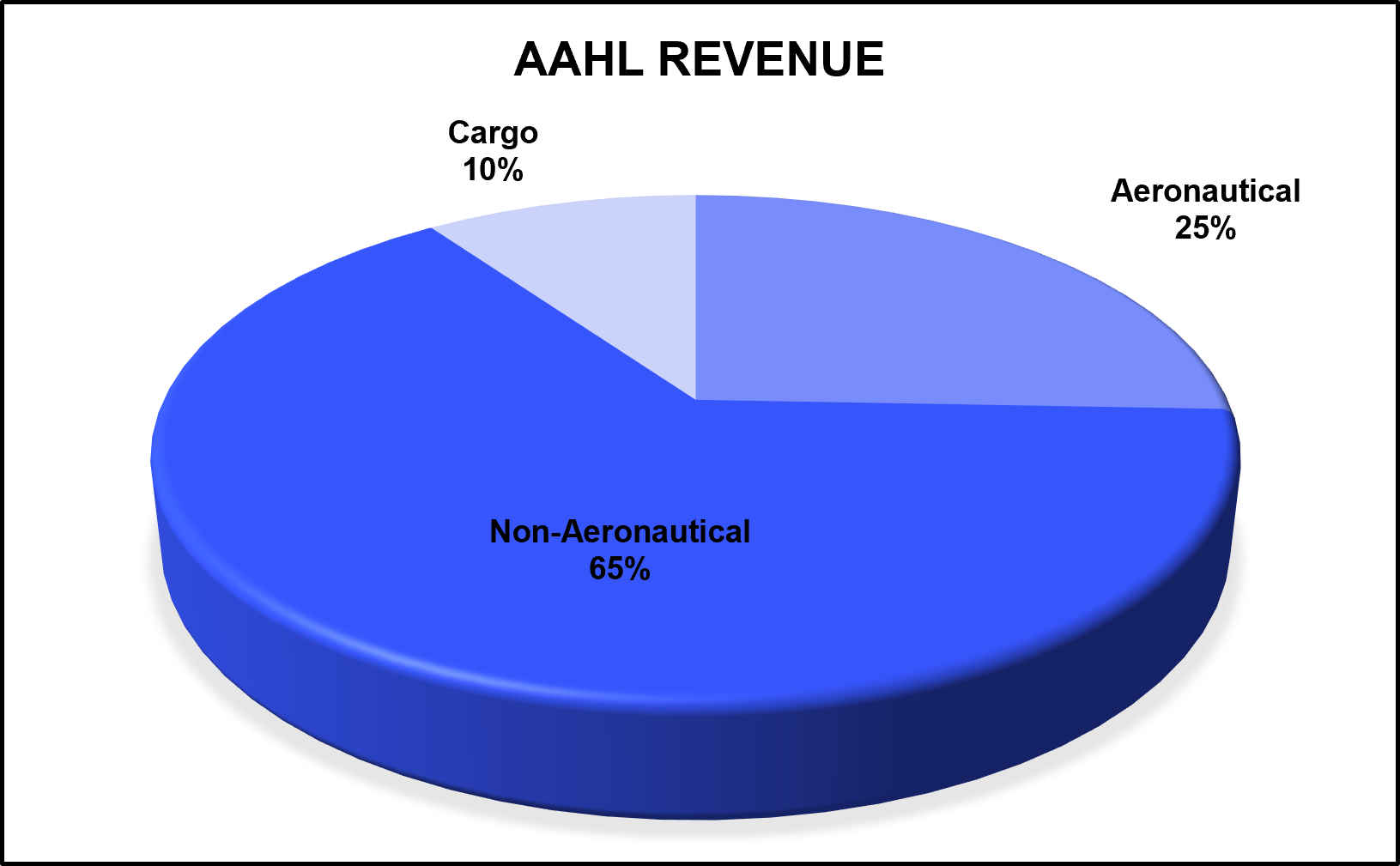
Source: Adani Airports Holdings Ltd Annual Report 2026
This explains why the Best Airports Don't Just Add Passengers. They Add Spend. They maximise the economic value generated from every passenger journey.
| Airport | Revenue Strength Driver |
|---|---|
| Singapore Changi | Retail & entertainment ecosystem |
| Dubai International | Duty-free & transit passenger spending |
| Paris ADP | High spends per passenger |
| Schiphol | Premium retail experience |
| Istanbul Airport | Commercialisation of transit traffic |
Global airport operators are increasingly focused not just on how many passengers pass through their terminals, but also on what those passengers do inside them. Paris Airports (Groupe ADP) provides an interesting example. Extime Paris spend per passenger reached €31.7 in 2025, compared with €19.7 in 2019. At Terminal 1's international areas, spend per passenger reached a record €87.6 in 2024. The example illustrates how improving the passenger experience can increase spend per passenger, not just passenger volumes. Extime Paris is Groupe ADP's retail and hospitality platform/brand operating inside Paris airports (Charles de Gaulle and Orly).
(Source: Groupe ADP’s 2025 Annual Report)
But retail is only part of the story. The most valuable airport asset is hidden plain in sight - Land.
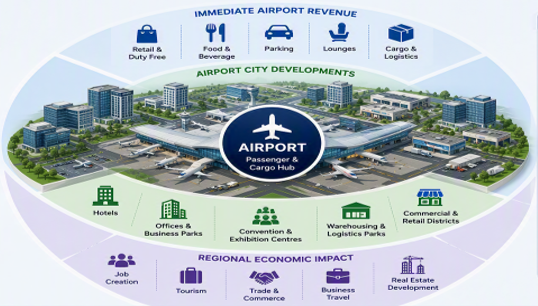
Almost all airports sit on large parcels of land surrounding terminals and runways. As passenger traffic grows, businesses seek proximity to these transport hubs, creating demand for hotels, logistics parks, offices, retail and convention centres.
Over time, airports evolve into economic ecosystems rather than standalone infrastructure assets. This concept, often referred to as an “aerotropolis”, is spread across global airport developments and is a key driver of value creation in India as well. GMR's airport portfolio alone has more than 3,000 acres of prime airport land with real-estate development potential. It has received Rs 1,800 cr for the same.
(Source: GMR Airports Limited, Q1FY27 Investor Presentation, August 2026)
The airport doesn't stop at the terminal.
Aerotropolis Model
Of course, all of this comes at a cost.
Airport businesses are among the most capital-intensive industries in the world and takes relatively longer time to break even. Long before passengers arrive, operators must invest in runways, terminals, taxiways, navigation systems, security infrastructure, parking facilities and baggage handling systems. Delhi Airport's Phase 3A expansion alone involved investments approaching Rs.9,800 crore, while Hyderabad's expansion programme exceeded Rs.7,600 crore. Airports spend billions today in anticipation of demand that may take years to materialise.
The airport isn't always owned outright
Airport operators often operate under long-term concession agreements, where they invest, develop and operate the airport for a defined period while meeting the financial and operational obligations of the concession. As airport is a capex heavy industry with longer break-even period the concessions are generally for a longer period.
Let’s understand this through an example of Navi Mumbai International Airport (NMIA). NMIA's concession is on a Design, Build, Finance, Operate and Transfer (DBFOT) basis, with a 30-year concession and provision for a 10-year extension.
What Airport Capex Actually Funds
| Category | Examples |
|---|---|
| Airside | Runways, Taxiways |
| Terminal | Buildings, Gates |
| Technology | Baggage Systems |
| Safety | Security Infrastructure including ATC |
| Passenger Experience | Lounges, Facilities |
| Commercial | Parking, retail, lounges, F&B |
Source: AERA capex filings and airport expansion plans
Why Airport Profits Often Take Years to Arrive
Construction happens first. Passengers come later. Debt servicing begins post commencement of operation. Revenue ramps gradually. Higher fixed cost in the form of revenue share/per passenger fees paid to concerned authority, depreciation and financing costs can weigh on earnings long before the infrastructure reaches full utilisation.
This creates a timing mismatch: airports can experience strong passenger growth while still reporting modest profits. The payoff often comes later, as passenger volumes rise, commercial ecosystems mature and non-aeronautical revenues begin contributing more meaningfully.
Airport businesses are exposed to factors they cannot control. An economic slowdown can reduce passenger traffic, airline failures can disrupt routes, fuel price spikes can put pressure on airline capacity, fares and passenger demand, while regulatory changes can alter the economics of airport operations. External shocks can also have an outsized impact, as the pandemic demonstrated.
The opportunity, therefore, is not simply about how many people fly. It is about an airport's ability to build traffic, increase spend per passenger and develop its surrounding ecosystem while navigating the risks along the way.
The next time you walk through an airport, it may be worth looking beyond the aircraft parked outside the terminal.
Planes may bring people to airports. Airports monetise everything that follows.
Mr. Arun Bansal, CEO of Adani Airport Holdings Limited said that “With digital interventions, modern day airport infrastructure is becoming smarter, delivering greater ease, comfort and predictability for passengers. Digital interventions such as facial recognition technology and AI-powered video analytics are making airports smarter, safer and more seamless for passengers. Real-time data and automation are streamlining operations, enabling smarter energy management and resource optimisation.”
Disclaimers
The stocks/sectors mentioned do not constitute any kind of recommendation and are for information purpose only. Kotak Mahindra Mutual Fund may or may not hold position in the mentioned stock(s)/sector(s). These materials are not intended for distribution to or use by any person in any jurisdiction where such distribution would be contrary to local law or regulation. The distribution of this document in certain jurisdictions may be restricted or totally prohibited and accordingly, persons who come into possession of this document are required to inform themselves about, and to observe, any such restrictions. Use of the company/ brand names does not imply any affiliation with or endorsement by them or any of its holding companies, subsidiaries or affiliates and are used for illustrative purpose only.
Mutual Fund investments are subject to market risks, read all scheme related documents carefully.