9 Sep 2025
Chips are no longer niche—they’re macro-critical.
From your morning brew to your evening drive, semiconductors are everywhere. Take your car, for instance—it’s a silicon jungle. A modern vehicle contains anywhere from 1,000 to 3,000 semiconductor chips, depending on its make, model and features. These chips control everything from engine performance, fuel injection and braking systems to lane-keeping assist, adaptive cruise control, and infotainment units.
Source: Polarsemi
But how are these chips made?
At the heart of every chip is sand—specifically, silicon. Through purification, this sand becomes ultra-pure silicon ingots, which are sliced into thin wafers. These wafers are then etched with billions of transistors using light, chemicals and metals—a process called photolithography.
Once fabricated, chips are packaged and mounted on Printed Circuit Boards (PCBs) alongside other components. These boards go into everything from smartphones to satellites.
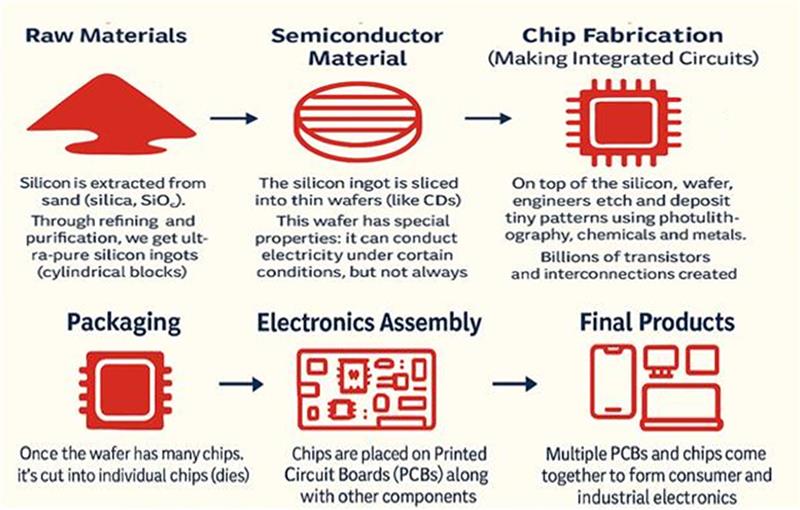
While this can be described in simple steps, the actual chip-making process is one of the most intricate and precise manufacturing feats in the world.
A microchip the size of your fingernail can contain billions of transistors, each just a few nanometres wide, built through over 1,000 process steps. The industry has consistently shrunk transistor sizes—from 90 nm in the mid-2000s to 3 nm today.
To put that in perspective:
- A nanometer is one-billionth of a meter, or one-millionth of a millimeter.
- A human red blood cell is about 7,000 nanometers in diameter.
- The flu virus is roughly 100 nanometers.
Each stage must be executed in ultra-clean environments, as a single dust particle can ruin an entire wafer.
Source: ASML
Only one company in the world manufactures EUV (Extreme Ultraviolet) lithography machines—ASML (Advanced Semiconductor Materials Lithography), based in the Netherlands. Today, ASML claims the title of the only company in the world which manufactures EUV lithography machines which house more than 100,000 parts. It sells these machines for ~EUR 350 million (roughly Rs. 3,480 crore) a piece to chipmakers.
Source: Gadgets360 , IBM
The broader semiconductor industry can be viewed across several key segments:
- Design (IP): Develops and licenses chip architectures, logic designs and IP cores but do not manufacture chips. Example: ARM holdings, whose technology powers around 99% of today’s smartphones. Source: Arm newsroom
- Foundries: Manufacture chips for other companies. Example: TSMC (Taiwan Semiconductor Manufacturing Company) is the world’s largest foundry and dominates leading-edge nodes. TSMC’s share of the global pure-play wafer foundry market reached 70.2% in Q2 2025, according to TrendForce. Other key players are Samsung Electronics, Global Foundries, etc.
- Fabless Companies: Design chips such as SoCs, CPUs, GPUs, ASICs. Example: NVIDIA, which controls ~90% of the AI chip market; other leaders include Qualcomm, Broadcom, AMD, MediaTek,etc. Source: Barrons
- IDMs (Integrated Device Manufacturers): Both design and manufacture chips in-house. Example: Intel, historically the leader in CPUs, is now expanding into foundry services under its IDM 2.0 strategy. Other IDMs include Samsung, Micron, and SK hynix.
- Equipment Makers: Build tools for chip fabrication (e.g., lithography, etc). Example: ASML, the only company that produces EUV lithography machines.
- OSAT Providers: Handle chip packaging, assembly, and testing for Semiconductor designers and manufacturers. Examples: ASE Technology, Amkor, JCET.
The semiconductor landscape is no longer just about business—it’s about geopolitics. With TSMC and Samsung anchoring Asia’s dominance, Intel has become central to America’s effort to rebuild domestic capacity and reduce reliance on fragile overseas supply chains.
Intel was once the king of chips. But delays in making smaller, faster chips let TSMC and Samsung take the lead. Apple dropped Intel in 2020 and AMD (Advanced Micro Devices) grabbed data-center share.
In 2024, Intel’s chip-making arm lost USD 13bn. To fight back, Intel launched Intel Foundry, a new business to make chips for others and itself. It’s betting on 18A and 14A chips (two advanced semiconductor process nodes) using High-NA EUV tech and offering advanced packaging (Foveros/EMIB) to attract AI chipmakers. (Source: Financial Times, Intel Annual Report)
The U.S. is backing this big time: after CHIPS Act grants, the government bought ~10% of Intel for USD 8.9bn in 2025, a historic move to keep chipmaking at home.
The U.S. ended waivers for Samsung Electronics Co. Ltd and SK Hynix Inc., limiting advanced chip equipment for their China fabs. They can maintain current lines—but no upgrades. Since 2019, U.S. export bans have hit Chinese firms like Huawei and ZTE, blocking access to advanced tools—especially EUV lithography machines, made only by ASML in the Netherlands.
China’s chip journey starts with sand, but the real challenge is infrastructure: ultra-pure water, specialty chemicals, precision tools and skilled talent.
China’s top foundry, SMIC (Semiconductor Manufacturing International Corporation), now uses older DUV (Deep Ultraviolet) machines to make 5nm-class chips. It works, but it’s slow, costly, and less efficient.
To catch up, China is investing in:
- Domestic tools to cut reliance on ASML and U.S. firms
- Packaging & testing (OSAT) where India and Southeast Asia also play
- Specialty nodes for autos and industrial chips
But the chokepoint remains: no EUV and no cutting-edge logic chips.
China’s workaround is a reminder: from sand to 5nm isn’t one leap—it’s thousands of steps.
As China battles export bans and tech chokepoints, India sees a chance to plug into the global chip value chain - not by chasing EUV, but by focusing on what it can win: design talent, OSAT and government-backed fabs.
India is taking a practical route into semiconductors. Instead of chasing 2nm chips, it’s starting with what can be built fast and scaled—28nm fabs and advanced packaging. These projects target high-volume uses like EVs, appliances and industrial devices, where 28nm is ideal.
| Project | Type | Location |
Capacity/Focus |
|
Tata Electronics (TEPL) in partnership with Powerchip Semiconductor Manufacturing Corp (PSMC) of Taiwan |
28nm Fab |
Dholera, Gujarat |
50,000 wafers/month; PMICs, MCUs, auto logic |
|
Tata Semiconductor Assembly and Test Pvt Ltd (TSAT) |
OSAT Packaging |
Morigaon, Assam |
Assembly & testing for consumer/industrial 48 million chips/day |
|
CG Power & Industrial Pvt Ltd in partnership with Renesas & Stars |
ATMP Packaging |
Sanand, Gujarat |
Specialized packaging for auto & consumer 15 million chips/day |
Source: PIB
India’s approach is about speed, credibility, and compliance—critical in a geopolitically sensitive era. By building trusted packaging hubs and specialty fabs, India is plugging into the global chip value chain where it can add value quickly.
India is not trying to compete with TSMC or Intel on 2nm logic. Instead, it’s plugging into the global chip value chain where it can add value quickly through packaging, testing and specialty nodes.
Semiconductors are no longer just about technology—they’ve become the compass of global strategy. From powering your phone to guiding missiles, chips now sit at the intersection of economics, geopolitics, and national security.
Governments are writing billion-dollar checks not just to build fabs, but to secure sovereignty. Companies are reshaping their business models—some going fabless, others vertically integrating—to stay relevant in a world where supply chain resilience is as important as innovation. And countries are redrawing alliances, not just trade routes, to ensure access to the tools, talent and trust needed to make chips.
In this new era, chips aren’t just inside every app you use. They’re inside every decision the world makes.
This blog was researched with the help of AI and guess what? AI itself runs on thousands of chips, so you could say it takes a lot of chips to talk about chips.
The stocks/sectors mentioned do not constitute any kind of recommendation and are for information purpose only. Kotak Mahindra Mutual Fund may or may not hold position in the mentioned stock(s)/sector(s).
MUTUAL FUND INVESTMENTS ARE SUBJECT TO MARKET RISKS, READ ALL SCHEME RELATED DOCUMENTS CAREFULLY.
These materials are not intended for distribution to or use by any person in any jurisdiction where such distribution would be contrary to local law or regulation. The distribution of this document in certain jurisdictions may be restricted or totally prohibited and accordingly, persons who come into possession of this document are required to inform themselves about, and to observe, any such restrictions.