5 Nov 2026
SEBI Registered Name - Kotak Mahindra Mutual Fund | SEBI Registered Number - MF/038/98/1
India produces and consumes a wide range of temperature-sensitive products, from fruits and vegetables to dairy products, seafood and pharmaceuticals. However, for many of these products, production is only one part of the value chain. Maintaining the right conditions between the point of production and the point of consumption is equally important.
This is where cold-chain logistics comes into play.
Unlike conventional warehousing, a cold chain is a temperature-controlled network that can extend across storage, transportation and handling. Its role is to maintain appropriate conditions as products move through the supply chain, helping preserve their quality and shelf life.
More Than Just Cold Storage
Cold-chain infrastructure is often associated with refrigerated warehouses. In practice, however, an effective cold chain can begin much earlier and extend much further.
The government's Integrated Cold Chain and Value Addition Infrastructure framework illustrates this broader approach. It encompasses farm-level infrastructure such as pre-cooling and primary storage, processing centres for sorting and grading, distribution hubs, and refrigerated or insulated transportation.
This transition from standalone storage towards an interconnected chain is particularly important for perishables. A well-managed temperature-controlled network can help reduce food wastage, preserve food quality and improve the shelf life of products.
The commercial cold-chain market is also gradually broadening. Refrigerated warehouses accounted for 57.4% of India's cold-chain logistics market by type in 2025, while refrigerated transportation represented 42.6%.
Source: IMARC Group, India Cold Chain Logistics Market Size, Share, Trends and Forecast by Type, Application, and Region, 2026–2034.
For India, the role of cold-chain infrastructure goes beyond storage, helping preserve products through different stages of their journey.
Food Remains at the Heart of the Cold Chain
Agriculture and food remain among the most visible applications of cold-chain infrastructure.
Fruits and vegetables represented 36.8% of India's cold-chain logistics market by application in 2025, while dairy and frozen desserts accounted for another 23.4%.
Source: IMARC Group, India Cold Chain Logistics Market Size, Share, Trends and Forecast by Type, Application, and Region, 2026–2034.
The role of the cold chain becomes particularly important for perishable agricultural produce, which passes through multiple stages before reaching consumers, from pre-cooling and storage to processing, transportation and distribution. Maintaining appropriate conditions throughout this journey can help extend shelf life and reduce losses across the supply chain.
This need for end-to-end infrastructure is also reflected in government policy, which has focused on building the cold chain beyond storage capacity alone. As of June 2025, 395 integrated cold-chain projects had been approved under the government's Cold Chain Scheme since its launch in 2008, of which 291 had been completed and were operational. These operational projects had created annual preservation capacity of 25.52 lakh metric tonnes and processing capacity of 114.66 lakh metric tonnes.
Source: Press Information Bureau, Government of India, Integrated Cold Chain and Value Addition Infrastructure (ICCVAI), October 2025.
Cold Chains Are Moving Beyond the Farm
While agriculture provides the foundation for India's cold-chain ecosystem, temperature-controlled logistics now serves a wider set of industries.
- Dairy and frozen products: These products rely on temperature-controlled storage and movement to maintain their quality across the distribution chain.
- Meat, poultry and seafood: Cold-chain infrastructure supports the movement and preservation of another set of highly perishable categories. The government's Integrated Cold Chain scheme itself encompasses dairy, meat, poultry and marine or fish products.
- Pharmaceuticals and biologics: Cold-chain logistics also plays a role in transporting temperature-sensitive pharmaceutical products. Market research increasingly identifies pharmaceuticals, biologics, vaccines and clinical-trial materials among the applications served by India's cold-chain industry.
- Retail and quick commerce: The expansion of organised retail and quick-commerce networks is creating another layer of temperature-controlled distribution. The expansion of organised food retail and quick-commerce dark stores is among the factors shaping demand for cold-chain logistics.
A Typical Cold Chain
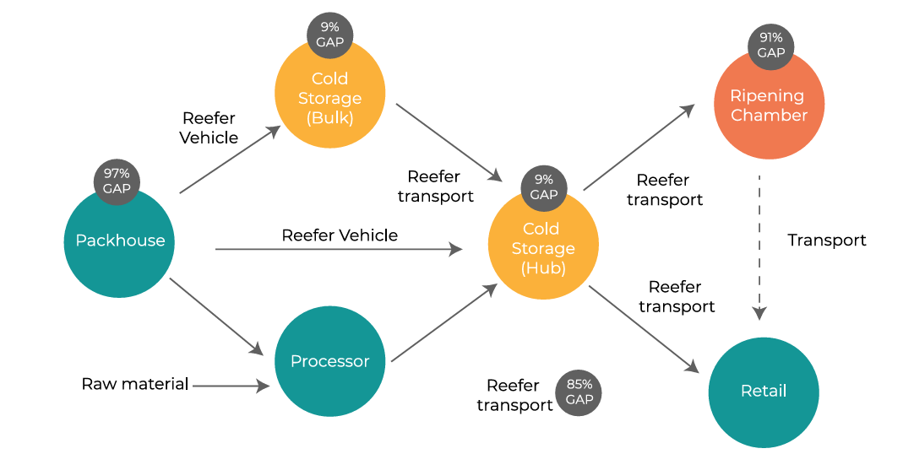
Source: India Cooling Action Plan 2019
From Capacity to Connectivity
India's next phase of cold-chain development is also about how different pieces of infrastructure connect.
Cold storage on its own may preserve goods at a particular location, but an integrated cold chain links the various stages through which the product travels. This includes pre-cooling closer to the source, appropriate storage, processing and distribution infrastructure, and temperature-controlled transportation.
This distinction is particularly relevant because government programmes are increasingly structured around end-to-end infrastructure. Under the Integrated Cold Chain and Value Addition Infrastructure scheme, projects seeking assistance are required to establish farm-level infrastructure and connect it with a distribution hub and/or refrigerated or insulated transport.
In other words, the focus is gradually shifting from creating cold-storage capacity to developing a connected cold-chain ecosystem.
Technology Is Changing the Cold Chain
Another change is taking place within the facilities themselves.
Digitalisation and energy-efficient technologies are increasingly becoming part of the development of modern cold-chain infrastructure. India's National Centre for Cold-chain Development highlights digitisation, certification, energy-efficient technologies and renewable-energy integration as important elements in upgrading existing infrastructure and guiding new facilities.
Technology can also improve visibility across the supply chain. Temperature and humidity monitoring can allow operators to track storage environments, while digital systems can help manage increasingly complex cold-chain networks.
At the same time, energy remains an important consideration. Refrigeration makes cold-chain infrastructure energy intensive, which means that improving energy efficiency is relevant not only from a sustainability perspective but also from an operating-cost perspective.
The NCCD's 2025 roadmap consequently focuses on upgrading existing facilities with higher-efficiency technologies, improving operations and maintenance, and integrating clean energy, particularly solar power.
Source: National Centre for Cold-chain Development, Energy Transition in the Cold Chain Sector in India, September 2025.
Policy Support Is Building the Ecosystem
Cold-chain infrastructure has also received support through several government programmes.
Under the Mission for Integrated Development of Horticulture, financial assistance is available for the construction, expansion and modernisation of cold-storage facilities of up to 5,000 metric tonnes.
The National Horticulture Board separately supports cold-storage and Controlled Atmosphere facilities with capacities ranging from 5,000 to 20,000 metric tonnes.
Meanwhile, the Agriculture Infrastructure Fund has a corpus of ₹1 lakh crore for the development of post-harvest management and community-farming assets, including cold storage, warehouses and processing facilities.
The government has also continued to expand funding for food-processing infrastructure. In July 2025, the Union Cabinet approved an additional ₹1,920 crore for the Pradhan Mantri Kisan SAMPADA Yojana, taking the total allocation for the 15th Finance Commission cycle to ₹6,520 crore.
Together, these initiatives demonstrate the wider infrastructure ecosystem emerging around storage, processing and transportation of perishable products.
Source: Press Information Bureau, Government of India, Integrated Cold Chain and Value Addition Infrastructure (ICCVAI), October 2025.
A Market Gradually Expanding Its Reach
The evolution of consumption patterns, food distribution and temperature-sensitive industries is reflected in the expected expansion of India's cold-chain logistics market.
The market increased from USD 8.30 billion in 2020 to USD 12.56 billion in 2025 and is estimated at USD 14.16 billion in 2026. The market is projected to reach USD 27.45 billion by 2034, implying a CAGR of 8.62% between 2026 and 2034.
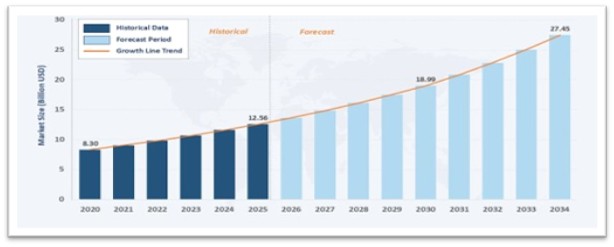
Source: IMARC Group, India Cold Chain Logistics Market Size, Share, Trends and Forecast by Type, Application, and Region, 2026–2034. View IMARC report
But the cold-chain opportunity is about more than its market size.
The more significant structural change is the industry's evolution from fragmented storage towards more integrated temperature-controlled supply chains. Food and agriculture remain central to this ecosystem, but newer demand from pharmaceuticals, organised retail and quick commerce is widening the range of products that require controlled storage and movement.
As these networks expand, cold-chain logistics is increasingly becoming an important link between production, preservation and consumption.
For a country with a large agricultural base, growing food-processing ecosystem and expanding market for temperature-sensitive products, strengthening this link can play an important role in ensuring that the value created at the point of production is preserved until the product reaches its destination.
Mandar Pawar, Senior Vice President & Fund Manager, Kotak Mahindra Asset Management Co. Ltd adds “India’s cold-chain opportunity is evolving from standalone storage towards an integrated ecosystem connecting production, processing, transportation and consumption. It is not about merely preserving temperature but its ultimately about preserving value of food or other goods stored and transported. India’s rising consumption needs to be accompanied by greater sophistication in cold chain logistics infrastructure. The Future of cold chain logistics will be shaped not only by capacity creation but also energy efficient operations, better monitoring and digitisation for quality assurance and entrenched network for faster delivery to end consumers. There are likely to be investment opportunities in capacity creation as well as upgradation over coming years.”
Disclaimers:
The stocks/sectors mentioned do not constitute any kind of recommendation and are for information purpose only. Kotak Mahindra Mutual Fund may or may not hold position in the mentioned stock(s)/sector(s). These materials are not intended for distribution to or use by any person in any jurisdiction where such distribution would be contrary to local law or regulation. The distribution of this document in certain jurisdictions may be restricted or totally prohibited and accordingly, persons who come into possession of this document are required to inform themselves about, and to observe, any such restrictions.
Mutual fund investments are subject to market risks, read all scheme related documents carefully.