1 Oct 2026
SEBI Registered Name - Kotak Mahindra Mutual Fund
SEBI Registered Number - MF/038/98/1
On a difficult summer night, an air conditioner can feel like a very small story. A family gets home, the room is warm, children are restless and sleep suddenly becomes precious. One button changes the room. Yet that button also activates a larger chain: electricity must arrive when demand is highest; appliances must be affordable to run; buildings must keep some heat out; and food, medicines and services must keep working. For investors, that makes heat more than a weather story. It is a structural-demand theme with several, very different, listed-market exposures.
India’s cooling demand is expected to grow sharply. The Government of India’s India Cooling Action Plan estimated that room-air-conditioner ownership could rise from about 8% of households in 2017 to 21% by 2027-28 and 40% by 2037-38. It also projected that aggregate cooling demand could increase almost eightfold from the 2017-18 baseline by 2037-38. These are policy projections, not actual ownership data, but they establish the direction of travel: cooling is moving from a discretionary purchase to a central question for homes, businesses and cities.
The investment thesis is not just an air-conditioner sales cycle
For many households, the first air conditioner is not a symbol of excess. It is a way to make a small flat liveable in May, help an elderly parent sleep more comfortably or get through a work-from-home afternoon. Consumers still care about the purchase price, but they care just as much about the monthly power bill, repair costs, warranties and whether a product works reliably through another difficult summer. This is why penetration growth alone is not enough to form an investment view.
The more useful institutional question is whether demand growth converts into durable economics. For a consumer-facing original equipment manufacturer, that means volume growth, pricing power, product mix, distribution and working-capital control. For a component supplier, it means localisation, customer concentration and factory utilisation. For power and cold-chain businesses, the link to cooling is more indirect and must be assessed alongside their wider capex plans and operating model. Heat can be a demand tailwind; it is not a substitute for company-level analysis.
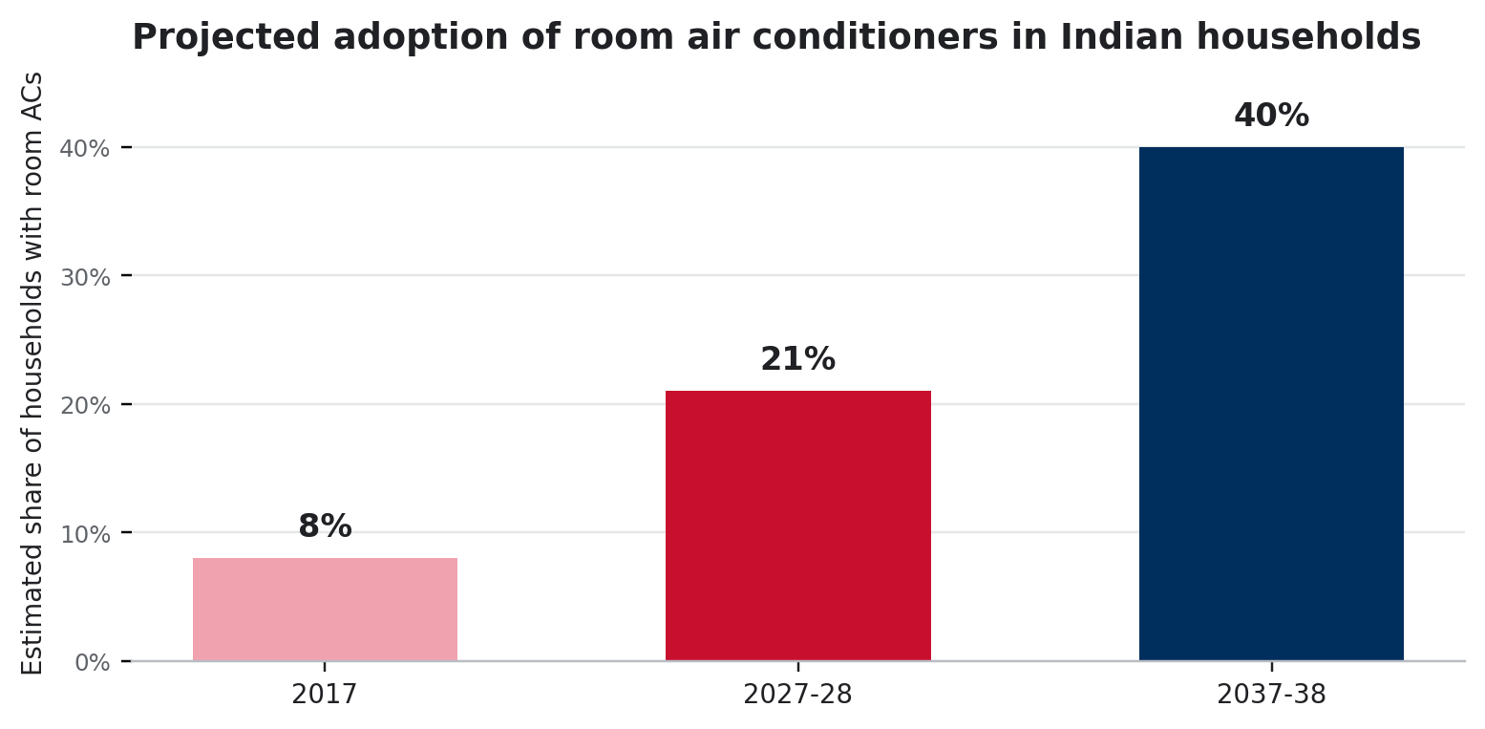
Source: India Cooling Action Plan (2019). As per latest data available.
Map The Value Chain Before Naming the Winners
A hotter city creates demand in several places at once. Better appliances matter, but so do components, installation services, electricity networks, solar, storage and cold-chain infrastructure. The common thread is not simply selling cool air. It is helping people and businesses manage heat more reliably and with less energy. This matters because direct beneficiaries and enabling businesses have different earnings drivers, valuation frameworks and risks.
India’s Cooling Value Chain
The listed market offers direct, enabling second order exposure
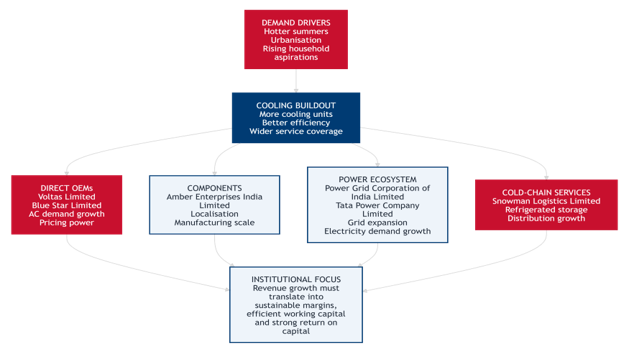
Illustrative listed-market exposure map. Company names are examples, not recommendations.
Listed-Market Exposure Is Uneven
| Exposure | Illustrative Listed Names | What The Market Should Test |
|---|---|---|
| Direct Cooling | Voltas Limited; Blue Star Limited | Room-AC volume, pricing, premium mix, channel inventory and service quality. |
| Components | Amber Enterprises India Limited; PG Electroplast Limited | Localisation, customer concentration, utilisation and raw-material pass-through. |
| Power Ecosystem | Power Grid Corporation of India Limited; Tata Power Company Limited | Broader transmission, distribution and supply resilience. Cooling is only one demand driver. |
| Cold-Chain Services | Snowman Logistics Limited; Blue Star Limited | Asset utilisation, customer mix, operating leverage and execution in storage or refrigeration. |
Illustrative exposure map only. The named companies have broader businesses and should not be treated as pure-play cooling investments.
Source: KMAMC Internal
Efficiency Is The Quality Filter
There is an easy but incomplete way to read this trend: hotter weather means more air conditioners, so appliance sales rise. The deeper story is efficiency. An efficient unit reduces the electricity required to cool a room. A thoughtfully designed building reduces the amount of cooling a room needs in the first place. A reliable service network makes it more likely that equipment will perform as promised. As the market matures, this quality of demand may matter more than headline units.
This is where the investment debate becomes more nuanced. A company may post strong seasonal volume growth yet face intense price competition, a higher promotional bill or pressure from copper, aluminium and refrigerant costs. Equally, a supplier may benefit from localisation only if incremental capacity is absorbed at acceptable margins. The better outcome is not simply more consumption; it is better comfort per unit of energy and capital deployed.
Second-Order Effects Matter Too
Consider what happens to a mango after it leaves a farm, or to a vaccine on its way to a clinic. Both depend on temperatures being managed well. As heat rises, the cold chain - refrigerated storage, transport and distribution - becomes more important for reducing food loss and protecting products that people depend on. Warehouses, supermarkets, restaurants and pharmacies all become part of the same story. But this is a slower, execution-heavy exposure than selling a room AC; it needs to be judged on utilisation and customer economics, not only on the theme.
The same distinction applies to electricity. Cooling increases the need for dependable power, yet no investor should attribute a utility or transmission company’s earnings to temperature alone. Renewable integration, regulatory returns, industrial demand, distribution losses and capital allocation may be more important to the equity story. A thematic lens can identify a research queue. It cannot replace a view on the business model.
What Turns A Theme Into Earnings
An institutional reading of the cooling theme should separate pre-season channel filling from genuine consumer sell-out. It should ask whether premium products are lifting realised prices, whether dealers are carrying comfortable inventory, and whether service capacity can keep pace with installations. It should also test whether a company is adding capacity ahead of demand or because demand has already proven durable. These details determine whether growth becomes profitable growth.
Valuation discipline matters as much as thematic appeal. A direct cooling business may deserve attention for its volume opportunity, but the market will also judge return on capital, cash conversion and the ability to protect margins through a competitive summer. The same applies to component suppliers and indirect infrastructure beneficiaries. The right conclusion is rarely that every company linked to heat will win. It is that the theme creates a focused set of questions worth underwriting.
Catalysts, Risks And The Human Outcome
The visible catalysts are clear: higher penetration, rising disposable income, replacement demand, product premiumisation, better distribution and energy-efficiency upgrades. The less visible risks are just as important: a weaker-than-expected summer, an early monsoon, aggressive discounting, commodity-cost inflation, capacity oversupply and higher receivables across the channel. An institutional-quality view should treat each of these as a variable to monitor, not as a footnote.
The human side matters too. For a delivery worker, construction worker or commuter, heat can make an ordinary day much harder. For a family, cooling can become a new recurring cost. The most meaningful solutions will not merely sell a premium product; they will make comfort more efficient, accessible and dependable. India is not just preparing for hotter summers. It is learning how homes, businesses and cities can live through them more wisely - and that is the real business of heat.
Saumil Mehta, Senior Vice President - Equity Research at Kotak Mahindra Asset Management Company Limited adds, “Cooling is emerging as one of the world's most compelling structural growth opportunities. For decades, air conditioning was considered a discretionary consumer product, largely confined to developed markets and affluent households. Today, rising temperatures, rapid urbanization, increasing incomes, and changing lifestyles are transforming cooling from a luxury into a necessity.
Despite accounting for nearly 18% of global electricity consumption, air conditioning penetration remains surprisingly low across many emerging markets. In India, for example, household AC penetration is still estimated to be in the low double digits, significantly below levels seen in developed economies. Yet India is among the countries expected to experience some of the highest cooling demand growth over the coming decades due to its hot climate, expanding middle class, and rising urban population.
The need for cooling is no longer limited to residential comfort. A new generation of industries is becoming increasingly dependent on temperature-controlled environments. Data centers supporting AI workloads, semiconductor fabrication facilities, pharmaceutical manufacturing, EV battery plants, food processing units, cold-chain logistics, and modern commercial buildings all require sophisticated cooling infrastructure. As digitalization and advanced manufacturing accelerate globally, cooling is becoming a critical enabler of economic growth.”
Disclaimers
The stocks/sectors mentioned do not constitute any kind of recommendation and are for information purpose only. Kotak Mahindra Mutual Fund may or may not hold position in the mentioned stock(s)/sector(s). These materials are not intended for distribution to or use by any person in any jurisdiction where such distribution would be contrary to local law or regulation. The distribution of this document in certain jurisdictions may be restricted or totally prohibited and accordingly, persons who come into possession of this document are required to inform themselves about, and to observe, any such restrictions. Use of the company/ brand names does not imply any affiliation with or endorsement by them or any of its holding companies, subsidiaries or affiliates and are used for illustrative purpose only.
Mutual Fund investments are subject to market risks, read all scheme related documents carefully.