16 Oct 2026
SEBI Registered Name - Kotak Mahindra Mutual Fund | SEBI Registered Number - MF/038/98/1
Ask someone about cryptocurrency, and the response is often preceded by hesitation. Whether driven by limited knowledge, uncertainty, complexity, or lack of experience, that hesitation reflects the many questions people still have about this emerging asset class.
However, despite the uncertainty surrounding it, cryptocurrency has evolved from a niche concept into a global asset class that is reshaping the way we think about money and our investments.
The numbers make it hard to ignore. About 741 million people own some form of crypto, up roughly 12% in a year, and around 119 million of them are in India (Source: Crypto.com, Crypto market sizing, Coin Index). The whole market is worth about $2.9 trillion, with Bitcoin being close to 57% of that (Source: Trading View). For you to get any idea of how big is that, data proposes that India's entire equity market is around $5 trillion (Source: Trading View).
The question that kept coming back was not about the market behaviour. It was simpler.
Do we actually need another asset class, and is this one for building wealth or just for making quick money?
Crypto 101
Crypto is a digital asset you can own, send and trade online without a bank in the middle. It runs on a blockchain, which is just a shared record of transactions. Instead of one company holding the ledger, thousands of computers each keep a copy, so no single party can quietly change it.
This opens doors to two interconnected concepts.
DeFi, short for decentralized finance, lets people lend, borrow or trade crypto using rules written in code, so there is no bank or broker involved.
Tokenization means creating a digital token that represents ownership of something, like a bond, a property or a piece of art. Once it's a token, that ownership can be recorded, transferred and traded online.
How the system fits together
Think of cryptocurrency as a chain of interconnected participants. It begins with money first entering the ecosystem through platforms that convert traditional currency to cryptocurrency. Exchanges provide the marketplace for trading, pretty much like traditional exchanges. While market makers ensure liquidity by keeping buy and sell orders available. The assets are then stored in wallets, either controlled directly by users or managed by third-party providers who hold and secure the assets on their behalf. Beneath it all, blockchain networks record and settle every transaction.
While the ecosystem may appear decentralized, trading activity remains concentrated among a handful of large platforms, an important consideration when assessing potential risks.
Bitcoin: the original
Bitcoin is the largest crypto, making up more than half of the whole market. Its growth driver is scarcity. The supply is limited and no company or government controls it, which is why people call it digital gold.
The idea that matters most is the halving. Roughly every four years, the reward Bitcoin miners get for adding new coins is cut in half, so new supply slows down. The reward started at 50 BTC and it is currently at 3.125 BTC.
An interesting trend of the prices at each halving have delivered a story of BTC prices to rise after the process. We shall surely take it as a pattern, not a promise.
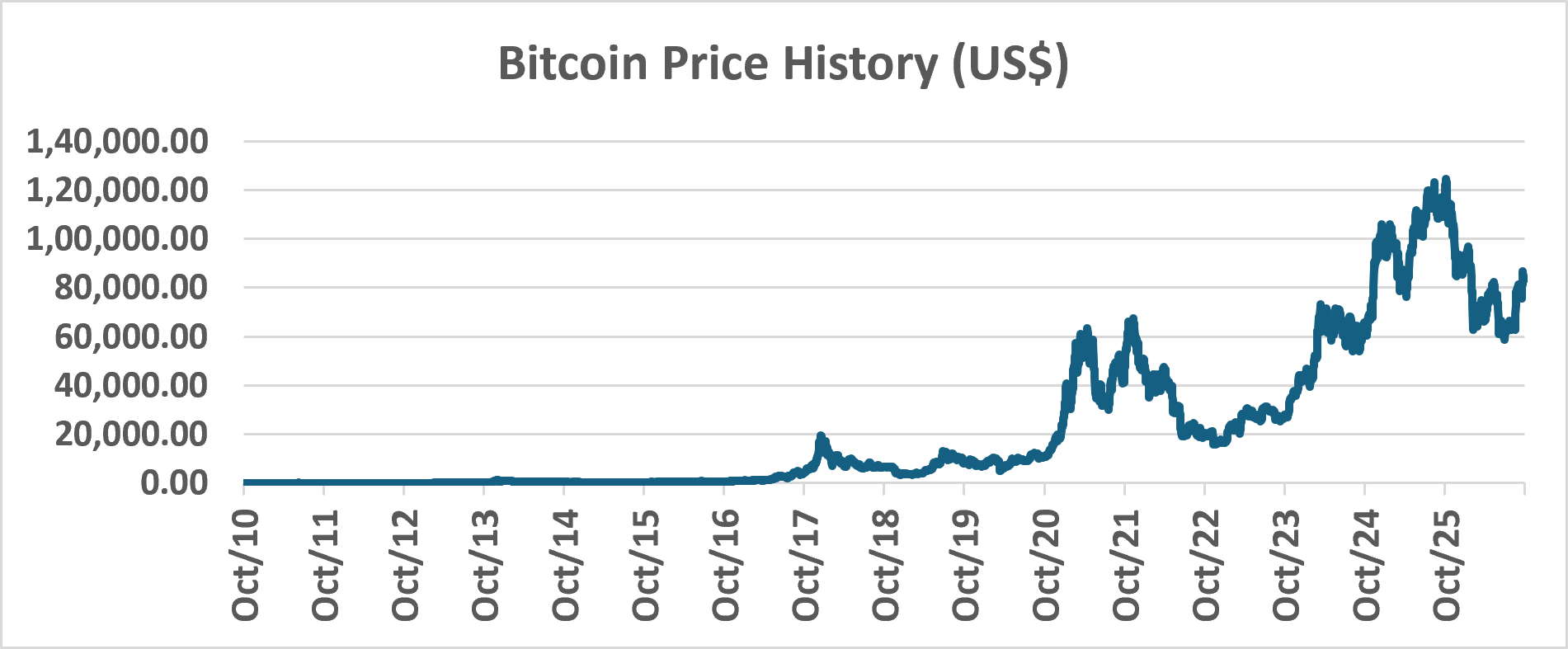
Source: Investing.com. Data as of Sep 2026.
Bitcoin peaked near $125,000 in October 2025 and now sits around $84,000, roughly a third lower. Over ten years it returned about 64% a year in dollar terms, in comparison to asset classes such as gold, the Nasdaq, the S&P 500 and the Nifty 50, which have delivered returns ranging from 8% to 20%.
The catch is volatility, which just means how much the price swings. Bitcoin's monthly swings are about 21%, against 4% to 5% for the others.
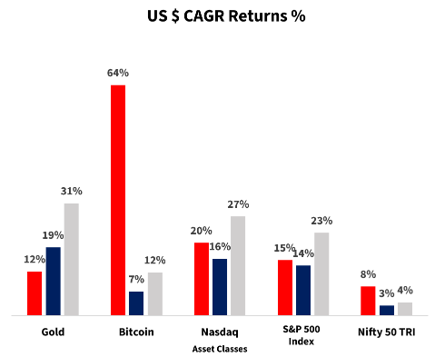
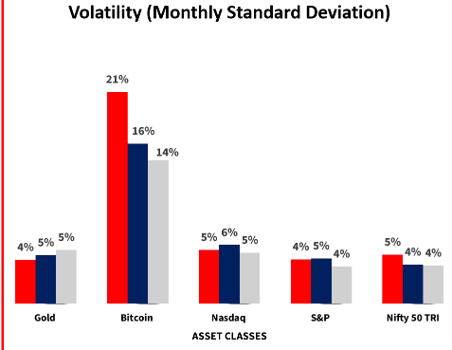
Left: US$ CAGR returns over 10, 5 and 3 years. Right: monthly volatility. Bars on the left follow the same order as the right: Gold, Bitcoin, Nasdaq, S&P– Standard and Poor’s, Nifty 50 TRI. Source: Bloomberg, Internal research, Investing.com. Data as of 31 Aug 2026.
This graph is a great representative of when people ask if it's luck; Timing clearly matters a lot. The same asset looks brilliant or terrible depending on the year you start counting.
So who is actually Buying Cryptocurrencies? Part of it is ordinary people, and retail demand tends to follow price. The other part is institutions, and that is what is changing. Spot Bitcoin ETFs in the US have pulled in about $55 billion, and a survey expects the share of firms putting over 5% of their assets into crypto to rise from 18% to 29% by the end of 2026. (Source: Bloomberg, BitBo, Bernstein analysis, Coinbase, EY Parthenon).
Companies are buying too. Strategy, formerly MicroStrategy, is a US-listed software company that began adding Bitcoin to its balance sheet in 2020 and kept buying through the rallies, including near the highs. Strategy is now the largest public corporate holder, with over 840,000 BTC. (Source: Company filings, BitBo, Bitcoin Treasuries).
Stablecoins: the useful ones
Another big name is Stablecoin. These are pegged to a currency, usually the US dollar, so the price stays close to $1. This makes them handy for moving money across borders in minutes and for parking value between trades. Talking about the uses of it, as the graphs shows, transfers qualify as it’s biggest use at 29%, just ahead of trading on exchanges at 26%.
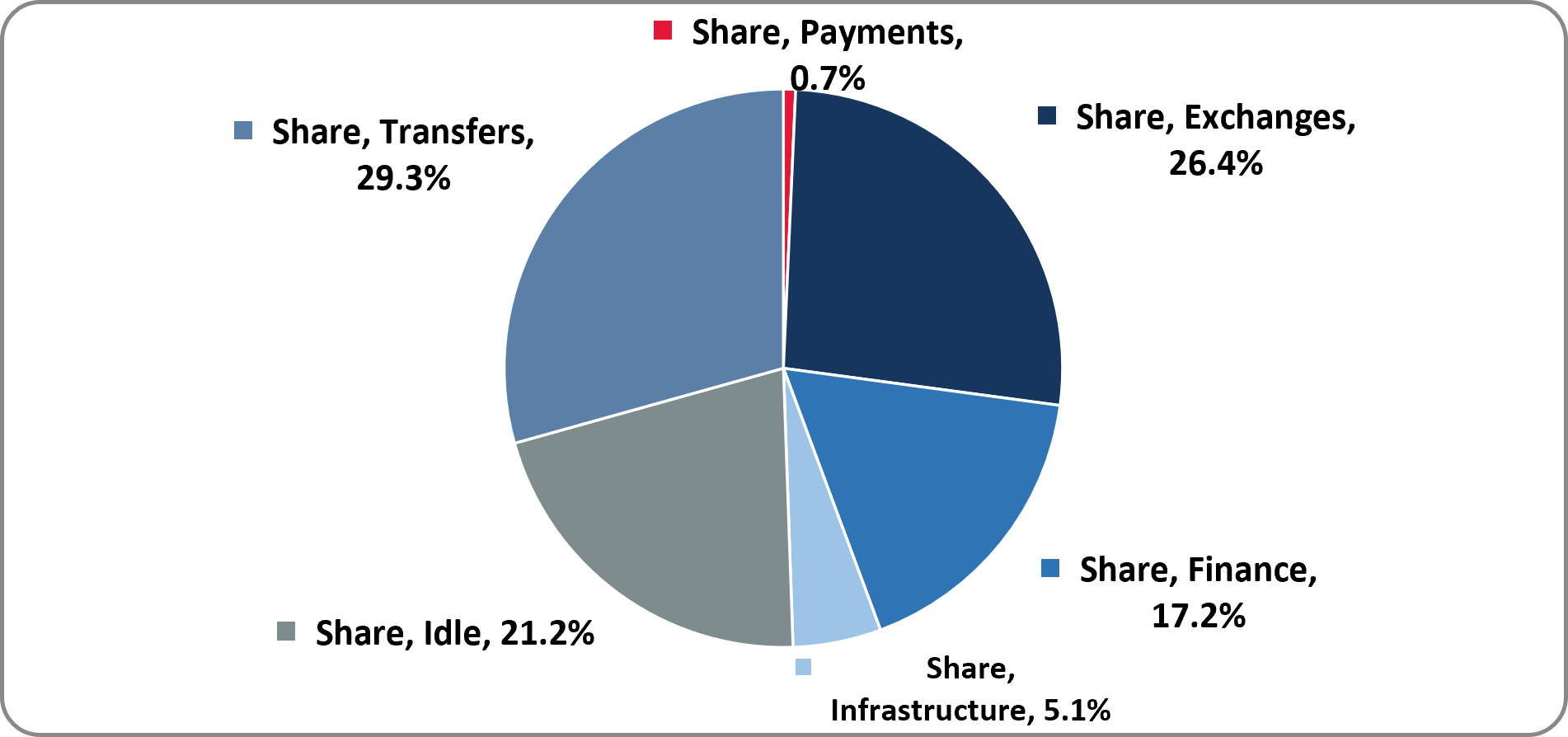
Source: DefiLlama (2025), Lurie (2024), Yim and others (2025). Latest available data.
Everyday payments are still under 1%, indicating that its really not come into the everyday use. In addition to that, the peg that exists can break; So "stable" is not a guarantee.
Power and energy
Mining is a competitive process in which miners use powerful computers to validate transactions and add new blocks to the blockchain. It involves solving of complex mathematical problems and earn rewards in a form of a created currency and transaction fees. This entire process leads to the large consumption of power and electricity. Reports put it at about 135 TWh a year, around 0.5% of the world's electricity. That is more than some entire countries use: Bitcoin's yearly consumption is nearly three times the Czech Republic's and about 1.7 times the Netherlands'.
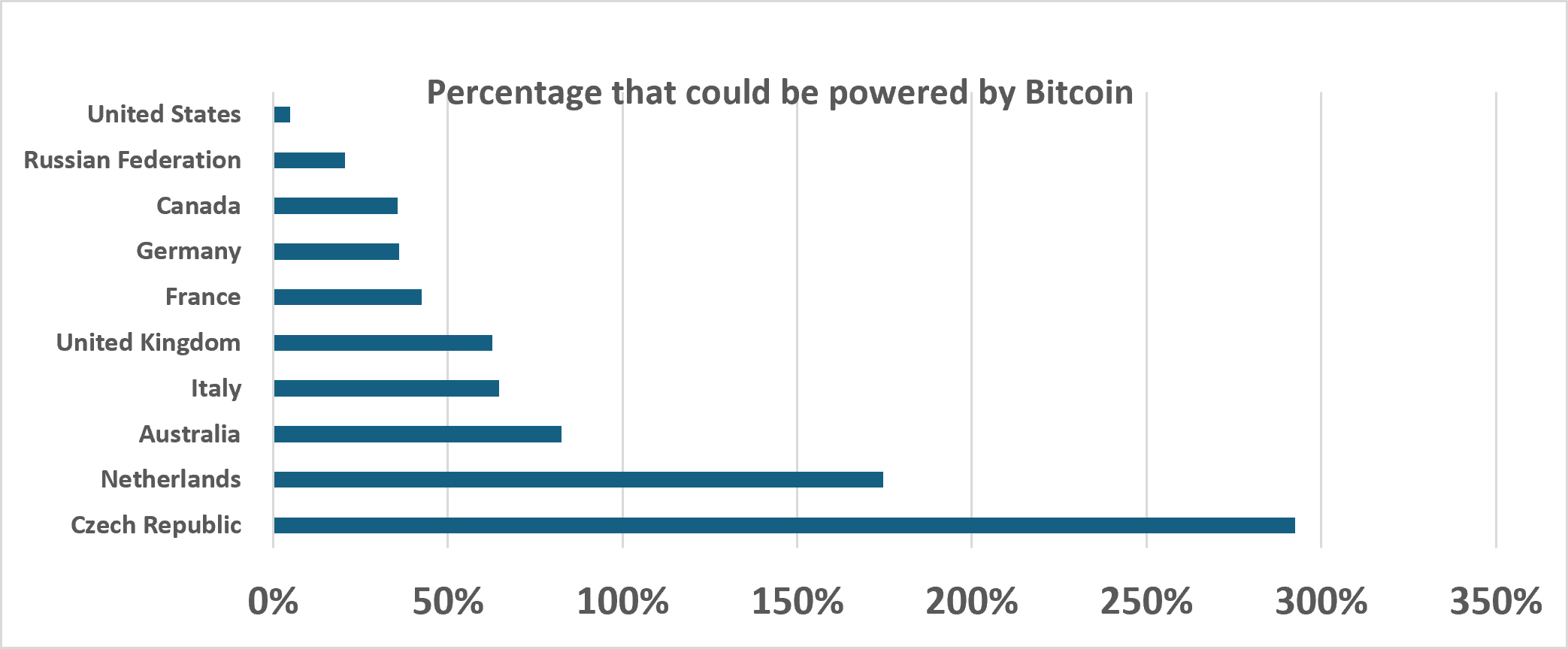
Bitcoin's annual electricity consumption as a percentage of each country's. Source: BitcoinEnergyConsumption.com, Digiconomist. Data as of May 2025.
A positive in this process is the energy mix that’s being used. About 52% of mining energy comes from renewables and nuclear, while natural gas and coal supply most of the rest.
Risks
With no bank to call, most losses happen at the points of access. Over $3.4 billion was stolen in 2025, including $1.5 billion in a single breach at the Bybit exchange. People lose money to phishing, exposed keys and hacked exchanges, while the blockchain itself keeps running (Source: Chainanalysis).
The risks involved in Crypto would be well known. Let’s divide it into 2 sections :
Price – Bitcoin prices have dropped by 83% to 99% from peak to trough on four separate occasions, with the most recent one in 2018. Holding through a fall like this is not easy, it requires great financial strength and patience for a recovery (Source: Webopedia, Analytics Insight, CoinCodex, Investopedia).
Security – As we mentioned that there are no financial intermediaries, making it really difficult to recover from a mistake. Over $3.4 billion was stolen in 2025, including $1.5 billion in a single breach at the Bybit, which is a cryptocurrency exchange (Source: Chainanalysis). People tend to lose money due to phishing, exposed keys and hacked exchanges, which is getting really common.
What it means for India
India has been one of the leading adopters to this with about 119 million Indians holding crypto, which is roughly 8% of the population, mostly aged 18 to 35. Estimates in the chart below put the market at about $3 billion in 2025, rising to roughly $14 billion by 2034, highlighting the significant growth potential of crypto adoption and participation in India over the coming decade.
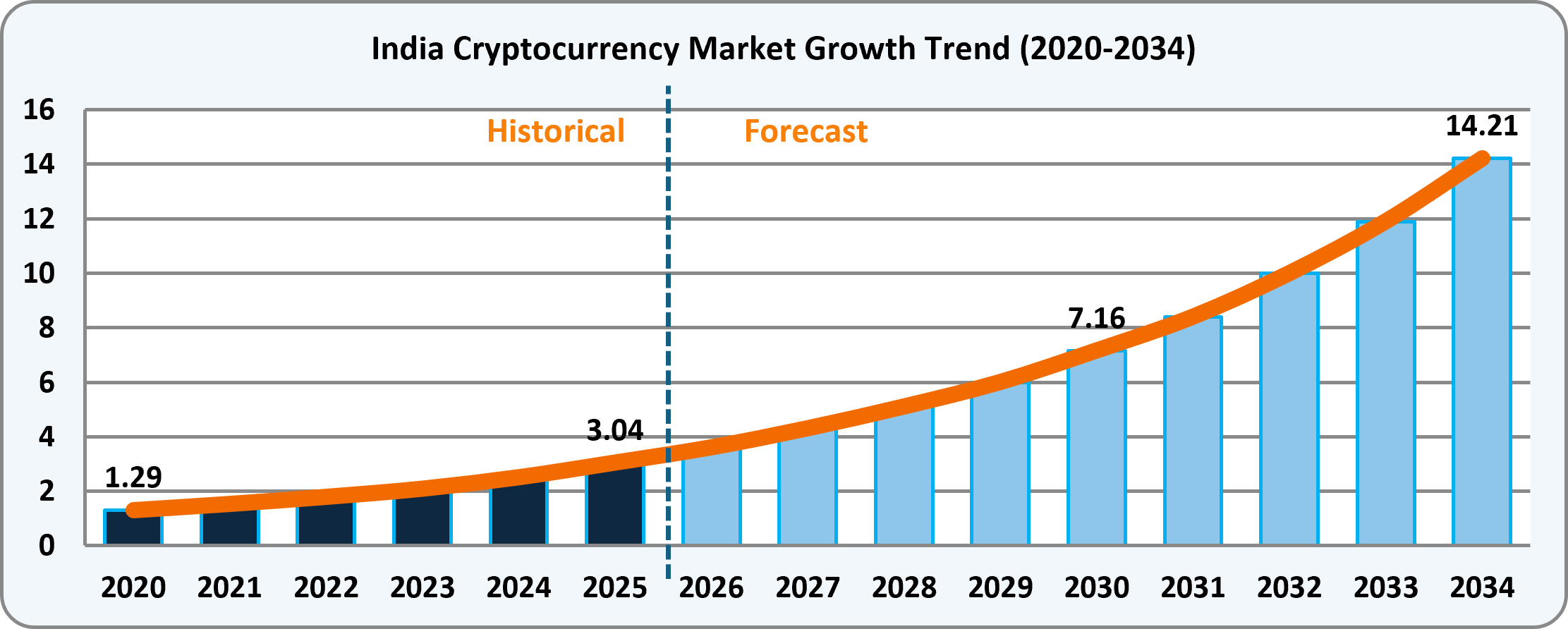
Source: IMARC. Data as of 2025.
Where this leaves us
Crypto is not a simple yes or no. Dismissing it as unsafe and untrustworthy is the easy way out, and many people probably do it because they don't understand it, not because they've studied it. This could surely be considered fair due to its risks and complexity involved.
Looking at it from a wealth formation aspect would open doors to a look of uncertainty and lays as an open question, due to its high volatility in comparison to the traditional wealth creation assets. One’s background, risk appetite and financial strength would be one of the most important factors to complement the risk return game of crypto.
With 119 million Indians already holding crypto, should we be spending more time on inclining ourselves towards greater research and education towards this asset class to make the most out of it.
Disclaimer: This presentation/document/video is intended solely for informational and educational purposes. Kotak Mahindra Mutual Fund does not invest in, endorse, or recommend cryptocurrencies. Any reference to cryptocurrencies is purely educational and should not be construed as a recommendation, solicitation, or offer to buy, sell, or invest in any cryptocurrency or related product.
The stocks/sectors mentioned do not constitute any kind of recommendation and are for information purpose only. Kotak Mahindra Mutual Fund may or may not hold position in the mentioned stock(s)/sector(s). These materials are not intended for distribution to or use by any person in any jurisdiction where such distribution would be contrary to local law or regulation. The distribution of this document in certain jurisdictions may be restricted or totally prohibited and accordingly, persons who come into possession of this document are required to inform themselves about, and to observe, any such restrictions. Use of the company/ brand names does not imply any affiliation with or endorsement by them or any of its holding companies, subsidiaries or affiliates and are used for illustrative purpose only.
Mutual fund investments are subject to market risks, read all scheme related documents carefully.