13 Aug 2026
SEBI Registered Name - Kotak Mahindra Mutual Fund | SEBI Registered Number - MF/038/98/1
In finance, every trade has two sides. For years, one of the most popular trades in the world was to borrow cheaply in Japanese yen and invest in higher-yielding US assets. It was simple, profitable and widely accepted. In late July 2026, something unusual happened. As the yen slid to nearly ¥164 per dollar, its weakest level in four decades, the United States stepped into the currency market to support it.
However, in 2026, when the yen approached ¥164 against the US dollar, a near four-decade low, it ignited concerns about Japan's economic outlook, global capital movements, and the resilience of financial markets. The pressure became so intense that it triggered a rare joint intervention by Japan and the United States, the first coordinated action of its kind since 2011. The move underscored a crucial lesson: even in an era dominated by markets, governments retain the ability to shape outcomes when stability is at stake.
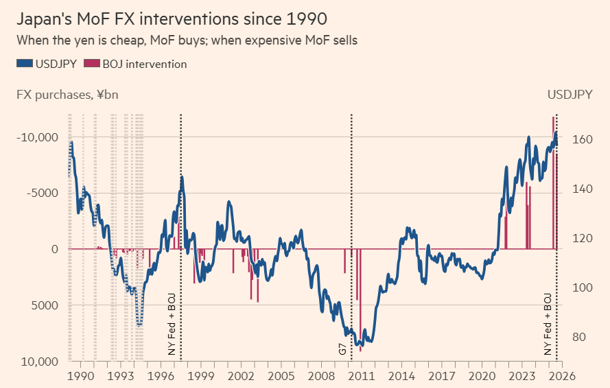
Note: BOJ: Bank of Japan, MoF: Ministry of Finance, FX: Foreign Exchange | Source: Financial Times Article dated 5th august 2026, Bloomberg, Fed, MOF | Vertical lines show interventions that also spent US money. Things were very different in the days before 1996
Which raises an obvious question: Why would America intervene to support a currency?
The yen's decline can largely be traced to a widening interest rate gap between Japan and the United States. Even as the Bank of Japan cautiously stepped away from decades of ultra-loose monetary policy, Japanese interest rates remained well below those in the United States. The federal fund rates 3.50-3.75%, compared with 1% of Japan’s policy rates. This divergence fuelled the carry trade, with investors borrowing cheaply in yen and seeking higher returns in dollar-denominated assets, steadily weighing on the currency.
As money flowed out of Japan and into the United States demand for dollars remained strong and yen remained under pressure. The trend was so persistent that many investors began viewing yen weakness as a one-way trade. As expectations of further depreciation grew, speculative bets against the currency steadily increased, with net short positions reaching an estimated $12.5 billion by mid-2026.
Source: Reuters article dated Aug 03, 2026| Financial Times
As the trade became increasingly crowded, the weakness of the yen ceased to be just an economic story and started becoming a policy concern.
For export-oriented economies such as Japan, currency depreciation can boost overseas earnings and improve global competitiveness. Products manufactured in Japan become cheaper for international buyers when measured in foreign currencies. However, the benefits come with costs. Japan imports a substantial portion of its energy requirements and many key raw materials. As the yen weakened, import bills increased, placing upward pressure on inflation and household expenses. Policymakers repeatedly warned that currency weakness was contributing to the rising cost of living. Compounding the challenge were geopolitical tensions and higher oil prices linked to the Middle East conflict, which further increased Japan's import burden.
Source: Plaung, Reuters article dated Jul 01, Aug 03, 2026
The main problem was that Japan had limited options to stop the Yen decline. The most direct way to support a currency is by raising interest rates. Higher rates make domestic assets more attractive and reduce the appeal of borrowing that currency to fund carry trades. But for Japan, the trade-off was difficult. After decades of ultra-low rates, the economy had become heavily reliant on cheap borrowing, while government debt stood among the highest in the developed world. Raising rates could support the yen, but it also risked slowing growth and increasing pressure on public finances.
That left Japan with its other traditional option: supporting the yen through direct intervention in the currency market. But there was a catch. To keep buying yen, Japan would need access to large amounts of dollars. Traditionally, that could come from selling its foreign exchange reserves, much of which are invested in US Treasury securities. And this is where Japan's currency problem began colliding with American interests. Japan had two ways to strengthen the yen: raise domestic interest rates or sell dollars and buy yen. Neither outcome is particularly appealing for the United States.
Japan owns roughly $1 trillion of US Treasury securities, making it one of America's largest foreign creditors. In theory, selling a portion of those holdings would provide the dollars needed to support the yen. In practice, however, that solution creates a new problem.
Source: FT article dated 4th august 2026
At a time when US fiscal deficits remain elevated, Treasury issuance is rising and bond yields are already under pressure, the last thing the US wants is one of its largest creditors becoming a significant seller. Large-scale Treasury sales could push US borrowing costs even higher. What began as a Japanese currency problem was increasingly at risk of becoming an American bond market problem.
On July 30, traders witnessed one of the largest intraday yen rallies in years. The dollar abruptly dropped from near ¥164 to around ¥158, prompting widespread speculation that Japanese authorities had entered the market. Currency volumes surged, and analysts described the move as difficult to explain through normal market dynamics.
On August 3, Japan and the United States confirmed that they had jointly intervened to support the yen.
The immediate impact was clear. The yen rallied sharply from its 40-year low, forcing investors to reassess heavily crowded short positions and signalling that authorities were serious about supporting the currency. However, the longer-term outlook remains uncertain.
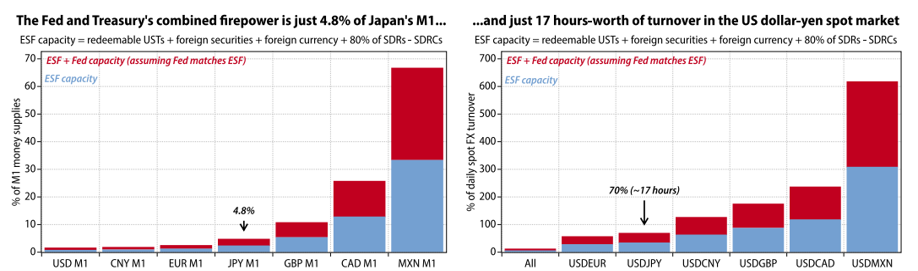
At first glance, coordinated intervention appeared to be a powerful response. According to Gavekal Research, even if the US Treasury and Federal Reserve deployed the full capacity of the Exchange Stabilization Fund and related mechanisms, the total intervention firepower would amount to roughly $330 billion. While that sounds substantial, it represents only about 17 hours of turnover in the dollar-yen market.
Note: ESF: Exchange Stabilization Fund | Source: Gavekal Research report dated 5 august 2026
This was precisely the lesson from the last major coordinated intervention between the United States and Japan in 1998. The initial impact was dramatic, with the yen rallying sharply immediately after the intervention. But the move quickly faded. It was only after Russia's sovereign default, the collapse of Long-Term Capital Management (LTCM), and subsequent Federal Reserve rate cuts that the yen began a sustained appreciation.
In other words, intervention can send a strong signal to markets, but it is unlikely on its own to alter the yen's trajectory for long if underlying economic forces remain unchanged.
This raises an interesting question.
If large-scale direct intervention is difficult, could US support Japan in another way?
One possibility is the Foreign and International Monetary Authorities (FIMA) Repo Facility, introduced by the Federal Reserve in 2020. The facility allows foreign central banks to temporarily borrow dollars against their holdings of US Treasury securities, rather than selling those securities outright. Reports suggest Japan may have used the facility as part of its intervention efforts. The distinction matters. If Japan were forced to fund yen purchases by liquidating large quantities of US Treasuries, it could put upward pressure on US bond yields at a time when the US is already managing large fiscal deficits. The FIMA facility offers an alternative, providing dollar liquidity while allowing Treasury holdings to remain in place. In effect, FIMA creates a mechanism through which Japan can support the yen without becoming a significant seller of US government debt. For the United States, that means helping stabilize the currency market while reducing the risk of disruption in the Treasury market.
Interestingly, Treasury Secretary Scott Bessent appeared to acknowledge this dilemma. He remarked that it would be reasonable for the Federal Reserve to increase the size of a stopgap liquidity facility that Japanese authorities are eyeing for use in their effort to prop up the yen given the bond market has grown since the facility was launched. Yet FIMA is not a magic wand. The facility provides temporary liquidity, not a permanent solution.
The yen intervention also raises a broader question about the international monetary system. The US dollar remains the world's dominant reserve currency, but its share of global foreign-exchange reserves has gradually declined over the past two decades.)
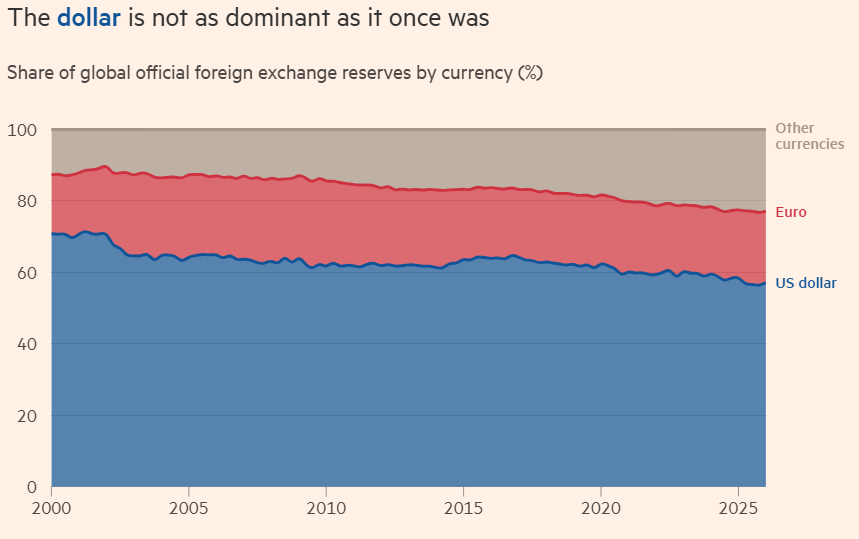
Source: Financial Times article dated 5th august 2026, IMF, Currency Composition Of Official Foreign Exchange Reserves (Cofer)
Against this backdrop, the response to the yen becomes particularly interesting. If the US is concerned about one of the largest foreign holders of Treasuries becoming a seller rather than a buyer, it highlights how important continued demand for US government debt has become.
This does not mean the dollar's reserve-currency status is under immediate threat. Far from it. But the growing focus on facilities such as FIMA suggests that maintaining stability in Treasury markets and preserving foreign demand for US assets has become an increasingly important policy objective.
In that sense, the intervention may have been about more than the yen. It was also a reminder that the strength of the dollar depends not just on America's economic might, but on continued confidence in the financial system that supports it.
Tanveer Sethi, Investment Manager - Fixed Income Strategies, Kotak Mahindra Asset Management (Singapore) Pte. Ltd. said, “With the rate at which the Japanese Yen was depreciating, an FX intervention was on the cards. However it was the timing (one day before BoJ meeting) and the joint nature of intervention (with the US) that caught the market participants by surprise. Actioning without signalling was definitely aimed at hurting the speculators; it probably worked, but the intervention does not fix the problem. Eventually economics prevails. At current levels, Yen continues to be a top candidate for funding currency for carry trades, albeit with heightened volatility. The BoJ will need to hike rates, or inflation will need to ease for the Yen to find support. While it seems all about the Yen, for US it’s all about their term-rates, which clearly have been a cause of worry. A stable (or stronger) JPY helps ease speculation on Japan’s sale of US securities, however on the other side , the use of FIMA and potential increase of counterparty limits (beyond USD 60billion) as suggested by the Treasury, needs Fed’s support, which brings back attention to the debate on Fed’s independence. Further, the US may have intentionally used EUR-JPY to avoid being seen as defending the dollar, but the intervention does bring back some focus on its currency policy and potential changes. Again, only a temporary reprieve against speculation, but speculators will be back. They will find one reason or another, until.. inflation is plugged!”
KMAMC is not guaranteeing/offering/communicating any indicative yield/returns on investments. The stocks/sectors mentioned do not constitute any kind of recommendation and are for information purpose only. Kotak Mahindra Mutual Fund may or may not hold position in the mentioned stock(s)/sector(s). Companies mentioned don’t constitute recommendation, brand name affiliation disclaimer & companies mentioned for illustrative purpose only. These materials are not intended for distribution to or use by any person in any jurisdiction where such distribution would be contrary to local law or regulation. The distribution of this document in certain jurisdictions may be restricted or totally prohibited and accordingly, persons who come into possession of this document are required to inform themselves about, and to observe, any such restrictions.
MUTUAL FUND INVESTMENTS ARE SUBJECT TO MARKET RISKS, READ ALL SCHEME RELATED DOCUMENTS CAREFULLY.