25 Jun 2026
SEBI Registered Name - Kotak Mahindra Mutual Fund
SEBI Registered Number - MF/038/98/1
Ethanol blending refers to the process of mixing ethanol (a biofuel derived from crops such as sugarcane, maize, and grains) with petrol in specified proportions such as E10 (10% ethanol), E20 (20%), or higher. Ethanol is produced through fermentation, distillation, and dehydration, resulting in fuel-grade anhydrous ethanol that can be blended with gasoline.
Globally, ethanol blending gained prominence after the 1970s oil crises, when countries like Brazil adopted biofuels to reduce dependence on imported crude. Over time, the United States and Brazil emerged as the largest producers, with ethanol becoming a core component of transport fuel.
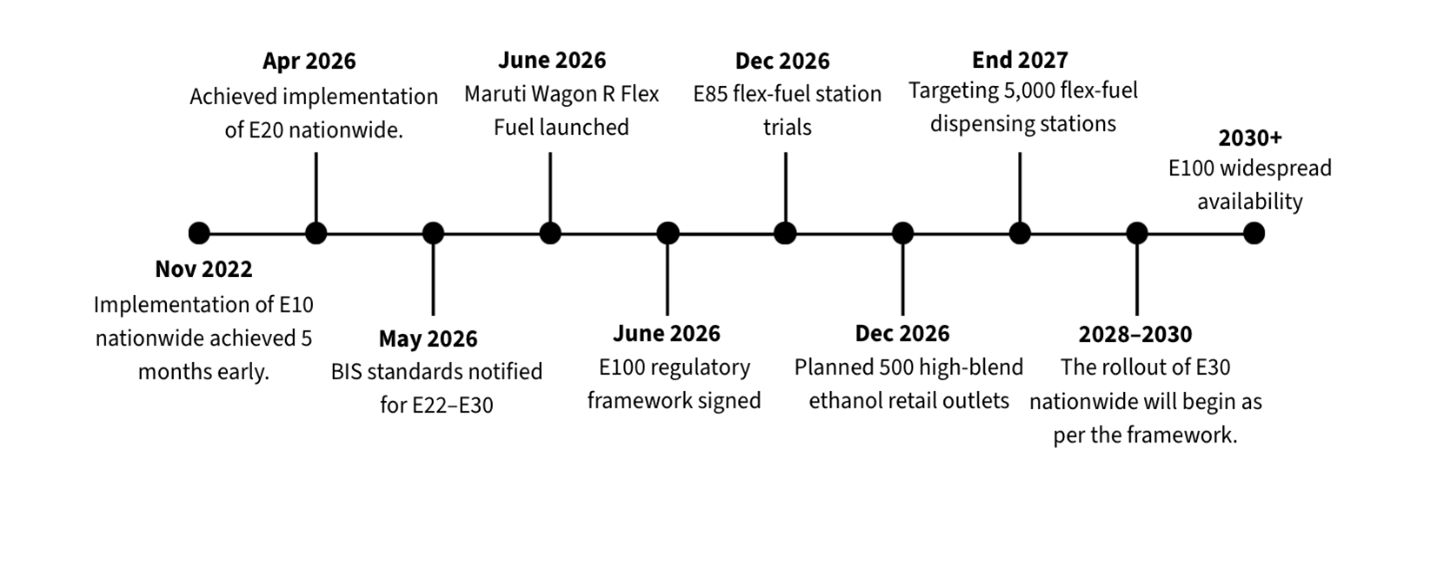
In India, ethanol blending started as early as 2003 under the Ethanol Blended Petrol (EBP) Programme, but progress was slow until policy reforms after 2014. Blending levels were only ~1.5% in 2014 (, reflecting infrastructure and supply constraints. Post-2018, policy support—such as administered pricing, multiple feedstock approval, and capacity expansion incentives—accelerated growth.
India scaled blending rapidly to:
10% by 2022 (ahead of target)
20% (E20) achieved in 2025–26 [Source : pib.gov.in], [ppac.gov.in]
The process involves a structured supply chain:
- Feedstock procurement (sugarcane, maize, grains)
- Ethanol production via distilleries
- Quality certification (BIS standards)
- Procurement by Oil Marketing Companies (OMCs)
- Blending at depots
- Distribution to retail outlets
- Consumption by vehicles
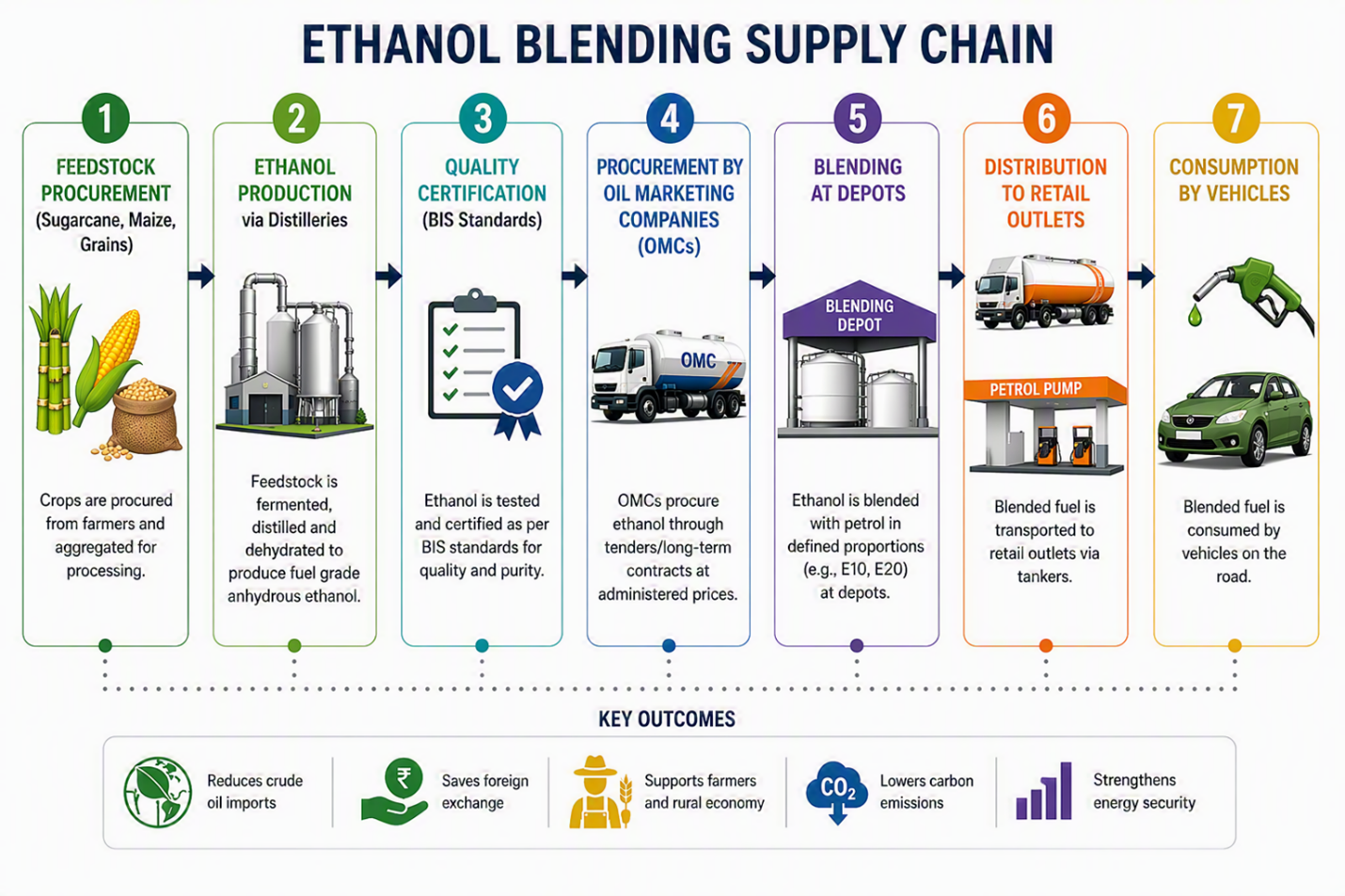
Note: BIS - Bureau of Indian Standards (BIS) is India’s National Standards Body
Globally, ethanol blending has emerged as a key energy strategy to reduce fossil fuel dependence, cut emissions, and support agriculture. For India, the rationale is particularly strong due to high crude oil dependence—India imports over 85% of its crude oil requirement (Source. PIB), exposing it to global price volatility and geopolitical risks.
Advantages / Benefits
Reduced Crude Oil Imports: Ethanol blending substitutes a portion of petrol consumption, directly lowering crude oil dependence. India has achieved ₹1.84 lakh crore in foreign exchange savings since ESY 2014–15 (Business Standard; Fortune India). Key beneficiaries: Government (forex savings), & Economy (lower trade deficit).
Boost to Agricultural Economy: Ethanol procurement has resulted in over ₹1.25 lakh crore in payments to farmers, creating a stable, government-backed demand for crops like sugarcane and maize (PIB). This strengthens rural incomes and reduces surplus inventory pressures. Key beneficiaries: Farmers, sugar mills, grain suppliers, rural economy.
Source: www.pib.gov.in
Environmental Benefits: Ethanol burns cleaner than petrol, leading to lower CO₂ emissions and reduced vehicular pollution, supporting India’s net-zero target (2070 – Source: PIB). Key beneficiaries: Environment, public health systems, urban population.
Energy Security: By diversifying the fuel mix, ethanol reduces reliance on volatile global oil markets, improving India’s resilience to supply shocks and geopolitical risks. Key beneficiaries: Government, energy sector, consumers (long-term price stability).
Industrial Growth: Ethanol blending drives distillery capacity expansion, infrastructure investment, and supply chain development, while enabling new sectors such as grain-based ethanol and logistics. The Key beneficiaries: Distillery companies, agri-processing firms, logistics providers, auto OEM ecosystem.
Disadvantages:
Ethanol blending has many benefits, but there are also some practical challenges in using it widely across the country. These challenges affect everyday users, car manufacturers, fuel companies, and even farmers. The table below explains the key issues in simple terms and who they impact the most.
Mentioned below are a few challenges :
| CHALLENGES | Stakeholder | Key Issue / Constraint |
|---|---|---|
| Consumer Constraints | Fuel Availability | Only 500 outlets targeted by Dec 2026 vs ~90,000 total pumps → limited accessibility. |
| Consumer Constraints | Mileage & Economics | Ethanol has lower energy density → higher fuel consumption. E20 already reduces mileage by 2–7%; E100 impact is higher. Cost viability depends on ethanol pricing vs petrol. |
| Consumer Constraints | Vehicle Compatibility | Majority of 35 crore vehicles are E10/E20 compatible only. Transition requires 10–15 years (fleet replacement cycle). |
| OEM Challenges | Cost Increase | FFV vehicles cost ₹40,000–₹70,000 more due to hardware upgrades (fuel systems, sensors, ECU). |
| OEM Challenges | Demand-Infrastructure Gap | Chicken-and-egg problem: low consumer demand vs limited fuel infrastructure. |
| OEM Challenges | Limited Product Availability | Only one commercial FFV car (Wagon R) currently; others in pipeline/testing stage. |
| OMC & Retail Infrastructure | Capex Requirement | Requires dedicated tanks, pipelines, dispensing systems due to ethanol properties. |
| OMC & Retail Infrastructure | Scalability Challenge | Target of 5,000 stations by 2027 requires significant investment and execution capability. |
| Sugar Industry Trade-off | Food vs Fuel | Increased ethanol diversion reduces sugar availability → potential export restrictions and revenue impact. |
| Cross-Sector Impact | Maize Supply Pressure | Higher diversion to ethanol increases input costs for poultry/cattle feed. |
| Cross-Sector Impact | Crop Allocation Distortion | Shift toward maize reduces pulses/oilseeds cultivation → increases edible oil import dependence. |
Global Scenario
Ethanol blending is widely adopted across global economies as a tool to reduce oil dependence and support agriculture, with the United States and Brazil accounting for nearly 80% of global production. The U.S. follows a policy-driven approach under the Renewable Fuel Standard, with E10 as the base blend and higher blends like E15 and E85 supported by a strong corn-based supply chain. Brazil, a pioneer since the 1970s oil crisis, has one of the most advanced ecosystems with E27 as the standard and widespread use of flex-fuel vehicles running on sugarcane-based ethanol. In Thailand, ethanol blending (E10, E20, E85) is promoted using cassava and sugarcane to enhance regional energy security. Meanwhile, regions like the European Union focus on E10 blends with a growing shift toward advanced biofuels. Overall, global trends highlight a move toward higher blend compatibility and sustainable feedstocks, supported by strong policy frameworks.
A key global enabler is the adoption of flex-fuel vehicles (FFVs), which can run on fuel ranging from pure petrol to E85/E100 and are widely used in Brazil and the U.S. Additionally, countries are increasingly moving toward advanced biofuels such as agricultural waste and cellulosic ethanol, with the aim of reducing the food vs fuel trade-off.
Region / Country based table:
| Country | Blend Level | Feedstock/ Raw Material | Key Feature |
|---|---|---|---|
| United States | E10 standard, E15 & E85 available | Corn | Renewable Fuel Standard (RFS) mandates blending |
| Brazil | E18–E27.5 (E27 standard) | Sugarcane | World leader in flex-fuel vehicles |
| India | E20 achieved | Cane, maize, grains | Fastest scaling market |
| European Union | ~E10 | Mixed + advanced biofuels | Emission reduction focus |
| Thailand | E10, E20, E85 | Cassava, sugarcane | Southeast Asia leader |
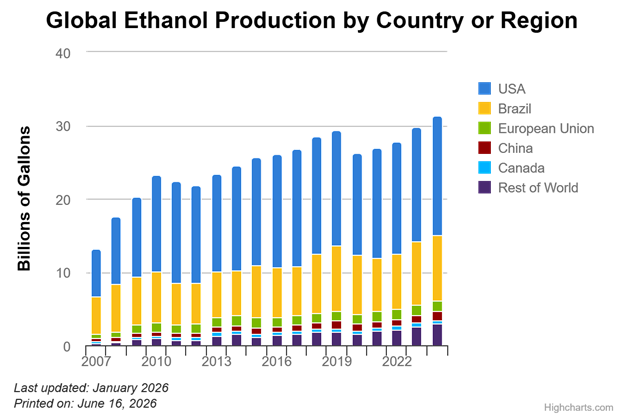
Source: Renewable Fuels Association & https://afdc.energy.gov/data/10331
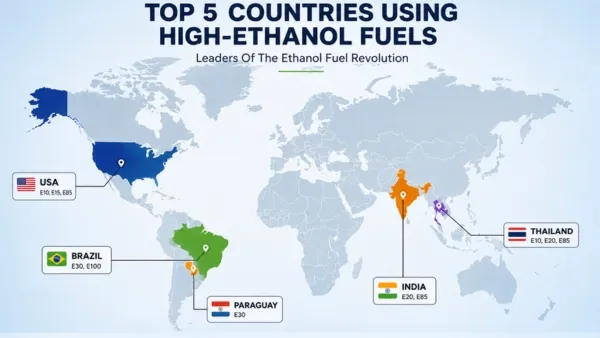
Note - This map is for pictorial representation purpose only and with no depiction of boundaries
Source https://www.drivespark.com/off-beat/top-5-countries-using-high-ethanol-fuels-india-brazil-086095.html
India’s ethanol blending journey began in 2003 with the launch of the Ethanol Blended Petrol (EBP) Programme, aimed at reducing crude oil imports and supporting the sugar industry. However, progress remained limited for over a decade due to supply constraints and policy gaps, with blending levels at only ~1.5% in 2014. Post-2014, a series of reforms—such as administered pricing, expanded feedstock eligibility beyond sugarcane, and incentives for distillery capacity—led to rapid scale-up, enabling India to achieve 10% blending by 2022 and 20% (E20) by 2025–26, ahead of target. [cartoq.com] [indianexpress.com] [autocarindia.com]
This expansion has delivered significant outcomes, including ₹1.84 lakh crore in foreign exchange savings and ~302 lakh metric tonnes of crude substitution, while also boosting rural incomes through ethanol procurement. The industry has simultaneously undergone a structural shift from sugar-based to grain-based ethanol, with maize contributing ~48% and overall grain-based sources accounting for ~69% of supply—improving resilience and diversifying the value chain. Looking ahead, India has begun pilot rollouts of higher blends such as E85, with infrastructure targets scaling from 48 stations to 5,000 by 2027, alongside policy development for E30 and E100 fuels, signalling a gradual transition toward a more ethanol-driven fuel ecosystem. [autonexa.com], [indiaobservers.com] [cnbctv18.com] [autocarindia.com]
Way Forward
Ethanol blending has become a key driver of India’s energy transition, delivering strong outcomes such as early achievement of E20, a robust domestic ecosystem, and significant foreign exchange savings. Ethanol is no longer just a blending additive—it is evolving into a core component of India’s fuel mix, though the pace of adoption will depend on execution across infrastructure, vehicle readiness, and pricing economics.
At the same time, ethanol blending presents a balanced mix of opportunities and trade-offs, supporting energy security, rural incomes, and emissions reduction, while raising concerns around efficiency, vehicle compatibility, infrastructure, and food vs fuel dynamics. The long-term success of the programme will depend on how effectively these challenges are managed, making a gradual and well-coordinated transition essential.
Mr Mandar Pawar, Executive Vice President, Kotak Mahindra AMC adds: India's ethanol blending programme has become a key building block in country’s energy security by strengthening the domestic energy supply chain and at the same time supporting farmers by creating new income stream for them. As global economies seek cleaner and more secure energy solutions, India has positioned ethanol blending as a key enabler of its energy transition. The success of this blending programme demonstrates how energy, agriculture, and sustainability can converge to create long-term value. As the ecosystem matures, ethanol has the potential to evolve from a petroleum substitute into a strategic domestic energy resource.
Disclaimers
Use of the company/ brand names does not imply any affiliation with or endorsement by them or any of its holding companies, subsidiaries or affiliates and are used for illustrative purpose only. The stocks/sectors mentioned do not constitute any kind of recommendation and are for information purpose only. Kotak Mahindra Mutual Fund may or may not hold position in the mentioned stock(s)/sector(s). These materials are not intended for distribution to or use by any person in any jurisdiction where such distribution would be contrary to local law or regulation. The distribution of this document in certain jurisdictions may be restricted or totally prohibited and accordingly, persons who come into possession of this document are required to inform themselves about, and to observe, any such restrictions
Mutual Fund investments are subject to market risks, read all scheme related documents carefully.