25 Jun 2026
Choosing between flexi cap and small cap mutual funds depends largely on your investment goals, risk appetite and time horizon. While both are equity oriented and suitable for long-term wealth creation, they differ significantly in how they are structured and how they behave in different market conditions. Flexi cap funds offer broad diversification by investing across large, mid and small-cap companies with the flexibility to adjust allocations based on market outlook. In contrast, small cap funds focus specifically on emerging smaller companies. Understanding these differences can help investors decide whether they need a balanced, all-weather equity fund or a more aggressive, high-growth focused strategy.
Key Takeaways
- Flexi cap funds offer broad diversification by dynamically allocating investments across large, mid and small-cap segments.
- Small cap funds focus on emerging companies with high growth potential, typically suited for long-term investment horizons.
- Both fund types are designed for long-term investing but differ significantly in risk profile and portfolio concentration.
- Combining flexi cap and small cap funds can help strike a balance between stability and growth within a portfolio.
- The final allocation should be guided by individual financial goals, investment horizon and risk tolerance.
What is a Flexi Cap Fund?
A flexicap fund is an open ended equity mutual fund that invests in companies of all sizes including large cap, mid cap and small cap without following any fixed allocation pattern. This approach allows the fund manager to move investments freely across different segments of the market depending on changing conditions and opportunities. For instance during uncertain times the fund may focus more on large well established companies for stability while in growth phases it may increase exposure to mid-sized and smaller companies to capture higher returns. By investing across a wide range of sectors and company sizes the fund maintains diversification which helps in balancing risk and return.
What is a Small Cap Fund?
A smallcap fund is an open ended equity mutual fund that invests predominantly in equity and equity related instruments of small cap companies, which are defined as companies ranked 251st and below in terms of full market capitalization. These companies are generally at an early stage of growth and may offer higher return potential over time. However, due to their relatively smaller size and lower market liquidity, they may be subject to higher volatility and market risk compared to large cap and mid cap companies. Investment in such funds is suitable for investors with a higher risk appetite and a long term investment horizon, as returns may be uneven in the short term. Investors are advised to consider their risk profile and investment objectives before investing.
Flexi Cap vs Small Cap - Key Differences
| Basis of Difference | Flexi Cap Fund | Small Cap Fund |
|---|---|---|
| Investment Scope | Invests in large cap, mid cap and small cap companies with no fixed allocation among them | Invests predominantly in small cap companies (ranked 251st and below as per SEBI classification) |
| SEBI Mandate | Must invest minimum 65% of total assets in equity and equity related instruments with no restriction on market cap mix. | Must invest minimum 65% of total assets in small cap companies as per SEBI definition |
| Diversification | Highly diversified across all market capitalizations | Concentrated exposure mainly in small cap segment |
| Flexibility | High flexibility to dynamically allocate across market caps based on market outlook | Limited flexibility due to mandated small cap exposure |
| Return Potential | Aims to deliver balanced returns by combining stability from larger companies with growth potential from mid and small caps. | Offers higher long term growth potential but with significantly higher volatility and sharper fluctuations. |
| Market Sensitivity | Can reduce risk by shifting towards large caps during volatility | More sensitive to market cycles and economic changes |
| Investment Horizon | Suitable for long term investors | Suitable for long term investors |
| Investor Suitability | Suitable for investors seeking flexibility across market segments | Suitable for investors aiming for long term wealth creation through exposure to emerging small sized companies |
Risk & Volatility Comparison
Flexi cap funds generally show relatively stable movement because they invest across large cap, mid cap and small cap companies. The presence of large cap stocks in the portfolio helps provide stability during market fluctuations and supports smoother performance over different market cycles.
In contrast, small cap funds tend to experience higher price fluctuations as they are concentrated in smaller companies that are more sensitive to market and economic changes. While they may deliver strong performance during favorable market conditions, they can also witness sharper declines during downturns.
Who Should Invest in Flexi Cap Funds?
Flexi cap funds are suitable for investors who want equity exposure across large, mid and small sized companies through a single mutual fund scheme. These funds allow the fund manager to invest freely across market capitalizations and adjust the portfolio based on changing market opportunities, which helps in maintaining a well-diversified approach.
Who Should Invest in Small Cap Funds?
Small cap funds are suitable for investors with a long term investment horizon who want exposure to smaller, growing companies. These funds focus on emerging businesses that may offer higher growth potential over time. They are suited for investors who can stay invested through market ups and downs without reacting to short term changes. Small cap funds are ideal for those focused on long term wealth creation and willing to remain invested to benefit from the growth of smaller companies.
Can You Hold Both in Your Portfolio?
Yes, it is possible to include both flexi cap and small cap funds in a portfolio, depending on your financial goals and investment horizon. A common strategy is to use flexi cap funds as the core holding to provide diversified equity exposure across market segments, while adding small cap funds as a satellite allocation to target higher growth potential. This combination helps in maintaining a balance between stability and growth opportunities within a single portfolio.
How to Choose Between the Two?
The choice between flexi cap and small cap funds depends on your financial goals, investment horizon and comfort with market movements.
1) Regulatory Structure
As per the classification norms of the Securities and Exchange Board of India, flexi cap funds can invest freely across large, mid and small cap stocks without any fixed allocation limits. In contrast, small cap funds are required to invest primarily in companies ranked 251st and below by market capitalization. This distinction defines the core difference between broad diversification and focused exposure.
2) Investment Objective
Flexi cap funds aim to provide a single, diversified equity solution by spreading investments across market segments. Investors comparing diversified equity categories may also find it useful to understand flexi cap vs multi cap and how their allocation requirements differ. Small cap funds, on the other hand, focus on identifying emerging businesses with higher growth potential within the small cap universe.
3) Investment Horizon
Flexi cap funds are suitable for investors with long term goals who prefer a relatively balanced and diversified participation across market cycles, as they invest flexibly across large cap, mid cap and small cap segments within a single portfolio. Small cap funds are also appropriate for long term investors, but they differ in focus as they invest primarily in smaller companies that are part of the SEBI defined small cap universe.
4) Volatility Profile
Flexi cap funds generally exhibit comparatively lower volatility due to diversification across market capitalizations and sectors. Small cap funds tend to show higher volatility because they are concentrated in smaller companies, which are more sensitive to market cycles, liquidity conditions, and economic changes. This difference becomes clearer when you understand the Flexicap Fund Meaning, which is built around diversification and flexibility
5) Portfolio Role
Flexi cap funds are often used as a flexible core equity option since they invest across large, mid and small cap stocks in one fund, giving broad market exposure. Small cap funds are used as a focused equity allocation to add exposure to smaller companies with higher growth potential. The choice and proportion between the two depends on the investor’s financial goals, time horizon and preferred level of involvement in managing the portfolio.
Conclusion
Flexi cap funds provide diversified equity exposure across market segments in a single scheme, while small cap funds focus on smaller companies with higher growth potential. Both are designed for long term investing but differ in structure and behaviour. Flexi cap funds offer flexibility and balance, whereas small cap funds are more concentrated and growth oriented. The choice between them depends on investment goals, time horizon and risk comfort.
FAQs
1) Can I invest in both flexi cap and small cap?
Yes, you can invest in both. Many investors use flexi cap funds as the core holding for stability and diversification, while adding small cap funds as a satellite allocation for higher growth potential.
2) What is the minimum holding period for small cap funds?
An investment horizon of 5 years or more is generally recommended, as these funds are highly volatile and require sufficient time to potentially deliver strong long-term returns.
3) Do flexi cap funds include small cap stocks?
Yes. Flexi cap funds can invest across large, mid and small-cap stocks without restrictions, depending on the fund manager’s strategy and market conditions.
4) Is SIP better for flexi cap or small cap?
SIP is suitable for both flexi cap and small cap funds. It helps investors invest in a disciplined manner and reduce the impact of market volatility over time.
Kotak Flexicap Fund

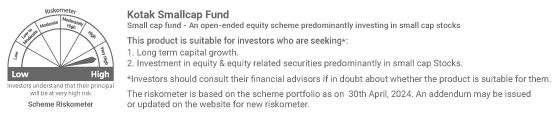
Kotak Small Cap Fund
Disclaimers
Investors may consult their Financial Advisors and/or Tax advisors before making any investment decision.
These materials are not intended for distribution to or use by any person in any jurisdiction where such distribution would be contrary to local law or regulation. The distribution of this document in certain jurisdictions may be restricted or totally prohibited and accordingly, persons who come into possession of this document are required to inform themselves about, and to observe, any such restrictions.
MUTUAL FUND INVESTMENTS ARE SUBJECT TO MARKET RISKS, READ ALL SCHEME RELATED DOCUMENTS CAREFULLY.