17 Sep 2026
SEBI Registered Name - Kotak Mahindra Mutual Fund | SEBI Registered Number - MF/038/98/1
From global pension funds and sovereign wealth funds to foreign institutions investing in Indian equities and infrastructure, international capital has become an integral part of India's growth story. Over the past decade, India has evolved from being viewed largely as an emerging market opportunity to becoming a strategic destination for long-term global investors. Capital now enters the country through a variety of channels, including Foreign Direct Investment (FDI), Foreign Portfolio Investment (FPI), private equity, venture capital, Real Estate Investment Trusts (REITs), Infrastructure Investment Trusts (InvITs), and long-duration pools of global savings. This transformation reflects not only India's economic potential but also the policy framework that has helped integrate the country more deeply into global capital markets.
Source: Press Information Bureau (PIB), Department for Promotion of Industry and Internal Trade (DPIIT)
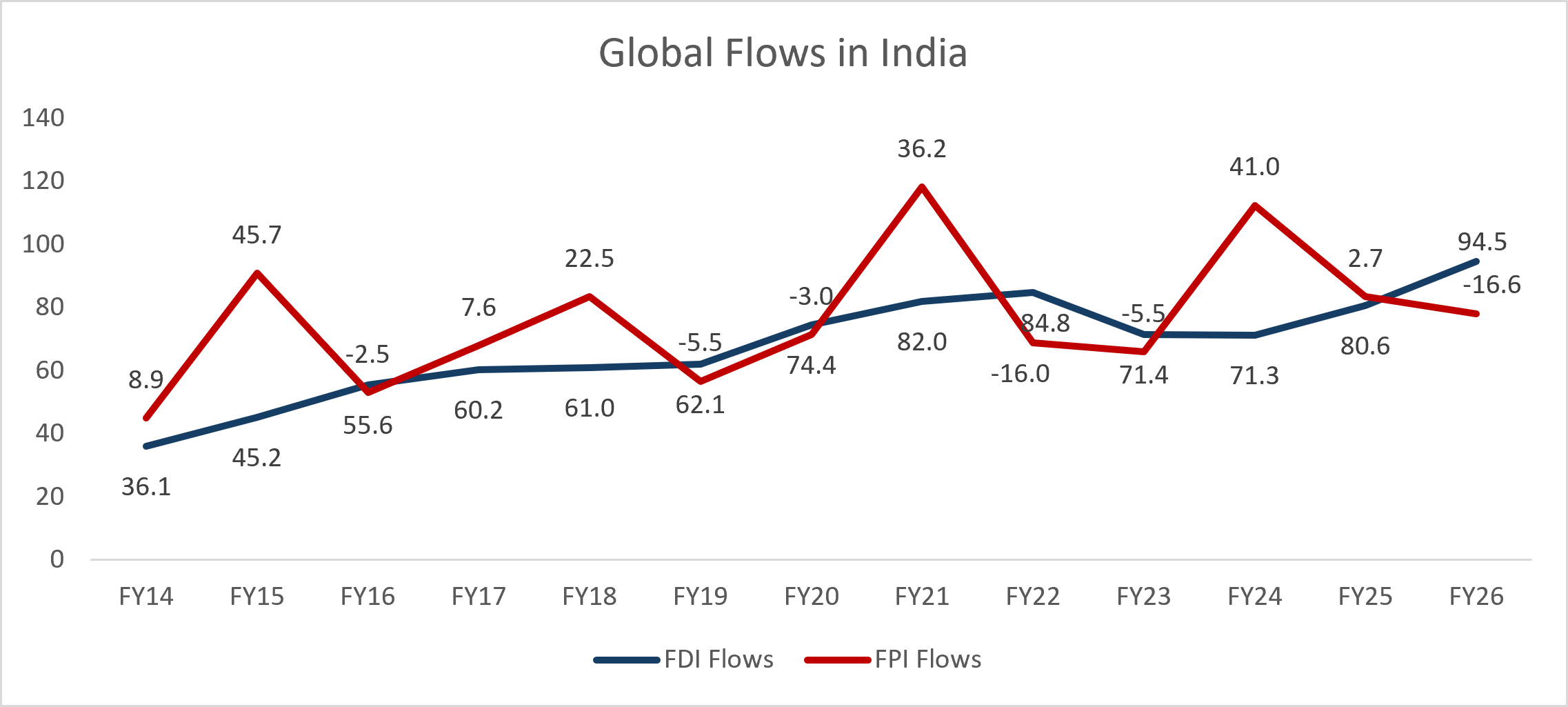
Source: FDI data – India Brand Equity Foundation (IBEF) Source: FPI Data - National Securities Depository Limited (NSDL)
I. A Decade of Change: The Evolution of Foreign Capital
The nature of foreign investment in India has changed considerably over the last decade. What was once concentrated in a handful of sectors has become increasingly diversified across manufacturing, technology, infrastructure, financial services, renewable energy, and digital businesses. Global investors today are not merely seeking short-term opportunities; many are looking to participate in India's long-term growth story.
Policy reforms, improvements in ease of doing business, rapid digitisation, and large-scale infrastructure investments have broadened the opportunities available to international capital. At the same time, India's expanding consumer base and rising formalisation of the economy have strengthened investor confidence. As a result, India has emerged as one of the most significant destinations for global capital in the developing world.
Source: Press Information Bureau (PIB)
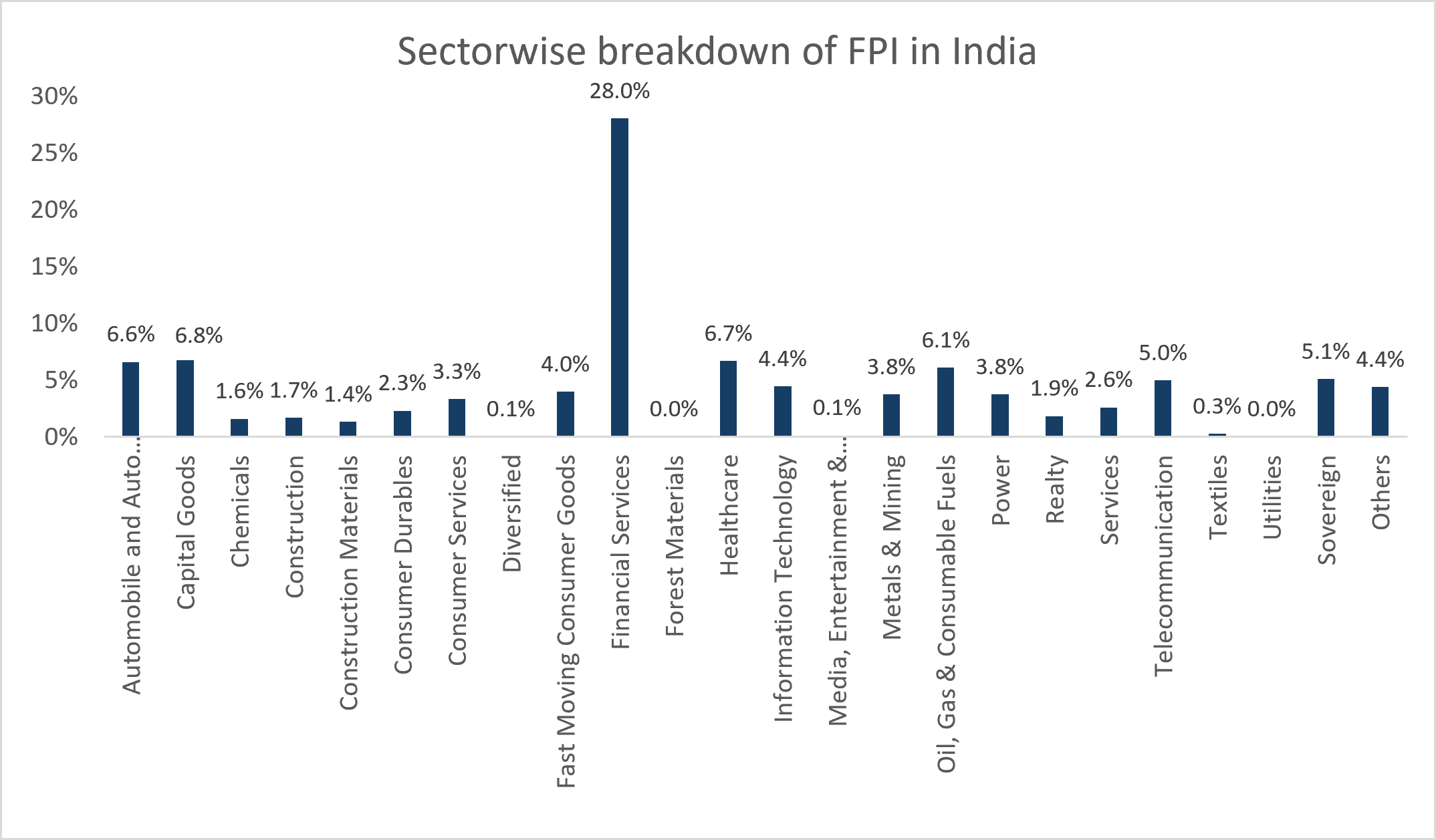
Data as of 30th June 2026 and as a % of total FPI inflows,
Source- National Securities Depository Limited (NSDL)
II. The Gateways into India
Foreign capital reaches India through several distinct channels, each serving a different purpose.
Foreign Direct Investment (FDI) involves long-term investments by overseas companies or investors into businesses operating in India. These investments often bring not only capital but also technology, managerial expertise, and global market access. Between April 2000 and March 2026, cumulative gross FDI inflows in India reached nearly US$1.16 trillion . This marked an all-time milestone. In FY 2025-26, total FDI inflows rose to a record $94.53 billion, a 17% increase over the previous fiscal year. On a cumulative basis since April 2000, Singapore leads with nearly $194.7 billion in equity inflows, followed by Mauritius at $186.8 billion and the United States at $81.8 billion. The sectors which received investment were Computer Software and Hardware, Services Sector, Manufacturing, Trading and Telecommunications and Renewable Energy.
Source – Invest India
Foreign Portfolio Investment (FPI) allows international investors to participate in India's listed equity and debt markets. FPIs play an important role in enhancing market liquidity and improving price discovery. During FY27, FPI investments in India stood at Rs. 14,47,459 crore (US$ 263.85 billion) as of August 12, 2026 with debt instruments having net inflows of Rs. 68,120 crore (US$ 7.13 billion), mutual fund schemes receiving Rs. 988 crore (US$ 0.10 billion) and Alternative Investment Funds (AIFs) recording inflows of Rs. 10 crore (US$ 1 million) during the period.
Source - India Brand Equity Foundation (IBEF)
Private Equity and Venture Capital investors provide growth capital to both established businesses and emerging startups. These investments have been particularly influential in India's technology, consumer, healthcare, and financial services sectors. India attracted US$60.7 billion across 1,475 PE/VC deals in 2025 Source - India Brand Equity Foundation (IBEF)
REITs and InvITs offer global investors access to income-generating real estate and infrastructure assets through regulated market instruments. They have expanded the range of investment opportunities available to institutional investors seeking stable, long-term returns. Recently SEBI Proposed a Framework For Depository Receipts to be issued linked to REITs, and publicly listed InvITs which could further promote overseas investments into Indian real estate and infrastructure trusts.
Source: Economic Times
Sovereign Wealth Funds and Pension Funds have emerged as important providers of long-term capital for India's infrastructure, renewable energy, logistics and digital economy. Government policies, including dedicated tax incentives for eligible infrastructure investments, have helped attract these investors, whose long investment horizons align well with India's development needs.
III. Policies, Treaties and Reforms That Enable Investment
India's ability to attract foreign capital is supported by a comprehensive regulatory framework.
The Foreign Exchange Management Act (FEMA) serves as the foundation for governing cross-border investments and capital flows. It provides the regulatory structure through which foreign investors access Indian markets and businesses.
India's FDI regime generally operates through two routes: the Automatic Route, where investments can proceed without prior government approval in eligible sectors, and the Government Route, where approval is required for specified sectors and circumstances.
Bilateral tax arrangements and treaties, including those involving jurisdictions such as Singapore and Mauritius, have historically contributed to cross-border investment flows by providing greater certainty around taxation and investment structures.
India has also strengthened economic linkages through trade and economic cooperation agreements such as the UAE Comprehensive Economic Partnership Agreement (CEPA), Australia Economic Cooperation and Trade Agreement (ECTA), Japan CEPA, and Singapore CECA. These agreements support trade, investment, and business collaboration between India and key international partners.
| Agreement | Partner(s) | Status | Entered Into Force | Headline Market Access |
|---|---|---|---|---|
| CEPA | UAE | In force | 01-May-22 | Preferential access on 97%+ of tariff lines, covering 99% of India's exports by value |
| TEPA | EFTA (Switzerland, Norway, Iceland, Liechtenstein) | In force | 01-Oct-25 | USD 100 billion investment commitment over 15 years |
| CETA | UK | In force | 15-Jul-26 | Duty-free access on 99% of India's exports by value |
| FTA | European Union | Concluded, awaiting ratification | Not yet in force | Preferential access on 97% of tariff lines, covering 99.5% of India's export value |
Alongside these agreements, ongoing regulatory reforms, digitalisation of compliance processes, and continued liberalization of investment norms have further enhanced India's attractiveness as an investment destination.
IV. Where the Money Goes
Foreign capital is increasingly being directed toward sectors that are shaping India's future growth. Manufacturing and the digital economy continue to attract strong investor interest, supported by efforts to strengthen production capabilities, expand supply chains, and accelerate technological adoption. Infrastructure, renewable energy, and green hydrogen are emerging as key destinations for long-term investment as India advances its connectivity, sustainability, and energy transition goals. At the same time, financial markets remain an important avenue for international investors seeking exposure to India's corporate and economic growth.
| Sector | What Foreign Capital Is Funding |
|---|---|
| 1. Manufacturing | Electronics, auto components, industrial supply chains, PLI-linked industries |
| 2. Digital Economy | Software services, fintech, digital payments, e-commerce, cloud and AI ecosystems |
| 3. Infrastructure | Roads, airports, logistics parks, urban infrastructure, rail-linked projects |
| 4. Renewable Energy | Solar projects, wind energy, transmission assets, green hydrogen initiatives |
| 5. Financial Markets | Listed equities, debt markets, private credit, alternative investment platforms |
V. Why Global Investors Keep Choosing India
Several structural factors continue to make India attractive to long-term global investors.
A large and growing domestic consumption market provides businesses with significant opportunities for expansion. India's demographic profile, characterised by a young workforce and rising aspirations, offers a powerful foundation for future economic growth.
The ongoing formalization of the economy has improved transparency, broadened the tax base, and expanded participation in the organised sector. Meanwhile, investments in physical and digital infrastructure are improving connectivity, productivity, and ease of doing business.
Most importantly, many global investors view India as a market where economic growth, policy continuity, entrepreneurship, and innovation can converge over the coming decades. These factors collectively support the perception of India as a long-term strategic allocation rather than merely a cyclical investment opportunity.
Conclusion : India's Next Capital Cycle
India's foreign investment story is no longer just about attracting capital. It is increasingly about channeling long-term global savings into infrastructure, manufacturing, innovation, and sustainability. As regulatory frameworks mature, investment avenues expand, and economic integration deepens, India is becoming an increasingly important destination within global portfolios. For international investors seeking long-term growth opportunities, exposure to India is not simply a tactical choice but an investment in one of the world's most significant economic transformations.
Gijo Joseph, Deputy Head – International Business, Kotak International & President and CEO of Kotak Mahindra Inc, USA - Investor priorities continue to evolve from seeking short-term market opportunities to identifying durable, long-term sources of value creation. As global capital increasingly looks for resilient growth markets, India remains uniquely positioned at the intersection of economic scale, demographic strength, innovation, and institutional development.
Ankit Sacheti, Senior Executive Vice President - Investments, Kotak Mahindra Asset Management (Singapore) Pte. Ltd., - Periods of uncertainty often create the most compelling opportunities for long-term investors. In our view, India's structural growth drivers remain intact, supported by formalisation, rising consumption, improving corporate competitiveness, and continued capital formation. The key is to stay focused on quality businesses with scalable models and the ability to compound earnings through cycles.
Disclaimers
Usage of brand names/ company names in generic content/non-scheme related content - Use of the company/ brand names does not imply any affiliation with or endorsement by them or any of its holding companies, subsidiaries or affiliates and are used for illustrative purpose only. The stocks/sectors mentioned do not constitute any kind of recommendation and are for information purpose only. Kotak Mahindra Mutual Fund may or may not hold position in the mentioned stock(s)/sector(s). These materials are not intended for distribution to or use by any person in any jurisdiction where such distribution would be contrary to local law or regulation. The distribution of this document in certain jurisdictions may be restricted or totally prohibited and accordingly, persons who come into possession of this document are required to inform themselves about, and to observe, any such restrictions
Mutual Fund investments are subject to market risks, read all scheme related documents carefully.