2 Jul 2026
SEBI Registered Name - Kotak Mahindra Mutual Fund | SEBI Registered Number - MF/038/98/1
This summer, the 2026 World Cup showcases the visible side of AI 3D-rendered offside calls, generative “Football AI Pro” assistants for all teams, and even AI-driven robodogs on patrol. Yet, beyond this spotlight, a quieter form of AI taking shape in India is gradually becoming just as significant.
In a distant village where the signal drops to one bar, a farmer asks a ₹10,000 phone a question in Gujarati, offline; it answers in his language, on a model built in Bengaluru. The AI race is usually framed as America versus China, with India a customer. That is now out of date: India is running a different race which is reshaping how Indian banks, businesses and markets will work.
Where India stands in the global AI race
The scoreboard is more flattering than most assume, and more complicated.
| Metric | India ranks | Position |
|---|---|---|
| Global AI Vibrancy | #3 | Up four places in a year, behind only the US and China |
| AI researchers & inventors | #2 | But the US has ~4× more; India still sees net outflow |
| AI skill penetration | #1 | Three times the global average |
And this is no longer just rankings AI is already inside India’s businesses. On the NASSCOM AI Adoption Index, India scores 2.45 out of 4, with 87% of enterprises actively using AI; the lead sectors are industrial, consumer, banking and healthcare that drive around 60% of AI’s value.
Source: NASSCOM AI Adoption Index, via PIB.
It has also moved past experiments: an EY-CII survey of 200+ enterprises found 47% already run multiple generative-AI (GenAI) use cases live in production, and 10% are scaling them a shift from pilots to performance.
Source: EY-CII, “The AIdea of India: Outlook 2026.”. These new models were benchmarked by their own makers, not independently, read the claims as promising, not proven.
How India Is Shaping Its Own AI Ecosystem
At the February 2026 India AI Impact Summit, three sovereign models were unveiled at once. But the real picture is a dense ecosystem with startups, IITs and government building in parallel. Recent developments also reflect growing industry backing: in June 2026, HCL Technologies Limited announced a ~$150 million (₹1,427 crore) strategic investment in Sarvam AI for a ~10.5% stake, as part of its Series B round to support development of sovereign AI capabilities.
Source: thehindubusinessline
| Creation | Built by | What it is | Why it matters |
|---|---|---|---|
| Sarvam (Vikram, Edge) | Sarvam AI | 30B & 105B models | From scratch on Indian compute, Edge runs offline |
| Param2 | BharatGen / IIT Bombay | 17B open, 22 languages | Govt-funded; grasps Indian law & schemes |
| Vachana | Gnani.ai | Voice, 12 languages | Voice clone from <10s; used by Tata, Air India |
| BharatGPT | CoRover.ai | Govt / enterprise assistant | Powers the IRCTC assistant at scale |
| Hanooman | SML + IITs | Multilingual (to 40B) | Jio-backed; healthcare spin-off |
| AI4Bharat | IIT Madras | Open translation & speech | The open backbone the rest builds on |
Source: India AI Impact Summit 2026; CoRover.ai; SML; AI4Bharat.
It is driven by two central ideas. The first is efficiency over size: Sarvam’s flagship activates only ~10 billion of its 106 billion parameters per token, and India leans deliberately into small language models - leaner AI that needs far less computing power, runs in local languages, and works on a basic phone with patchy signal. KPMG argues this fits India: lower compute and energy, better cost, on-device AI for smaller firms and towns. The second is deployment over demos - BharatGPT already answers IRCTC passengers daily.
Source: KPMG, “AI for Bharat” (2026); Sarvam AI.
HOW SARVAM AI CHARGES
Pay-as-you-go:
Usage is billed based on consumption per token (LLMs), per character (text/translation), per hour (speech), or per page (documents), with pricing denominated in INR and no mandatory subscription.
The Sarvam-30B model is priced on a per‑token basis for API usage, while a free tier is available for individual users via the chat interface. Speech transcription is ~₹30 per hour of audio, and translation ~₹20 per 10,000 characters, with usage deducted from prepaid credits.
For a bank or an app, that means AI can be switched on only when needed; a surge in calls, a seasonal peak and off again with nothing to pay in between: no idle cost, no per-seat licence. Billed in rupees and, by some estimates, 20-30% cheaper than global tools for Indian-language tasks, it makes on-demand AI affordable at scale.
Source: Sarvam AI API pricing (2026).
The open-source backbone
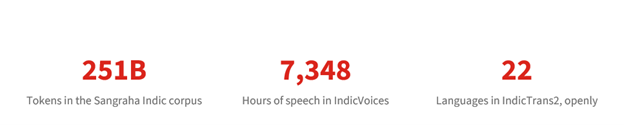
Beneath the branded models sits the most important creation of all: an open-source language foundation from AI4Bharat (IIT Madras) and the government’s BHASHINI mission given away free.
Source: AI4Bharat, IIT Madras; BHASHINI (MeitY).
It is already wired into the state. Sarvam is embedding homegrown AI through public partnerships: with UIDAI, adding AI voice, fraud detection and 10-language support to Aadhaar on its own secure servers; with Odisha, a 50MW “sovereign AI” hub; and with Tamil Nadu and IIT Madras, Digital Sangam, India’s first sovereign AI research park with a 20MW data centre - public partnerships deploying AI at population scale.
Source: PIB (IndiaAI Mission); Sarvam AI; Business Today.
From chip to app - owning the full AI stack
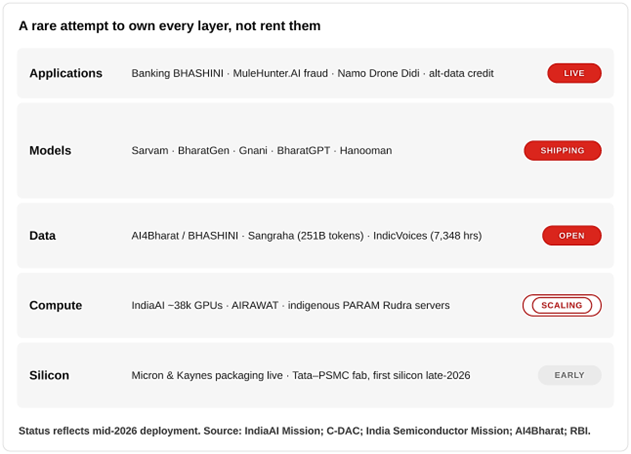
The most underrated fact about India’s push is how far down it goes: it anchors every layer of the stack at once.
Compute: cheap by design
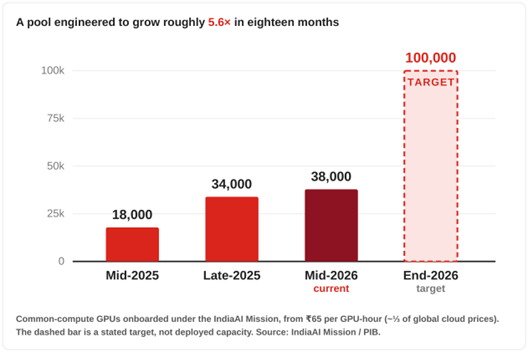
Compute is treated as a public utility. The ₹10,372 crore IndiaAI Mission has pooled ~38,000 GPUs from ₹65 per GPU-hour, about a third of global cloud prices targeting 100,000 by end-2026.
Silicon: the hardest layer, finally moving
For decades India designed chips but made none. Now, under ISM 2.0 (₹8,000 crore in Budget 2026-27), Micron’s Sanand plant has shipped India’s first memory modules to Dell, and the Tata-PSMC fabrication facility at Dholera targets first silicon late this year packaging today, a full facility still years out, but the base now exists.
Source: India Semiconductor Mission (MeitY); Micron; PIB.
AI in defence
The push reaches the military. DRDO’s Centre for AI and Robotics has fielded 75+ AI products across surveillance, autonomy and cyber; Project SANJAY fuses sensor feeds into one battlefield picture, and HAL’s CATS pairs AI drones with fighters. India used such tools in Operation Sindoor (2025), backed by ₹100 crore a year and 1,000+ defence-tech start-ups though a real gap to the US and China remains.
Source: indiaai.gov.in; India Strategic; CSDR (2026).
India’s real edge - distribution at scale
India’s advantage is not any single model’s quality, it is the ability to deploy AI to hundreds of millions faster than anywhere, because the rails already exist.

Source: UIDAI; NPCI; Reserve Bank of India (2026).
Alongside this, physical infrastructure continues to strengthen: 5G now reaches 99.9% of districts and 85% of the population, and data-centre capacity has roughly quadrupled since 2020 to ~1,500 MW, with several-fold growth expected by 2030.
Source: PIB / Department of Telecommunications (2025).
And on the measure that matters most AI deployed at scale and delivering returns - India already leads the global average in every major sector:
| Sector | Global | India |
|---|---|---|
| Financial services | 26% | 38% |
| Healthcare | 17% | 67%* |
| Industrial manufacturing | 23% | 33% |
| Consumer & retail | 42% | 67% |
The hard part - hallucination and the challenges that remain
For all the momentum, the most stubborn limit is the flaw in every large language model: hallucination.
DEFINITION - AI HALLUCINATION
When a model produces a fluent, confident, plausible-sounding answer that is factually wrong or fabricated without signalling that it is unsure. A known limit of all AI chatbots, not only Indian ones.
A hands-on review by Rajashree Rajadhyax found Sarvam stating the 2021 Census was conducted (it was postponed), inventing a wrong recipe for a Maharashtrian sweet, and misstating GST thresholds; Artificial Analysis benchmarks likewise flag high rates. It bites harder here because India is deploying AI into high-stakes domains tax, schemes, healthcare, banking and is hardest in low-resource languages where data is thin.
The challenges that make this hard
- A thousand languages and dialects, plus code-mixed “Hinglish” that blends scripts mid-sentence.
- Thin digital data in regional languages much of India’s knowledge was never put online.
- Deep cultural nuance food, festivals and local terminology that global data misses.
- The compute and capital gap OpenAI has raised over $100 billion and runs clusters in the hundreds of thousands; Indian labs work with tens of millions and clusters in the thousands.
- Building the whole ecosystem infrastructure, datasets, evaluation and safety, with an energy and data-governance overhang.
These are not just constraints they are the conditions under which India is building a different AI: local, multilingual, deployable at population scale.
Source: Article by Rajashree Rajadhyax (Medium), March 2026; Artificial Analysis; OpenAI.
What it means for markets and investors
For investors, the signal is not which model wins, but that AI is moving into the core of how Indian banks, lenders and insurers run. PwC India finds 90% of Indian financial institutions now treat AI and GenAI as their primary enablers of innovation; IDC puts global financial-services AI spend on track to rise from about $35 billion (2023) to $97 billion by 2027, a ~29% CAGR. It shows in deployment too: 38% of Indian financial-services firms run AI at scale and delivering returns, versus 26% globally (KPMG). With banking and financial services near 40% of the Nifty, the shift moves the index itself.
The value may lie less in creating the smartest AI, and more in companies that can deploy it widely, along with those benefiting from the infrastructure build‑out.
Source: PwC India; IDC; KPMG; NSE.
The Bottom line
India is unlikely to top the chart for the biggest model this decade. Its edge is narrower and more practical, resting on three things:
- Multilingual relevance: models built for Indic languages, not adapted to them.
- Cost-conscious design: doing more with less compute, by choice.
- Massive distribution: the DPI (Digital Public Infrastructure), UPI and Aadhaar rails that can carry AI to a billion people.
Measured against those three, India is not behind. It is building something different.
Vivek Raghavan, Co-founder, Sarvam AI, notes “Sovereignty matters much more in AI than building the biggest models; the edge is in reaching every citizen in their own language, on the devices they already own.”
Source: Free Press Journal
Sudheer Guntupalli, Vice President- Equity Research adds, “India is pursuing a differentiated AI strategy focused on efficiency, localization and deployment rather than building the largest models. It ranks strongly in AI talent, skills and enterprise adoption, with widespread live use cases across sectors. A growing ecosystem of indigenous, multilingual and low-compute models enables affordable, on-device applications suited to India’s conditions. Open-source initiatives and Digital Public Infrastructure (Aadhaar, UPI) allow rapid population-scale deployment. Government-led investments in compute and early semiconductor capabilities strengthen the ecosystem. Despite constraints such as limited capital, data gaps and model hallucinations, India’s competitive edge lies in cost efficiency and distribution, with investors benefiting from businesses embedding AI at scale.”
Disclaimers:
KMAMC is not guaranteeing/offering/communicating any indicative yield/returns on investments. The stocks/sectors mentioned in this slide do not constitute any recommendation and Kotak Mahindra Mutual Fund may or may not have any future position in these sectors/stocks. Companies mentioned don’t constitute recommendation, brand name affiliation disclaimer & companies mentioned for illustrative purpose only. Use of the company brand names does not imply any affiliation with or endorsement by them or any of its holding companies, subsidiaries or affiliates and are used for illustrative purpose only.
Mutual Fund investments are subject to market risks, read all scheme related documents carefully.