22 Oct 2026
SEBI Registered Name - Kotak Mahindra Mutual Fund
SEBI Registered Number - MF/038/98/1
India’s households are estimated to hold 28,000 tonnes of gold, worth ₹380–390 trillion. Only ~8% of the lendable value (at ~60% LTV) has been monetised through organised lenders. Even so, gold-backed lending has already grown into a ₹18.6 trillion credit category as of March 2026.
That makes gold loans an unusual part of India’s credit story: an asset long kept at home is increasingly being used to fund businesses and household needs without being sold. The pace of growth is striking, but it also prompts a closer look at what is driving it: new demand, rising gold prices, or repeat borrowing.
Source: Motilal Oswal Financial Services Gold Loan Report: Sep 2026
From ₹5.5 Trillion to ₹18.6 Trillion: How Fast Is the Market Growing?
The numbers leave little doubt about the pace of expansion. India’s gold-loan market has grown nearly threefold in five years, from ₹5.5 trillion in FY22 to ₹18.6 trillion by March 2026. FY26 alone added 50% year on year. The market is estimated to grow at a 28% CAGR between FY26 and FY28, crossing ₹30 trillion by March 2028.
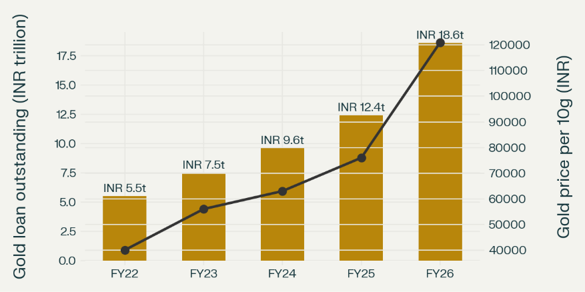
Gold loan outstanding and gold prices. Source: Motilal Oswal Financial Services, September 2026.
Gold loans have also moved up the retail-credit rankings. At ₹18.6 trillion in March 2026, the category stood ahead of personal loans at ₹16.5 trillion, making it the second-largest retail asset class for banks and NBFCs after housing loans, which stood at ₹44.4 trillion.
Source: Motilal Oswal Financial Services Gold Loan Report: Sep 2026
What Is Putting Gold Loans on a Faster Track?
The recent expansion has three main engines: a sharp rise in gold prices, stronger demand for quick working capital and a wider lending network across banks and NBFCs.
For borrowers, the appeal begins with cost. Interest rates on gold loans can be around 3 to 6 percentage points lower than unsecured credit. For lenders, the loan is backed by collateral, allowing the portfolio to grow with a layer of lower loss risk.
Gold prices rose by more than 60% in FY26. Since the jewellery itself is the collateral, a higher valuation allows a borrower to raise more money without pledging additional gold. This is one reason loan balances have grown faster than pledged tonnage and customer additions.
The product also fits the day-to-day funding needs of small businesses, traders and semi-formal borrowers. These customers may need working capital quickly but may not have extensive documentation or a long credit history. Faster disbursal, flexible repayment structures and lower dependence on credit-score history make gold loans useful in such situations.
Lenders have increased their capacity to serve this demand. Specialist NBFCs operate with dedicated valuers and secure storage at branches. Banks are adding branch infrastructure, digital sourcing and specialized teams. Public sector banks bring another advantage: an established rural and semi-urban network.
Household savings provide a supportive backdrop. Physical assets accounted for 64% of household savings in FY25, while savings held in gold and silver ornaments rose 27% during the year to ₹2.18 trillion.
Source: Motilal Oswal Financial Services Gold Loan Report: Sep 2026 Is the Gold-Loan Map Beginning to Change?
The southern states remain the centre of the market. Tamil Nadu, Andhra Pradesh, Karnataka, Kerala and Telangana together account for nearly 69% of originations. Yet growth is beginning to spread beyond this base. Uttar Pradesh recorded the highest origination growth at 75%, followed by Delhi at 70%, while Madhya Pradesh, Rajasthan and Gujarat each grew by more than 50%. Markets with lower current penetration could therefore play a larger role in the next leg of growth.
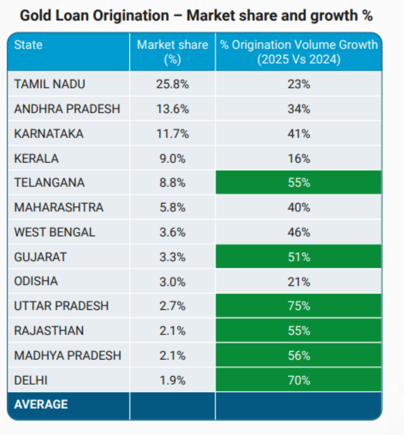
Source: Transunion CIBIL
Larger loans are becoming more common as gold values rise. The share of sourcing from ticket sizes above ₹2.5 lakh increased from 13% in 2022 to 20% in 2025, as borrowers were able to raise more against the same quantity of gold. NBFCs captured a growing part of this activity: their share of originations increased from 44% to 51%, while their share by value rose from 26% to 38% between 2022 and 2025. The sharper increase by value points to a stronger NBFC presence in higher-ticket loans.
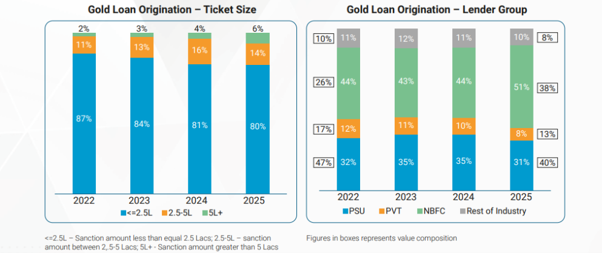
Source: Transunion CIBIL Report Dated April 2026
Who gains when gold becomes credit?
Small businesses are among the most direct beneficiaries. A gold loan can provide working capital at short notice and help keep cash available during a production or trading cycle. Among commercial borrowers who closed a business loan, 17% subsequently took a gold loan, compared with 12% who took a personal loan and 11% who took another business loan.
Source: Motilal Oswal Financial Services Gold Loan Report: Sep 2026 Is the Gold-Loan Map Beginning to Change?
Microfinance customers are also using gold-backed credit. Among MFI customers who accessed another retail-credit product, gold loans had the largest share at 18%. The average gold loan was about ₹1.9 lakh, roughly three times the ₹60,000 average ticket size for a microfinance loan.
For some personal-loan borrowers, gold loans offer a route from unsecured to secured credit. Among customers holding both products, outstanding personal-loan balances have moderated, particularly in the subprime segment. The lower cost can help, although pledging jewellery does not reduce the borrower’s responsibility to repay.
Lenders benefit in different ways. Public sector banks can use their branch reach and deposit franchises, while specialist NBFCs can spread branch costs across an established customer base. Repeat customers lower acquisition costs. The trade-off is that stronger competition may compress margins even as portfolios expand.
The growing demand for gold loans is visible in their share of retail credit sourcing, which rose from 20% in FY24 to 30% in FY25 and 41% in FY26. Behind this increase are clear benefits for borrowers and lenders alike.
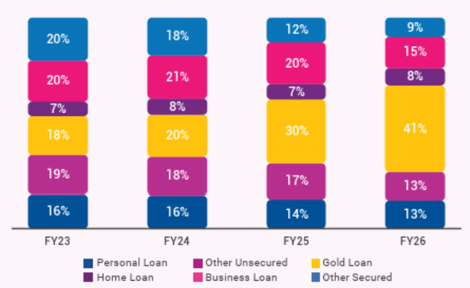
Source: Experian Report
What Do the New RBI Rules Change?
The Reserve Bank of India’s harmonized gold-loan framework took effect on 1 April 2026. It applies across regulated lenders, including banks and NBFCs, and introduces a common operating structure for the market.
The framework uses tiered loan-to-value limits for consumption loans: 85% for loans up to ₹2.5 lakh, 80% for loans between ₹2.5 lakh and ₹5 lakh, and 75% for loans above ₹5 lakh. For bullet loans, the LTV calculation must include the total repayment obligation, including accrued interest and capitalized charges.
Consumption-purpose bullet loans are limited to 12 months, and every renewal requires a fresh credit assessment. Lenders must assess repayment capacity, match repayment structures to the loan purpose, verify ownership of pledged gold and follow standardized valuation and custody controls.
The framework also sets expectations for auctions and the release of pledged gold. Ornaments must be returned within seven working days of loan closure, with compensation payable for delay. The added checks may slow lending in the near term, particularly for gold-focused NBFCs, but they should improve transparency and risk management.
Source: Transunion CIBIL Report Dated April 2026
When Familiar Customers Drive Growth, What Should Lenders Watch?
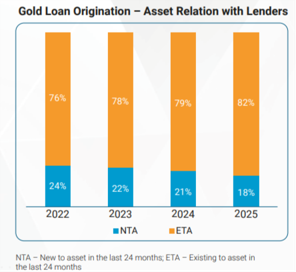
Source: Transunion CIBIL Report Dated April 2026
A growing proportion of originations come from Existing-to-Asset borrowers, particularly Existing-to-Gold-Loan customers. In other words, repeat borrowing is contributing more to growth than new customer additions. Repeating customers can make sourcing and disbursal more efficient, but too much dependence on the same borrower pool can raise refinancing and leverage risks. Repayment capacity and the balance between new and repeat customers will therefore need close attention.
Source: Transunion CIBIL Report Dated April 2026
From Momentum to Maturity: What Comes Next?
Gold loans solve a practical problem. They turn a household asset into usable credit, support working-capital needs and offer an alternative to higher-cost unsecured borrowing. The shift towards organised lenders, backed by a common regulatory framework, should also improve the borrowing experience.
The runway remains visible in the data: ₹18.6 trillion in outstanding loans, 50% growth in FY26, an estimated 28% CAGR through FY28 and only around 8% penetration of household gold holdings.
The opportunity lies in bringing more borrowers into formal credit without allowing collateral values to replace sound underwriting. Gold loans are likely to remain an important part of India’s retail credit system, but durable growth will depend on lenders assessing repayment capacity as carefully as they value the gold.
Vihag Mishra, Debt Fund Manager & Vice President at Kotak AMC adds - Gold loans have grown into one of India's largest retail credit segments, turning household gold into productive capital. Going forward lenders will need careful underwriting, sound valuation practices and strong collateral controls, especially if gold prices become more volatile. RBI's harmonised framework should help the market grow with stronger discipline and better transparency.
Disclaimers
The stocks/sectors mentioned do not constitute any kind of recommendation and are for information purpose only. Kotak Mahindra Mutual Fund may or may not hold position in the mentioned stock(s)/sector(s). These materials are not intended for distribution to or use by any person in any jurisdiction where such distribution would be contrary to local law or regulation. The distribution of this document in certain jurisdictions may be restricted or totally prohibited and accordingly, persons who come into possession of this document are required to inform themselves about, and to observe, any such restrictions
Mutual Fund investments are subject to market risks, read all scheme related documents carefully.