3 Sep 2026
SEBI Registered Name - Kotak Mahindra Mutual Fund | SEBI Registered Number - MF/038/98/1
Every morning at the Petrapole border crossing near Kolkata, a particular kind of traveller joins the queue: appointment letter in hand, a folder of scans, usually a relative or two. Mind it, they are not tourists. They are patients, crossing a border for treatment their own healthcare system could not give them in time.
Tourism to Treatment : Understanding Medical Value Travel
On a daily basis around 38,000 individuals are travelling the world in search of medical treatment. Everyday patients cross borders in search of something their domestic healthcare system cannot provide efficiently, which has simply been termed as Medical Tourism. (Source: Hospital CMQ)
This is what opens door to Medical Value Travel (MVT), which refers to the movement of patients across international borders to access healthcare services and wellness treatments. Unlike traditional medical tourism, MVT emphasises the overall value offered to patients through a combination of quality care, specialised expertise, affordability, timely access to treatment, and holistic wellness options such as ayurveda.
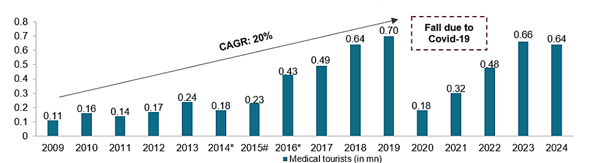
In 2025, around half a million nationals came to India specifically for medical treatment which is about 5.5% of the country's 9.15 million foreign arrivals, pointing out great significance (Source: PIB). A deeper study will in fact tell you that this doesn’t include patients from Nepal, Bhutan and Maldives, who travel to India under supportive visa clauses. Most come from the countries such as Bangladesh, Iraq and Uzbekistan (PIB).
However, of those 0.5 million patients, over 3.25 lakh came from Bangladesh alone, which rises concerns of moving towards a concentrated growth rather than a diversified one. (Source: PIB)
Growth In Medical Tourists - India
Source: Manipal Hospital – DRHP, Data as on Jan’25
Why Medical Tourism matters ?
India has emerged as one of the most significant destinations in this evolving global landscape (Source: PIB). Industry estimates place the medical tourism market at about USD 8.7 billion in 2025*, with projections of USD 16.2 billion by 2030. Its contributions to the GDP have also increased from 0.11% in 2020 to 0.18% in 2023 and 0.23% in 2025, indicating strong post-pandemic recovery, and highlighting the economic significance of the same (Source: Ministry of Tourism, India, 2023; Invest India, 2024; IMF World Economic Outlook, 2023; *Mint 2026).
India ranks 10th of the 46 destinations overall, but 6th on the quality of its facilities and services, indicating that given time, India has potential to go up the order. (Source: Medical Tourism Index)
More than Healthcare
The growth of medical tourism in India has not only catalysed expansion across pharmaceutical and wellness industries, but in terms of Medical Value Travel (MVT), healthcare experience starts at the airport and ends long after discharge. As a result, the economic impact of the same also multiplies and tends to affect all sectors positively, through factors such as post treatment stay, travel companions, hotel accommodation, food, transportation and tourist activities by the patients.
Stepping away from the financials, medical tourism has served as an important source for employment in India, supporting an estimated 167,000 direct and indirect jobs across hospitals, wellness services, and hospitality sectors, thereby contributing to both healthcare development and broader economic growth (FICCI, 2023; Confederation of Indian Industry Healthcare Panel Report).
Why India ?
1. Cost
As stated by the PIB, cost remains as a major draw for patients complimented by high quality treatment. The below chart out how the cost of common procedures in India compares with other leading medical tourism destinations. In addition to that India also offers great discounts ranging from 67% to 91% below global average costs, particularly in joint replacements and complex cardiac procedures, making it one of the most cost-effective destinations for medical tourism worldwide (Emkay Research, Industry Report).
Country-Wise Cost Of Treatment
| Treatment | US (Times) | Malaysia (Times) | Singapore (Times) | Thailand (Times) | India (Times) |
|---|---|---|---|---|---|
| Hip Replacement | 7.1 | 1.1 | 1.7 | 1.1 | 1 |
| Knee Replacement | 8.1 | 1.1 | 2.1 | 2 | 1 |
| Heart Bypass | 27.7 | 2.2 | 3.6 | 2.9 | 1 |
| Angioplasty | 17.3 | 1.6 | 3.9 | 1.1 | 1 |
| Heart Valve Replacement | 30.9 | 1.9 | 2.3 | 3.9 | 1 |
| Dental Implant | 2.8 | 1.7 | 1.5 | 3.6 | 1 |
Source: Industry, CRISIL Intelligence
2. Heal in India
The Heal in India initiative begun by the government in the year of 2022, and since has been a boon in forming India into global medical and wellness value travel hub. Its main objective is to smoothen the process and make India fit for medical tourism by providing international standards.
An end-to-end digital platform has been developed to streamline the process of a patient to make it really accessible and quick. There have been dedicated visa pathways, such as the AYUSH visa or the E-medical Visa to enable swift processing along with great immigration support to avoid hassle. India now has 250+ MVT facilitators and support 30+ languages to avoid any barriers. Furthermore, the program has led to the initiative to standardize the treatment through strict quality benchmarks by allowing treatment only in National Accreditation Board for Hospitals & Healthcare Providers (NABH) or the Joint Commission International (JCI) certified hospitals (India Healthcare Tourism). At home, NABH has accredited over 1,299 hospitals against more than 600 safety parameters strengthening the trust in the system. (Press Information Bureau, May 2026) .
3. AYUSH and Wellness Travel
While hospitals remain the core of medical tourism, we cannot sideline the importance of the wellness sector of this. AYUSH is an wellness initiative that was established in 2014, to take India to a global stage in Ayurveda, Yoga & Naturopathy, Unani, Siddha, and Homeopathy.
One of the most significant developments took place in January 2024, where we saw the inclusion of Ayurveda, Siddha and Unani in the ICD codes of the World Health Organization. ICD is the disease classification tool that allows insurance holders to acquire coverage for treatments that fall under it; Making these wellness treatments accessible to many more people and opening potential to a larger market. Additionally, 27 Indian insurers already offer 140-plus products covering AYUSH care. (Source: PIB)
4. Regional strength and Telemedicine Link
Now that India has broken the barrier of getting patients, its on a move to creating a more seamless and accessible healthcare system. Hence having regional medical hubs shall act as a catalyst for the same. The Union Budget for FY 2026-27 has proposed the creation of 5 hubs as a tool to have integrated facilities and a complete care process, acting as a singular location for end-to-end treatments. (Source: PIB)
This proposal is not just for the betterment for the patients, it goes onto acting upon one of India’s challenges of uneven distribution of healthcare infrastructure. Developing these hubs will help tourism grow further than the traditional locations such as Mumbai, Delhi, Chennai and Bengaluru. This opens doors to plenty of employment opportunities, improvement in infrastructure, and will also avoid crowding at traditional spots.
Living in the digital era makes us bound to touch upon about Telemedicine. Surely not as complex as it sounds, but it’s the practice of caring for patients remotely. It works for pre travel diagnosis, post treatment care, online consultation, or in some situation complete treatments. This can be observed in the government funded public welfare platform known as E-Sanjeevani which has already carried out 360 million consultations. This reflects how the integration of technology can make healthcare extremely scalable, inclusive and cost effective. (Source: Research Gate)
Medical Tourism : Opportunity or Trade-off ?
This is one of the most controversial topics that we tend to forget about, due to the upsides of medical tourism. Does catering to international patients strengthen a country’s healthcare system or does it just divert away the resources from domestic requirements?
We can consider it as a catalyst of growth as its encouraged the country to step up its standards, infrastructure, launch movements and invest in internationally accredited institutes. Reports by the NHA also suggest that out-of-pocket expenditure has fallen by 20.8% from 2013-14 to 43.4% as of 2023, signalling the use of insurances and strengthening the industry from a long-term perspective.
However, it is imperative to understand where India stands in terms of medical strength. India Times quotes that “India's poor bed-to-patient ratio, 1.4 beds per 1,000 people.” which is far from the WHO benchmark set at 3 beds per 1,000 people. In addition to that some policymakers and health care experts have raised concerns that large private hospital chains have benefited from medical tourism growth but questioned whether those benefits have sufficiently reached lower-income Indian patients.
Complementing the same, 75% of healthcare infrastructure in metro cities caters to only about one-third of the population, highlighting continuing access gaps outside major urban areas (Economic Times). So, should India be so inclined towards medical tourism, and medical visas, and streamlined process for international patients, while several regions in the country still lack adequate healthcare infrastructure and accredited hospitals?
Beyond the Numbers
India's rise as a medical tourism destination is not just a story of economic opportunity, but also of healthcare progress. As infrastructure, technology and accessibility continue to improve, the sector has the potential to create value for both patients and the broader economy. The real success, however, will be measured by how inclusively this growth strengthens healthcare outcomes across the country.
Mr. Dhananjay Tikariha, Fund Manager & Senior Vice President- Equity Research at Kotak Mahindra AMC adds "India's progress in medical tourism underscores the convergence of healthcare excellence, policy support and economic opportunity. As the sector scales, its impact extends well beyond healthcare, creating multiplier effects across tourism, hospitality, wellness and employment. With continued focus on quality standards, technology and infrastructure, India is well placed to strengthen its position as a leading global destination for medical value travel"
Disclaimers:
KMAMC is not guaranteeing/offering/communicating any indicative yield/returns on investments. The stocks/sectors mentioned do not constitute any kind of recommendation and are for information purpose only. Kotak Mahindra Mutual Fund may or may not hold position in the mentioned stock(s)/sector(s). Companies mentioned don’t constitute recommendation, brand name affiliation disclaimer & companies mentioned for illustrative purpose only. These materials are not intended for distribution to or use by any person in any jurisdiction where such distribution would be contrary to local law or regulation. The distribution of this document in certain jurisdictions may be restricted or totally prohibited and accordingly, persons who come into possession of this document are required to inform themselves about, and to observe, any such restrictions.
Mutual Fund investments are subject to market risks, read all scheme related documents carefully.