4 Mar 2026
Imagine planning a journey to a city you have never visited. You don’t know the roads, the traffic, or the shortcuts. Yet, with a quick glance at your phone, satellite navigation quietly guides you, recalculating routes in real time. This everyday convenience is powered by satellites orbiting thousands of kilometres above Earth; one of the many invisible ways space exploration shapes modern life.
What began as an audacious scientific experiment has evolved into a domain that underpins global security, economic growth, climate resilience, and international cooperation. Space today is no longer just about reaching the stars; it is about how humanity chooses to move forward together.
From First Orbits to Global Ambition
Spaceflight emerged in the 20th century on the back of theoretical breakthroughs by pioneers such as Konstantin Tsiolkovsky, Robert Goddard, and Hermann Oberth. Their ideas transformed rocketry from science fiction into engineering reality. Large‑scale rocket programmes, initially driven by military imperatives during World War II, laid the groundwork for what would become the Cold War era Space Race.
The Soviet Union achieved several historic firsts, launching Sputnik in 1957, sending the first human into orbit, and proving that space was no longer unreachable. The United States responded with an equally ambitious programme, culminating in the Apollo Moon landing of 1969. While framed as scientific triumphs, these missions were also powerful geopolitical statements, projecting technological superiority and national prestige on a global stage.
By the late 20th century, the space domain began to diversify. Europe, Japan, China, and later India developed independent capabilities, signalling a shift from a bipolar contest to a multipolar space environment. Space was no longer the preserve of two superpowers, it was becoming a shared, if competitive, arena.
Space Launch Statistics (1957-2026)
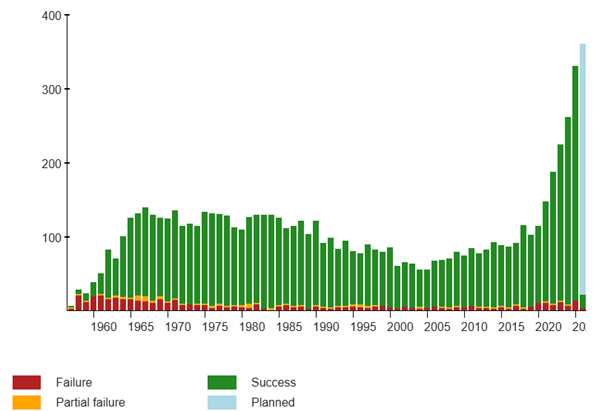
Source: Wikipedia
India’s Path: Space for Development and Scale
India’s space journey began in 1962 with the establishment of the Indian National Committee for Space Research (INCOSPAR). Early efforts focused on atmospheric studies from the Thumba Equatorial Rocket Launching Station near Thiruvananthapuram. The formation of the Indian Space Research Organisation (ISRO) in 1969 marked a turning point, embedding a clear philosophy: space technology should serve national development and societal needs.
Over the decades, ISRO built a robust launch ecosystem. The Polar Satellite Launch Vehicle (PSLV), Geosynchronous Satellite Launch Vehicle (GSLV), and LVM3 (Launch Vehicle Mark-3) have provided reliable access to space for Earth observation, communication, navigation, and exploration missions, supported by two operational launchpads at Sriharikota. The development of the Small Satellite Launch Vehicle (SSLV) reflects the global shift toward smaller, more frequent satellite deployments.
How Much a Space Mission Costs:
A defining feature of India’s programme has been cost efficiency. Nasa’s Maven orbiter had cost $582m and Russia’s Luna-25, which crashed on to the Moon’s surface two days before Chandrayaan-3’s landing, had cost $133m. While India spent $74m on the Mars orbiter Mangalyaan and $75m on last year’s historic Chandrayaan-3 – less than the $100m spent on a popular sci-fi space movie. Similarly, the PSLV‑C37 mission, which launched a total of 104 satellites in a single flight, set a world record at a fraction of global launch costs. India’s Mars Orbiter Mission (Mangalyaan), launched in 2013, became the least expensive Mars mission ever, demonstrating that deep‑space exploration need not be prohibitively expensive. By 2025, India had launched over 430* foreign satellites, with increasing private‑sector participation following space reforms announced in 2020 and the creation of IN‑SPACe (Indian National Space Promotion and Authorisation Centre) to regulate and promote non‑governmental activity.
Source: BBC news, *Source: pib.gov.in
India’s ambitions now extend to human spaceflight through the Gaganyaan programme and plans for a future Bharatiya Antariksha Station placing the country firmly within the next phase of global exploration.
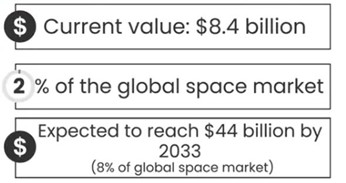
Source: Bhaskar English & ISRO (Indian Space Research Organization)
Space in Everyday Life
For most people, space exploration feels distant. Yet modern life is deeply dependent on space‑based systems. Satellites enable telecommunications, television broadcasting, navigation, financial transactions, disaster response, precision agriculture, and climate monitoring.
Earth observation data supports flood forecasting, cyclone tracking, drought assessment, deforestation monitoring, and urban planning. Navigation satellites underpin aviation, shipping, road transport, and emergency services. Medical technologies, advanced materials, robotics, and even food production techniques trace their origins to space research and its spin‑offs.
Space, in effect, has become a form of critical infrastructure which is largely invisible, but indispensable.
Space as a Strategic Domain
As reliance on satellites increased, so did their strategic importance. Space assets now underpin military communications, intelligence, surveillance, reconnaissance, navigation, and command‑and‑control systems. Many modern armed forces officially recognise space as an operational domain alongside land, sea, air, and cyber.
This dependence has introduced vulnerabilities. Satellites are expensive, difficult to repair, and exposed to interference from debris, cyber threats, jamming, or direct attack. At the same time, falling launch costs and commercial innovation have led to a rapid increase in the number of operational satellites, especially in low‑Earth orbit (LEO).
The combination of congestion, competition, and limited regulation raises concerns about orbital debris, collision risks, and long‑term sustainability. Space today mirrors terrestrial geopolitics: power projection, signalling, and strategic rivalry now extend beyond Earth’s atmosphere.
Growth, Opportunity, and Responsibility
Alongside strategic concerns, space has become a major economic domain. Lower launch costs and the rise of commercial players have potentially expanded access to space for governments, private companies, and emerging space nations. Satellite services support transport, energy, communications, banking, disaster management, and climate resilience especially as societies confront more frequent extreme environmental events.
At the same time, this rapid expansion has intensified pressure on the orbital environment. Ensuring the sustainability of space activities now requires coordination, responsible behaviour, and shared norms. Cooperation, in this context, is not idealistic it is essential.
From Competition to Coordination: The Role of ISECG
As space becomes more crowded, strategic, and expensive, a simple truth has emerged: no single country can sustainably explore space alone. Launch systems, deep‑space communications, science instruments, surface operations, and human exploration all demand different strengths. This is where coordination not just cooperation becomes critical.
The International Space Exploration Coordination Group (ISECG) was created to address this reality. Rather than acting as a governing body, ISECG functions as a strategic alignment forum, bringing together space agencies to share plans, identify overlaps, and chart a long‑term exploration pathway that is technically realistic and economically sustainable.
A useful way to think about ISECG is as an international potluck. Every country brings what it does best to the table.
Geography, history, and industrial capability shape what each nation can contribute. Countries located close to the equator enjoy a natural advantage in launching satellites, benefiting from Earth’s rotational velocity. Others contribute through infrastructure, science, technology, or specialised research environments.
Australia illustrates this clearly. Thanks to its geographic location, large landmass, and relatively radio‑quiet skies, Australia has supported deep‑space communications for human and robotic missions for over six decades. Its natural environment also provides valuable lunar and Martian surface analogues. Under the Australian Space Agency’s Moon to Mars Initiative, Australia is contributing advanced surface mobility capabilities, including the Australian‑designed lunar rover Roo‑ver, planned for launch on a future NASA mission.
Brazil’s contribution highlights a different strength. Long‑duration human exploration will depend on the ability to grow food beyond Earth. Recognising this, the Brazilian Space Agency (AEB) and the Brazilian Agricultural Research Corporation (EMBRAPA) established the Brazilian Space Farming Research Network to develop crops capable of surviving high radiation, low gravity, and soil‑less environments. These innovations will also drive agricultural productivity on Earth.
Mexico contributes at the intersection of robotics and autonomy. The Mexican Space Agency’s Colmena project is a series of lunar missions designed to develop swarm microrobotics for prospecting and resource exploration on the Moon and asteroids.
Norway shows how specialised scientific expertise becomes indispensable. Norwegian instruments have already operated on Mars, most notably the Rimfax ground‑penetrating radar aboard NASA’s Perseverance rover. Norway has also advanced life‑support and environmental monitoring technologies, such as the ANITA air analyser aboard the International Space Station.
None of these contributions replace one another, and together, they form a system.
Source: ISECG (International Space Exploration Coordination Group)
A Shared Roadmap to the Moon and Mars
ISECG’s most important output is the Global Exploration Roadmap, which aligns national plans into a shared scenario extending through 2050. The roadmap outlines a step‑by‑step progression: sustained activity in low‑Earth orbit, expanded exploration on and around the Moon, and Mars as the long‑term horizon goal.
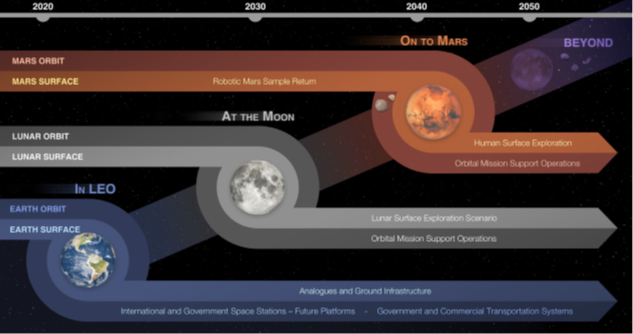
Crucially, the roadmap is non‑binding. Agencies retain full sovereignty over their programmes. What ISECG provides is something subtler but powerful: visibility into each other’s plans, early identification of partnership opportunities, and technical coherence across missions, systems, and timelines. This reduces duplication, spreads risk and allows emerging space agencies to participate meaningfully without building every capability from scratch.
The Moon has emerged as the near‑term focus because it is close enough to test technologies under real deep‑space conditions while still allowing rescue, resupply, and rapid learning. Capabilities such as surface power, resource utilisation, habitation, mobility, and life support can be demonstrated on the Moon before being relied upon for Mars.
Mars, by contrast, remains the horizon goal scientifically compelling, technically demanding, and operationally complex. The roadmap treats Mars not as a standalone destination, but as the logical extension of capabilities proven step by step closer to Earth.
A Quiet but Optimistic Outlook
Space exploration today sits at an unusual intersection. It is more competitive, more congested, and more geopolitically sensitive than ever before. At the same time, it is also more interconnected.
ISECG does not eliminate rivalry in space, nor does it pretend that national interests have disappeared. What it offers is a practical framework for alignment—one that recognises that exploration at planetary scale is only possible when countries contribute their strengths rather than duplicate each other’s weaknesses.
Space has always reflected life on Earth. Increasingly, it also reflects humanity’s ability to plan beyond short‑term competition. The next giant leaps on the Moon, Mars, and beyond are unlikely to carry a single flag, they will carry many.
Disclaimers:
The stocks/sectors mentioned do not constitute any kind of recommendation and are for information purpose only. Kotak Mahindra Mutual Fund may or may not hold position in the mentioned stock(s)/sector(s). These materials are not intended for distribution to or use by any person in any jurisdiction where such distribution would be contrary to local law or regulation. The distribution of this document in certain jurisdictions may be restricted or totally prohibited and accordingly, persons who come into possession of this document are required to inform themselves about, and to observe, any such restrictions.
Mutual Fund investments are subject to market risks, read all scheme related documents carefully.