10 Sep 2026
SEBI Registered Name - Kotak Mahindra Mutual Fund
SEBI Registered Number - MF/038/98/1
“A generation ago, people-built collections of CDs, DVDs, software discs, and books. Today, those collections fit into a smartphone with Subscriptions”
For decades, ownership was the ultimate expression of value. Today, that mindset is changing. Consumers increasingly prefer access over ownership, whether for music, movies, software, transportation or everyday services. This shift has fuelled the rise of the Subscription Economy, where recurring access replaces one-time purchases. What started with newspaper and magazine subscriptions has evolved into a global business model spanning entertainment, technology, retail, healthcare and mobility, fundamentally changing how consumers engage with products and services
The rise of digital platforms, seamless payment systems and on-demand services has accelerated this shift. Rather than accumulating products, consumers increasingly prioritize:
- Convenience over possession
- Flexibility over commitment
- Experiences over accumulation
- Continuous access over one-time purchases
Streaming platforms such as Netflix and Spotify, cloud-based software providers like Adobe and Microsoft, and membership services such as Amazon Prime have demonstrated that consumers are often willing to pay recurring fees in exchange for instant, hassle-free access.
The result is a fundamental redefinition of value. Instead of asking,"What do I own?" consumers are increasingly asking,"What can I access?"
A Massive Economic Opportunity
What may appear as a lifestyle shift has evolved into a significant economic trend.
The Global Subscription Economy market size has reached to $623.61 billion in 2025. Expected to grow to $1,441.65 billion in 2030 at a compound annual growth rate (CAGR) of 18.2%
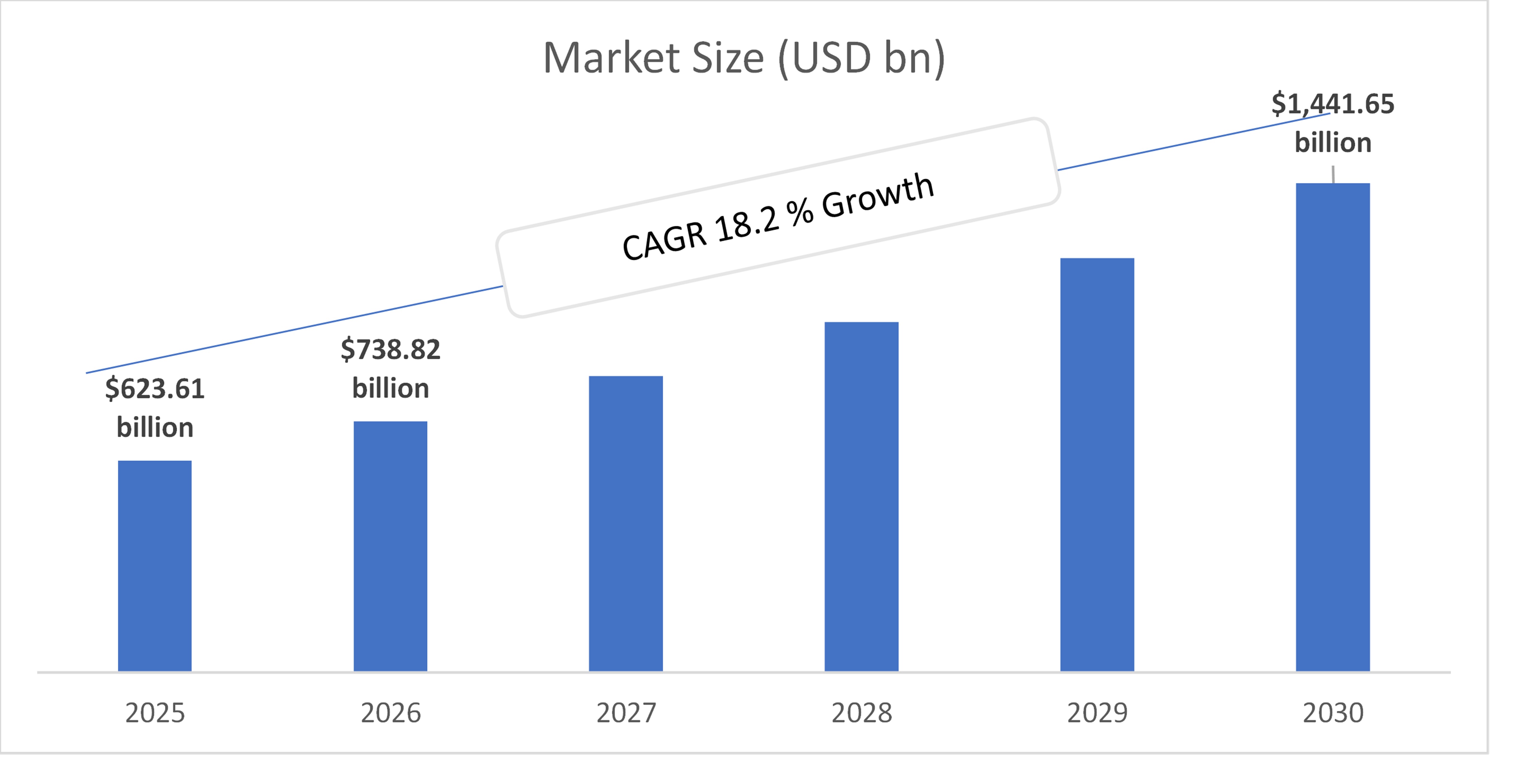
Source: The Business Research Company Report dated July 2026
This growth is being driven by several factors:
- Increasing digital adoption
- Improved online payment infrastructure
- Greater consumer comfort with recurring payments
- Businesses seeking predictable revenue streams
- Growing preference for personalized services
Why Businesses Appreciate Subscriptions:
The traditional model of selling products often relied on repeatedly finding new customers. Subscription models, in contrast, focus on building long-term relationships.
For businesses, recurring subscriptions offer several advantages:
- Predictable Revenue
- Stronger Customer Relationships
- Higher Customer Lifetime Value
Recent industry data suggests that subscription businesses are increasingly focusing on retaining customers rather than solely acquiring new ones. Recurly's 2026 State of Subscriptions Report, based on data from 76 million subscribers, found that 25% of new sign-ups came from former subscribers returning to a service, highlighting the growing importance of customer re-engagement. The report also noted a 337% increase in subscription pauses, as companies increasingly offer flexible alternatives to cancellation in an effort to improve retention
Source: Recurly’s Report Dated July 2026
The Companies That Built the Subscription Economy
Perhaps the strongest evidence of the Subscription Economy's success lies in the growth of companies that embraced recurring revenue models early.
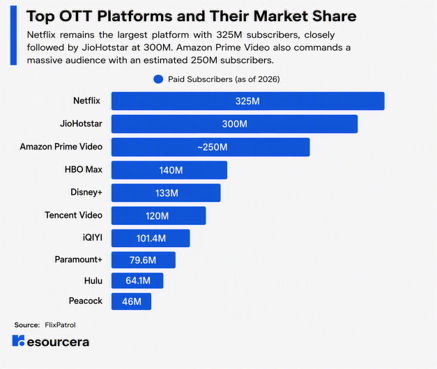
Netflix, which began as a DVD rental service, has evolved into one of the world's largest entertainment platforms with over 325 million paid subscribers globally. Its revenue grew to approximately USD 45 billion in 2025, reflecting the scale that a subscription-led model can achieve
Source: CNBC News dated Jan 20, 2026
Spotify transformed how people consume music. Instead of purchasing individual songs or albums, users gained access to millions of tracks for a monthly fee. By the end of 2025, Spotify had reached around 290 million Premium subscribers and over 750 million monthly active users, while revenue continued to grow at double-digit rates.
Adobe made a bold shift when it moved from selling one-time software licenses to the Creative Cloud subscription model. Today, Adobe generates more than USD 25 billion of annual recurring revenue (ARR) across its subscription-driven businesses, demonstrating the power of recurring customer relationships over traditional product sales.
Source:www.analystlens.com
-
A Bigger Shift Than Entertainment
The subscription model is no longer limited to movies, music or software.
Today consumers subscribe to:
- Video streaming (Netflix, Disney+, JioHotstar)
- Music streaming (Spotify, Apple Music)
- Productivity tools (Microsoft 365, Adobe Creative Cloud)
- E-commerce memberships (Amazon Prime)
- Fitness platforms
- Cloud storage services
- Education and learning platforms
What started as a business model has evolved into a consumer mindset. People are increasingly willing to pay for ongoing access and convenience rather than make large upfront purchases.
India’s Subscription Economy:
India is witnessing a significant shift in consumption—from one-time purchases to recurring access. The subscription economy, once largely associated with OTT platforms and software, is now becoming a broader consumption trend spanning entertainment, digital services, education, fitness, commerce and more.
Digital media provides perhaps the clearest evidence of this structural shift. According to the FICCI-EY 2026 report, India's digital subscription revenues reached ₹16,300 crore in 2025, rising 60% from ₹10,200 crore in 2024. Video remained the dominant category, with subscription revenues reaching ₹14,800 crore, up 61% in a year.
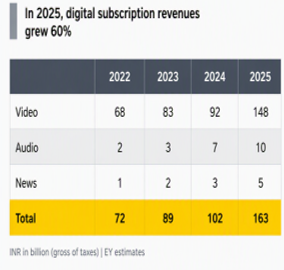
INR in billion (gross of taxes) | EY estimates EY Estimates | Year-end numbers excluding event based spikes
Source: Source: FICCI-EY-Report-March-2026
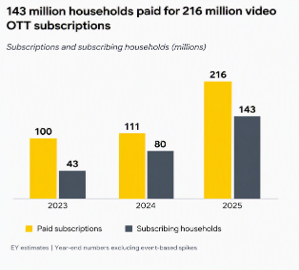
The number of paid video subscriptions also almost doubled—from 111 million in 2024 to 216 million in 2025. More strikingly, the number of subscribing households increased from 80 million to 143 million. Bundling has been an important catalyst: around 71% of video subscriptions were estimated to be bundled, highlighting how telecom, e-commerce and content ecosystems are increasingly converging.
Source: https://creativefirst.film/wp-content/uploads/2026/03/FICCI-EY-Report-March-2026.pdf?
For investors, this makes the subscription economy an important structural theme at the intersection of digitalisation, rising consumption and changing consumer behaviour. India may still be in the early stages of this transition, but the direction is increasingly visible.
The Subscription Economy Is Evolving
The next phase of the subscription economy is not simply about charging monthly fees.
Leading companies are moving toward hybrid monetization models that combine subscriptions, usage-based pricing and one-time purchases. Research suggests businesses using multiple revenue models are often growing faster than those relying on a single approach.
Artificial intelligence is also beginning to influence the sector. Subscription providers increasingly use AI to improve personalization, recommend content, manage billing and enhance customer experiences. Consumer acceptance of AI-driven subscription management is also gradually increasing.
This suggests the future may not belong to pure subscription models alone, but to flexible models that allow customers to choose how they consume products and services.
But There Are Challenges:
Despite its growth, the subscription economy is not without drawbacks.
As consumers accumulate subscriptions across entertainment, software, fitness, shopping and digital services, concerns around subscription fatigue have emerged. Many consumers are becoming more selective about which subscriptions provide sufficient value.
Price increases are also a major reason for cancellations. Industry surveys show that rising costs remain among the most frequently cited reasons for ending subscriptions.
For businesses, this creates an important challenge: they must continuously justify their existence by delivering value month after month.
Unlike a one-time purchase, subscriptions require companies to earn customer loyalty repeatedly.
Conclusion
The subscription economy reflects a broader transformation in how people define value. Ownership is no longer the only path to convenience, utility or enjoyment. Increasingly, consumers are choosing flexibility, personalization and access.
Whether it is music, movies, software, transportation or even everyday services, the trend is clear: we may own fewer things than previous generations, but we have access to more than ever before.
And as technology continues to make access easier, the subscription economy is likely to remain one of the defining business and consumer trends of the digital age.
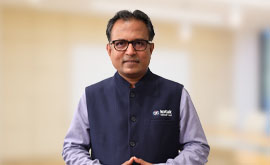
Mr. Arjun Khanna, Fund Manager & Senior VP- Equity Research at Kotak Mahindra AMC adds, “The subscription economy is more than a business model; it represents a structural shift in how consumers perceive value, moving from ownership of products to access of experiences. For investors, it highlights the growing importance of recurring revenue, customer engagement, and digital ecosystems. Its enduring appeal lies in aligning consumer convenience with business visibility through recurring relationships rather than one-time transactions. Companies that successfully monetize this shift are building some of the most durable business models of our time.”
Disclaimers
The stocks/sectors mentioned do not constitute any kind of recommendation and are for information purpose only. Kotak Mahindra Mutual Fund may or may not hold position in the mentioned stock(s)/sector(s). These materials are not intended for distribution to or use by any person in any jurisdiction where such distribution would be contrary to local law or regulation. The distribution of this document in certain jurisdictions may be restricted or totally prohibited and accordingly, persons who come into possession of this document are required to inform themselves about, and to observe, any such restrictions. Use of the company/ brand names does not imply any affiliation with or endorsement by them or any of its holding companies, subsidiaries or affiliates and are used for illustrative purpose only.
Mutual Fund investments are subject to market risks, read all scheme related documents carefully.