12 Nov 2026
Buying an electric vehicle is only the beginning of its economic life. Once an electric scooter, car, bus or delivery vehicle is on the road, it needs charging access, battery health monitoring, diagnostics, repairs and eventually, a responsible route for reuse or recycling. That is why the opportunity around electric mobility is wider than vehicle manufacturing alone.
India's electric-vehicle market is now large enough for this post-sale ecosystem to matter. Official data shows sales rising from around 50,000 vehicles in 2016 to 23 lakhs in 2025, a roughly 46-fold increase. Each vehicle added to the installed base creates a longer-term need for services, software and infrastructure that helps keep it moving.
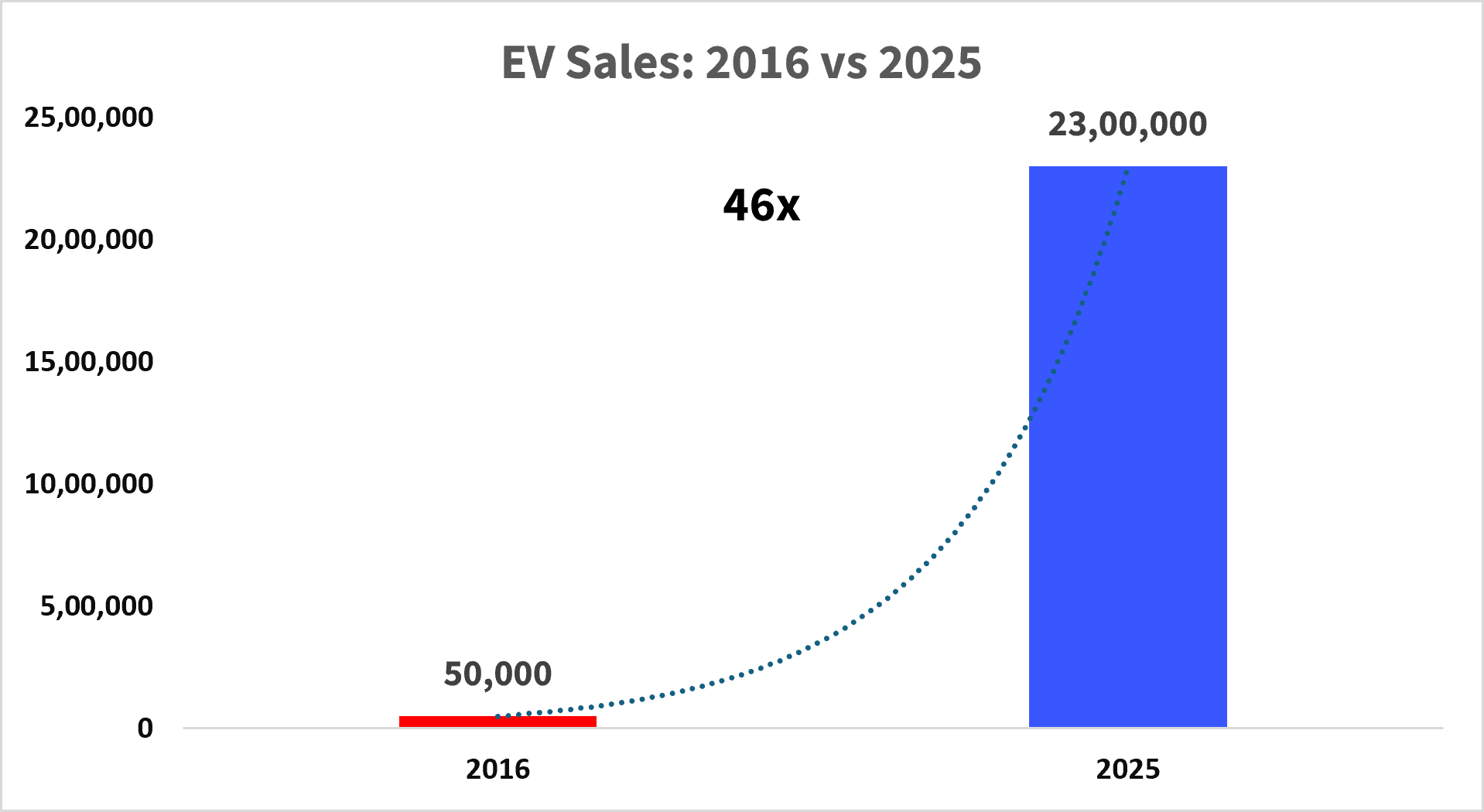
Source: Press Information Bureau, Government of India, Roads Reimagined: The Rise of India's Electric Vehicles Ecosystem, August 2026
https://www.pib.gov.in/PressNoteDetails.aspx?ModuleId=3&NoteId=159436&lang=1®=+3
The right way to view this is not as one aftermarket, but as a connected post-sale ecosystem. Some parts resemble the traditional automotive aftermarket; others, such as charging networks, battery analytics and high-voltage diagnostics, are specific to electric mobility.
Why the installed base matters
The shift from Internal Combustion Engine (ICE) to EVs is especially relevant in India's two-wheeler and three-wheeler segments, where EV adoption has broadened the addressable base of vehicles in use. As that base grows, the recurring needs around charging, maintenance, battery life and end-of-life handling become more visible.
Electric vehicles do have fewer mechanical moving parts than ICE vehicles, but they are not maintenance-free. The service mix changes. Battery checks, motor and inverter diagnostics, braking systems, thermal management and software updates require different tools, training and safety processes. That creates scope for OEM (Original Equipment Manufacturer) workshops, specialised independent service centers, diagnostic-equipment providers and component suppliers.
Charging is another important part of the ecosystem. Public charging stations make electric mobility more practical for individual users, fleets, and commercial operators. According to a Press Information Bureau note published in August 2026, India had 52,718 public charging stations as of July 2026, including 16,561 fast-charging stations. Beyond the equipment itself, the opportunity includes site selection, network operations, payments, energy management and utilisation analytics.
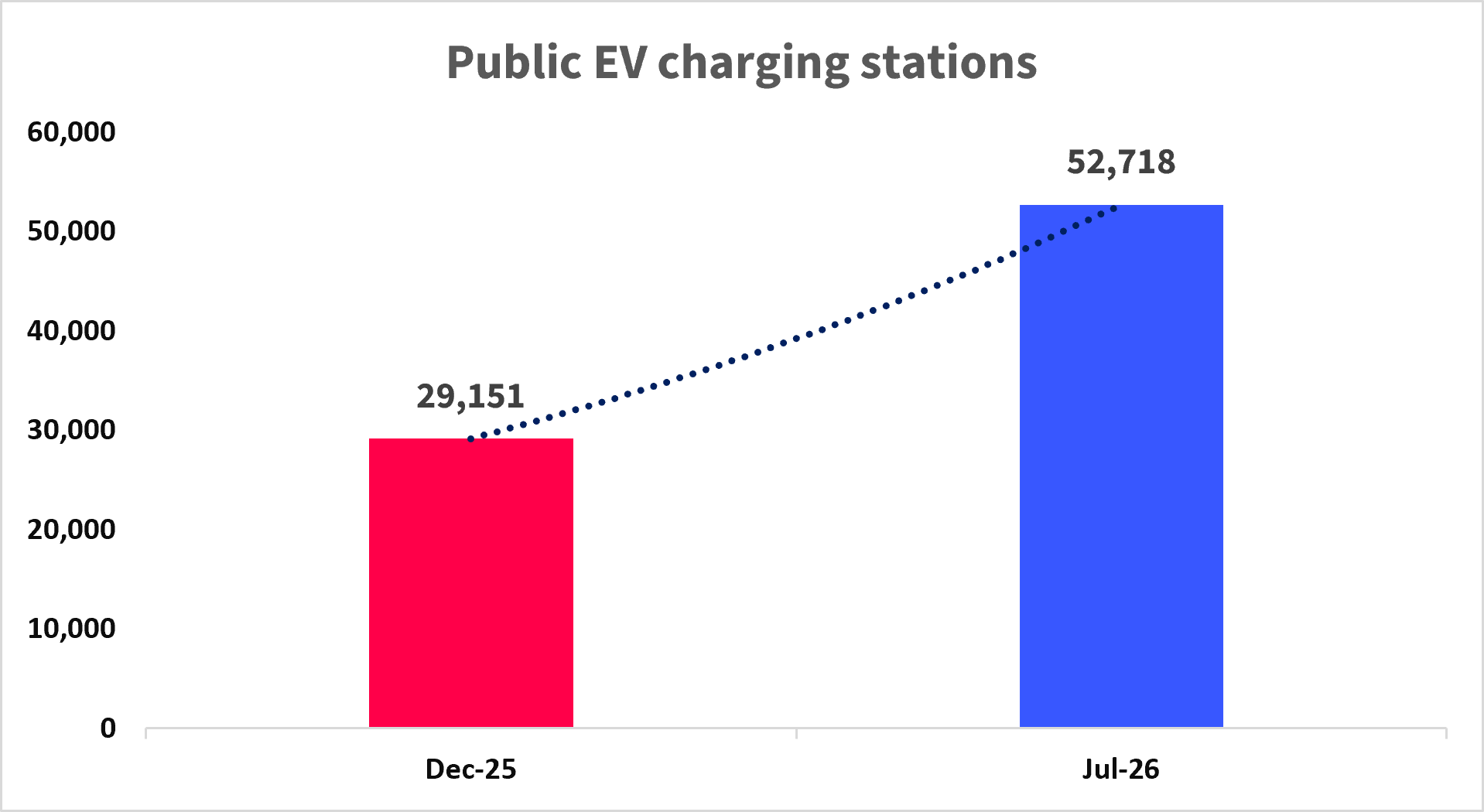
Source: Ministry of Heavy Industries, Government of India, December 2025 and July 2026 reported figures
https://www.pib.gov.in/PressReleasePage.aspx?PRID=2287125®=48&lang=2
The Journey of an Electric Vehicle
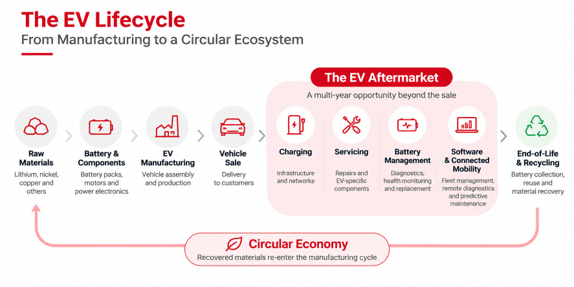
Understanding the EV Aftermarket: What Happens After the Sale?
Unlike the conventional automotive ecosystem, where servicing is largely associated with engines, lubricants and mechanical components, the EV aftermarket places greater emphasis on batteries, electrical systems, software and charging infrastructure.
Consider the difference:
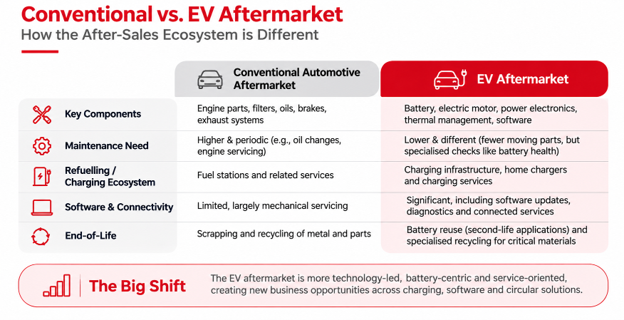
Source: ACMA 2023, NITI Aayog, BIS Research “The Electric Drive Forward: Exploring the Future of Electric Vehicle Ecosystems and Battery Innovation”
Battery value extends beyond the first sale
The battery is central to an EV's performance, driving range and cost. It is also a source of recurring engagement throughout the vehicle's life. Battery-health monitoring, warranty support, refurbishment and battery-as-a-service models can help lower the upfront ownership burden while creating recurring service relationships.
There is also a circular-economy angle. A battery that is no longer suited to automotive use may retain enough capacity for stationary storage, depending on its condition and chemistry. It can then be repurposed before it is finally recycled for material recovery.
Rocky Mountain Institute estimates that battery circularity in India could represent a market opportunity of Rs. 75,500 crore or about US$9 billion. This includes value from battery reuse, second-life applications and recycling. The opportunity is meaningful, but it will depend on safe collection systems, reliable diagnostics, viable economics and consistent quality standards.
India's Battery Waste Management Rules, 2022 apply the Extended Producer Responsibility (EPR) principle to all battery types, including EV batteries. Producers, including importers, are responsible for the collection and recycling or refurbishment of the batteries they place on the market, and producers, recyclers and refurbishers must register on a central portal run by the Central Pollution Control Board. Later amendments have added recycled-content requirements and digital traceability, making collection, recycling and traceability central to the battery value chain.
Source: Ministry of Environment, Forest and Climate Change, Government of India, Battery Waste Management Rules, 2022 (notified August 2022) PIB press release, 25 August 2022; CPCB EPR Portal for Battery Waste Management
One early example is Ather Energy's July 2026 partnership with LICO Materials. Under the arrangement, end-of-life batteries routed through Ather's service-centre network are assessed for second-life use or material recovery, with traceability across collection and processing. It shows how OEMs may use existing service networks to support reverse logistics, although the model's commercial scalability will still need to be established. However, the commercial scalability of this model will depend on collection volumes, recovery economics and the ability to establish efficient reverse-logistics networks.
Source: https://rmi.org/resources/charting-a-circular-battery-future-in-india/, https://www.autocarindia.com/bike-news/ather-announces-partnership-for-end-of-life-ev-battery-recycling-440209
The component and software layer
The EV transition also changes the mix of components that matter. Motors, power electronics, thermal-management systems, chargers and control units take on a larger role than they do in a conventional vehicle. An IEEFA and JMK Research report estimates that traction motors, motor controllers, power electronics, thermal-management systems and vehicle-control electronics, excluding batteries, account for about 25-30% of vehicle value.
| EV component | Approximate share of vehicle value |
|---|---|
| Battery pack | 35–45% |
| Chassis and structural components | 15–20% |
| Interior, technology and infotainment | 10–15% |
| Motor and drivetrain | 10–12% |
| Power electronics | 5–8% |
| Thermal management and other systems | 5–10% |
Source: JMK Research, reproduced in IEEFA's June 2026 report https://ieefa.org/resources/beyond-battery-packs-localisation-ev-component-manufacturing-india
This creates manufacturing and localisation opportunities, but it is not a simple story of domestic assembly. The same research highlights continued dependencies on semiconductors, rare-earth magnets and specialised materials. For businesses, the relevant question is not only whether a component is assembled in India, but also how much technology, supply-chain control and value addition sit within the country.
Software is equally important. Connected vehicles and fleet platforms can help operators monitor battery health, plan charging, flag faults and schedule maintenance before a vehicle is taken out of service. These capabilities may be particularly useful for delivery, logistics and shared-mobility fleets, where vehicle downtime directly affects economics.
An opportunity, not an automatic outcome
Post-sale economics also vary by vehicle category and use case. A charger on a busy commercial route faces different utilisation, maintenance and revenue dynamics from one in a residential setting. Similarly, a fleet operator with predictable routes may derive more value from connected monitoring and planned charging than an individual owner. Assessing demand therefore means looking beyond installed assets to utilisation, uptime and the cost of maintaining them over their useful lives.
Standards and interoperability matter as well. Evolving battery chemistries, charging protocols and vehicle software may require repeated investment in tools, training and upgrades. Regulation can improve safety and traceability, but it can also add compliance costs and lengthen implementation timelines. The opportunity is likely to develop unevenly across regions, use cases and business models and not all growth may translate into sustainable returns.
A growing EV ecosystem will not necessarily produce profitable businesses across every part of the value chain. Charging networks need sufficient utilisation. Component manufacturers need scale, quality control and dependable supply chains. Battery-recycling businesses need access to feedstock, sound processes and compliant collection networks. Technology providers must prove that their offerings improve over time or lower operating costs.
Looking beyond the vehicle
India's EV journey is no longer only about how many vehicles are sold in a year. It is also about the services and systems that support those vehicles through their working lives. Charging, diagnostics, components, connected software, battery reuse and recycling will all have a role to play.
Selling an electric vehicle may be the first transaction. Supporting it reliably, safely and efficiently over time could create more durable opportunities.
Nalin Bhatt, Senior Vice President & Fund Manager, Kotak Mahindra Asset Management Co. Ltd adds “Next phase of India's EV journey will be shaped not only by adoption, but by the strength of the ecosystem that supports it. Charging infrastructure, Battery Management Service (BMS), battery circularity and specialised services are likely to become critical enablers of sustainable growth and offer opportunity to capture value for vendors/OEMs.”
Disclaimers
The stocks/sectors mentioned do not constitute any kind of recommendation and are for information purpose only. Kotak Mahindra Mutual Fund may or may not hold position in the mentioned stock(s)/sector(s). These materials are not intended for distribution to or use by any person in any jurisdiction where such distribution would be contrary to local law or regulation. The distribution of this document in certain jurisdictions may be restricted or totally prohibited and accordingly, persons who come into possession of this document are required to inform themselves about, and to observe, any such restrictions. Use of the company/ brand names does not imply any affiliation with or endorsement by them or any of its holding companies, subsidiaries or affiliates and are used for illustrative purpose only.
Mutual Fund investments are subject to market risks, read all scheme related documents carefully.