19 Aug 2026
Large cap funds are a category of equity mutual funds that invest predominantly in the equity and equity related instruments of large cap companies. As defined under SEBI's mutual fund categorisation framework, these schemes are required to invest at least 80% of their total assets in large cap companies. Understanding the large cap fund meaning, investment mandate, portfolio characteristics, taxation and risk considerations can help investors evaluate the role of large cap funds within a long term investment portfolio.
Key Takeaways
- A large cap fund is an open ended equity mutual fund that invests at least 80% of its total assets in the equity and equity related instruments of large cap companies, in accordance with SEBI's categorisation norms.
- Large cap companies are the top 100 listed companies by full market capitalisation, as classified by SEBI.
- Large cap funds generally exhibit relatively lower volatility than mid cap and small cap funds, but remain subject to market risk.
- These funds may be considered by investors seeking long term equity exposure, typically with an investment horizon of five years or more.
- Investors can invest through a Systematic Investment Plan (SIP) or a lump sum, depending on their financial goals and investment strategy.
SEBI's Market Capitalisation Framework
SEBI classifies listed companies into large cap, mid cap and small cap categories based on their full market capitalisation. This framework provides a uniform basis for categorising equity mutual fund schemes and helps investors understand the investment universe of each category*.
| Category | SEBI Classification |
|---|---|
| Large Cap Companies | 1st to 100th company by full market capitalisation |
| Mid Cap Companies | 101st to 250th company by full market capitalisation |
| Small Cap Companies | 251st company onwards by full market capitalisation |
*As per Para 7.2 of SEBI Master Circular No. HO/24/13/11(1)2026-IMD-POD-1/I/7602/2026 dated March 20, 2026.
What is a Large Cap Fund?
A large cap fund is an open ended equity mutual fund that predominantly invests in the shares of India's largest listed companies. As per SEBI regulations, the scheme must invest at least 80% of its total assets in the equity and equity related instruments of large cap companies, which are the top 100 companies by full market capitalisation.
How Do Large Cap Funds Work?
A large cap fund invests predominantly in the equity and equity related instruments of large cap companies in accordance with its investment objective. The fund manager builds a diversified portfolio by selecting companies across sectors and actively monitors the portfolio to keep it aligned with the scheme's strategy and regulatory requirements.
When you invest in a large cap mutual fund, you are allotted units of the scheme instead of owning individual stocks directly. The value of these units is reflected in the scheme's Net Asset Value (NAV), which is declared on every business day. The portfolio may be rebalanced periodically based on changes in market conditions, company fundamentals or investment opportunities. Investors can invest in large cap funds through a Systematic Investment Plan (SIP) or a lump sum, depending on their financial goals, investment horizon and risk appetite.
Features of Large Cap Funds
Large cap funds have certain structural characteristics that define how they are managed and invested.
1) Invest Primarily in Large Cap Companies
As per SEBI's categorisation norms, large cap funds invest predominantly in the equity and equity related instruments of large cap companies, providing exposure to India's largest listed businesses.
2) Minimum 80% Allocation to Large Cap Stocks
A large cap fund is required to invest at least 80% of its total assets in large cap companies, ensuring that the portfolio remains aligned with the scheme's investment mandate.
3) Diversified Equity Portfolio
The portfolio is typically diversified across companies and sectors, helping reduce concentration risk while maintaining exposure to the large cap universe.
4) Active Portfolio Management
The portfolio is managed by a fund manager who selects securities, monitors investments and rebalances the portfolio in line with the scheme's investment objective.
5) Daily NAV Declaration
Like other open ended mutual funds, the scheme's Net Asset Value (NAV) is declared on every business day.
6) Multiple Investment Options
Investors can invest through a Systematic Investment Plan (SIP) or a lump sum investment, depending on their preference.
Benefits of Investing in Large Cap Funds
Large cap funds may offer several potential benefits to investors, depending on their financial goals and investment horizon.
1) Exposure to Established Companies
These funds invest in some of India's largest listed companies, which generally have established businesses and a significant market presence.
2) Relatively Lower Volatility
Compared with mid cap and small cap funds, large cap funds have historically experienced relatively lower volatility, although they remain subject to market risk.
3) Diversification Through a Single Investment
A single investment provides exposure to a portfolio of companies across different sectors, reducing the need to invest in multiple individual stocks.
4) Professional Fund Management
Investment decisions are made by experienced fund managers who continuously monitor the portfolio and make changes in line with the scheme's investment strategy.
5) Suitable for Long Term Investing
Large cap funds can form part of a long term investment portfolio for investors seeking equity exposure. However, returns are market linked and not guaranteed.
6) Flexible Investment Approach
Investors have the flexibility to invest through a SIP for regular investing or make a lump sum investment based on their financial plan.
Risks in Large Cap Funds
Like all equity mutual funds, large cap funds are subject to market risks. Although they invest primarily in established companies, their performance depends on the movement of the underlying equity securities. Investors should consider the following risks before investing.
1) Market Risk
The prices of large cap stocks may fluctuate due to changes in market sentiment, economic conditions, interest rates or global events. These movements can affect the scheme's Net Asset Value (NAV).
2) Company Specific Risk
The performance of individual companies may be influenced by factors such as financial performance, business outlook, industry developments or corporate actions. Such events may impact the overall performance of the fund.
3) Economic and Regulatory Risk
Macroeconomic factors such as inflation, monetary policy, fiscal policy, regulatory changes and geopolitical events may influence equity markets and affect the performance of large cap funds.
Large Cap vs Mid Cap vs Small Cap Funds
Large cap, mid cap and small cap funds all invest in equities, but they differ in terms of the companies they invest in and their risk return characteristics. Understanding these differences can help investors select a fund category that aligns with their financial goals, investment horizon and risk appetite.
| Particulars | Large Cap Funds | Mid Cap Funds | Small Cap Funds |
|---|---|---|---|
| SEBI Definition | Invest at least 80% of total assets in the equity and equity related instruments of large cap companies. | Invest at least 65% of total assets in the equity and equity related instruments of mid cap companies. | Invest at least 65% of total assets in the equity and equity related instruments of small cap companies. |
| Investment Universe | Top 100 companies by full market capitalisation. | 101st to 250th companies by full market capitalisation. | 251st company onwards by full market capitalisation. |
| May Be Considered By | Investors seeking long term equity exposure with relatively lower volatility. | Investors seeking a balance between growth potential and risk. | Investors with a higher risk appetite and a longer investment horizon. |
Large Cap vs Large & Mid Cap vs Flexi Cap Funds
Large Cap, Large & Mid Cap and Flexi Cap Funds are all categories of equity mutual funds. While each category invests predominantly in equities, they differ in terms of their investment mandate, portfolio construction and allocation across market capitalisation segments.
| Particulars | Large Cap Funds | Large & Mid Cap Funds | Flexi Cap Funds |
|---|---|---|---|
| SEBI Investment Requirement | Minimum 80% of total assets in the equity and equity related instruments of large cap companies. | Minimum 35% each in the equity and equity related instruments of large cap and mid cap companies. | Minimum 65% of total assets in equity and equity related instruments, with no restriction on market capitalisation. |
| Portfolio Construction | Predominantly invests in large cap companies. | Mandatory allocation to both large cap and mid cap companies. | Allocation across market capitalisation segments is determined by the fund manager. |
| Portfolio Flexibility | Limited by the large cap investment mandate. | Limited by the minimum allocation to both large cap and mid cap companies. | Greater flexibility to allocate across market capitalisation segments. |
| May Be Considered By | Investors seeking long term equity exposure with relatively lower volatility. | Investors seeking exposure to both large cap and mid cap companies. | Investors seeking a diversified equity portfolio with flexibility across market capitalisation segments. |
Who Should Consider Large Cap Funds?
Large cap funds may be considered by investors seeking long term capital appreciation through exposure to large cap companies. While these funds have historically exhibited relatively lower volatility than mid cap and small cap funds, they remain subject to market risk.
Large cap funds may be considered by:
1) Investors with a Long Term Investment Horizon
As with other equity mutual funds, large cap funds are generally more appropriate for investors with an investment horizon of five years or more.
2) Investors Seeking Equity Exposure
Investors looking to participate in equity markets through a professionally managed and diversified portfolio of large cap companies may consider large cap funds as part of their investment portfolio.
3) Investors Investing Through SIP or Lump Sum
Large cap funds offer the flexibility to invest through a Systematic Investment Plan (SIP) or a lump sum, allowing investors to choose an investment mode based on their financial plan.
4) Investors Building a Diversified Portfolio
Large cap funds may form part of the core equity allocation within a diversified investment portfolio and can be combined with other asset classes or mutual fund categories based on an investor's asset allocation strategy.
5) Investors Able to Assume Equity Market Risk
Although large cap funds have historically exhibited relatively lower volatility than some other equity fund categories, they remain exposed to equity market risk. Investors should evaluate whether the scheme's risk profile is consistent with their financial goals and risk tolerance before investing.
How to Invest in a Large Cap Fund?
Investing in a large cap fund involves evaluating your investment needs and selecting a scheme that aligns with your financial goals and risk profile. The following steps can help you get started:
Step 1- Define Your Investment Objective
Identify the financial goal you want to achieve, such as long term capital appreciation, retirement planning or any other future financial requirement. Your investment objective will help determine whether a large cap fund is appropriate for your portfolio.
Step 2 - Evaluate Your Risk Profile
Large cap funds are equity oriented mutual funds and are subject to market risk. Before investing, assess your investment horizon and risk tolerance to ensure the scheme aligns with your investment profile.
Step 3 - Compare Available Schemes
Review key aspects of the scheme, including:
- Investment objective
- Asset allocation and portfolio composition
- Riskometer
- Expense ratio
- Fund manager and investment strategy
- Historical performance across different market cycles
Past performance may not be sustained in the future and should not be the sole criterion for selecting a scheme.
Step 4 - Select an Investment Mode
You can invest in a large cap fund through:
- Systematic Investment Plan (SIP) - Invest a fixed amount at regular intervals.
- Lump Sum - Invest the entire amount in a single transaction.
Step 5 - Review Your Investments Periodically
Monitor your investments periodically to ensure they remain aligned with your financial goals, investment horizon and overall asset allocation. Rebalancing may be considered if there are significant changes in your financial circumstances or investment objectives.
Factors to Consider Before Investing
Before selecting a large cap fund, investors should evaluate several factors instead of relying only on past returns.
Investment Objective
Read the Scheme Information Document (SID) to understand the scheme's investment objective and strategy.
Portfolio Composition
Review the sectors and companies in which the scheme invests. This helps you understand the portfolio's diversification.
Riskometer
Every mutual fund scheme discloses a Riskometer, which indicates the level of risk associated with the scheme.
Fund Manager's Investment Strategy
Different fund managers may adopt different investment approaches while managing portfolios within the same category.
Historical Performance
Review performance over multiple market cycles rather than focusing only on short term returns.
Asset Allocation
Ensure that your investment in large cap funds complements your overall asset allocation across equity, debt and other asset classes.
Expense Ratio & Costs
The expense ratio is the annual fee charged by a mutual fund scheme for managing and operating the fund. It includes expenses such as investment management, administrative and other permissible operating costs and is expressed as a percentage of the scheme's average daily net assets. Since the expense ratio is deducted from the scheme's assets, it has an impact on the fund's net returns over time. While evaluating large cap mutual funds, investors should consider the total expense ratio alongside factors such as the scheme's investment objective, portfolio characteristics, risk measures and long term performance.
Investment Horizon
As large cap funds invest predominantly in equities, they are generally intended for investors with a long term investment horizon, typically five years or more. A longer investment horizon allows investors to remain invested through different market cycles and manage the impact of short term market volatility.
Taxation of Large Cap Funds
Large cap funds are equity oriented mutual funds and are taxed in accordance with the applicable provisions of the Income-tax Act, 1961.
| Type of Capital Gain | Tax Treatment |
|---|---|
| Short Term Capital Gain (holding period up to 12 months) | Taxed at 20% |
| Long Term Capital Gain (holding period exceeding 12 months) | Gains exceeding ₹1.25 lakh in a financial year are taxed at 12.5% without indexation |
Please refer to the Scheme Information Document (SID) for more details on the applicable taxation provisions.
Conclusion
Large cap funds are equity mutual funds that predominantly invest in the shares of India's largest listed companies and, as per SEBI regulations, are required to invest at least 80% of their total assets in large cap companies. They can be considered by investors seeking long term equity exposure through a professionally managed and diversified portfolio. Before investing, it is important to evaluate factors such as your financial goals, investment horizon, risk tolerance, the scheme's investment objective and overall asset allocation. Since large cap funds are market linked investments, their returns are not guaranteed and are subject to market risks.
Frequently Asked Questions
1) What is a large cap fund as per SEBI?
As per SEBI, a large cap fund is an equity mutual fund that invests at least 80% of its total assets in the equity and equity related instruments of large cap companies.
2) What percentage must a large cap fund invest in large cap stocks?
Under SEBI's categorisation norms, a large cap fund must invest at least 80% of its total assets in the equity and equity related instruments of large cap companies.
3) What is the difference between large cap and mid cap funds?
The primary difference lies in the companies they invest in. Large cap funds invest in the top 100 companies by market capitalisation, while mid cap funds invest in companies ranked from 101st to 250th.
4) How are large cap funds taxed?
Since large cap funds are equity oriented mutual funds:
- Short Term Capital Gains (up to 12 months) are taxed at 20%.
- Long Term Capital Gains (holding period exceeding 12 months) above ₹1.25 lakh in a financial year are taxed at 12.5% without indexation.
Tax provisions are subject to change.
5) Who should consider investing in large cap funds?
Large cap funds may be considered by investors who
- Seek long term equity exposure through large cap companies
- Have an investment horizon of five years or more
- Are looking to build the core equity allocation of a diversified investment portfolio
- Are comfortable with the risks associated with equity investments
6) Can I invest in large cap funds through a SIP?
Most large cap mutual funds allow investments through a Systematic Investment Plan (SIP) as well as through lump sum investments.
7) What is the recommended investment horizon for large cap funds?
Since these are equity mutual funds, a minimum investment horizon of five years or more is generally considered appropriate to help investors navigate short term market fluctuations.
8) Are large cap funds less volatile than mid and small cap funds?
Historically, large cap funds have generally exhibited relatively lower volatility than mid cap and small cap funds because they invest in larger and more established companies. However, they remain subject to market risk and can experience fluctuations in value.
9) What are blue chip companies?
Blue chip companies are generally well established businesses with a strong market presence, sound financial position and a track record of operations.
10) How do large cap funds generate returns?
Large cap mutual funds generate returns from the performance of the underlying equity portfolio. If the value of the portfolio appreciates over time, the fund's NAV may increase. Returns are market linked and are not guaranteed.
11) How does the expense ratio affect a large cap fund?
The expense ratio is the annual fee charged by the mutual fund for managing the scheme. A higher expense ratio can reduce the net returns available to investors over time. Therefore, it is one of the factors investors may consider while comparing schemes.
12) What is the difference between a large cap fund and a large & mid cap fund?
A large cap fund invests at least 80% of its assets in large cap companies. A large & mid cap fund must invest at least 35% each in large cap and mid cap companies, providing exposure to both established businesses and medium sized companies.
Disclaimer
Kotak Large Cap Fund
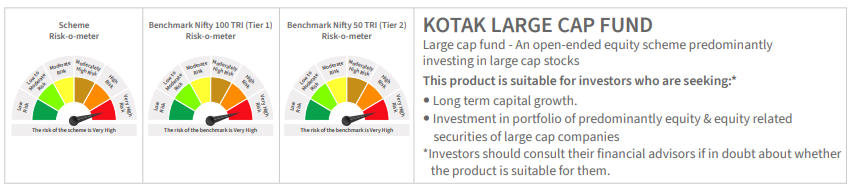
Investors may consult their Financial Advisors and/or Tax advisors before making any investment decision.
These materials are not intended for distribution to or use by any person in any jurisdiction where such distribution would be contrary to local law or regulation. The distribution of this document in certain jurisdictions may be restricted or totally prohibited and accordingly, persons who come into possession of this document are required to inform themselves about, and to observe, any such restrictions.
MUTUAL FUND INVESTMENTS ARE SUBJECT TO MARKET RISKS, READ ALL SCHEME RELATED DOCUMENTS CAREFULLY.