16 Apr 2026
When we talk about global commodities, the conversation almost always begins with oil and ends with gold. The familiar anchors of markets. The obvious movers of economies. But there’s a commodity you’ve probably never thought about. Not the kind that fills balloons at a birthday party but the one that’s critical to the chip in your phone, the MRI machine in your nearest hospital and quite possibly the future of AI.
Helium!! And today, it is under stress.
In the world of high-tech manufacturing and healthcare, helium isn't a luxury; it’s non-negotiable. And right now, the war in Ukraine and the escalating tensions in the Middle East have pushed the helium market into what experts are calling "Shortage 4.0."
A Supply Chain Built on Constraints
What makes helium unique is not just its use, but its nature. It is not manufactured. It is not renewable. It is not even directly mined. Helium exists as a byproduct of natural gas extraction, formed over billions of years beneath the Earth’s surface. And once released into the atmosphere, it escapes into space permanently. This makes helium a finite resource in the truest sense.
Global Helium Production Snapshot
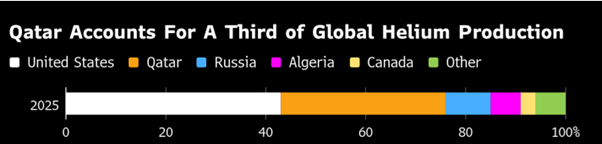
Source: US Geological Survey (2025–26), Bloomberg Economics
Now layer that with geography. Nearly 70% of global helium supply comes from just two countries, the United States and Qatar. This level of concentration introduces a structural vulnerability. Any disruption whether geopolitical, operational or logistical has immediate global consequences. And that is precisely what we are witnessing today.
When Geopolitics Meets Chemistry
The recent Middle East conflict has exposed this fragility in real time. Qatar’s Ras Laffan LNG facility, one of the world’s largest faced shutdowns, taking nearly one-third of global helium production offline. At the same time, the Strait of Hormuz, a critical trade route has seen severe disruption. This is not just about production; it is about movement.
Helium must be transported in specialised cryogenic containers. These containers have a limited holding window, after which the gas begins to evaporate. Delays are not just costly, they are irreversible.
Even more striking is the logistical lag. According to industry estimates, even a two-week disruption can take months to normalise, due to the complexity of rerouting containers and restoring supply chains.
Helium’s demand profile is equally unusual. It is not driven by discretionary consumption. It is driven by necessity.
Why Helium Matters to the Economy
Helium’s importance lies in its irreplaceability.
In healthcare, it cools MRI machines to extremely low temperatures, enabling accurate diagnostics. Without helium, these machines simply cannot function.
In semiconductors, it ensures precision during chip manufacturing—especially in advanced nodes used for AI and high-performance computing.
In data centres, aerospace, and scientific research, helium plays a quiet but critical role in maintaining stability and performance.
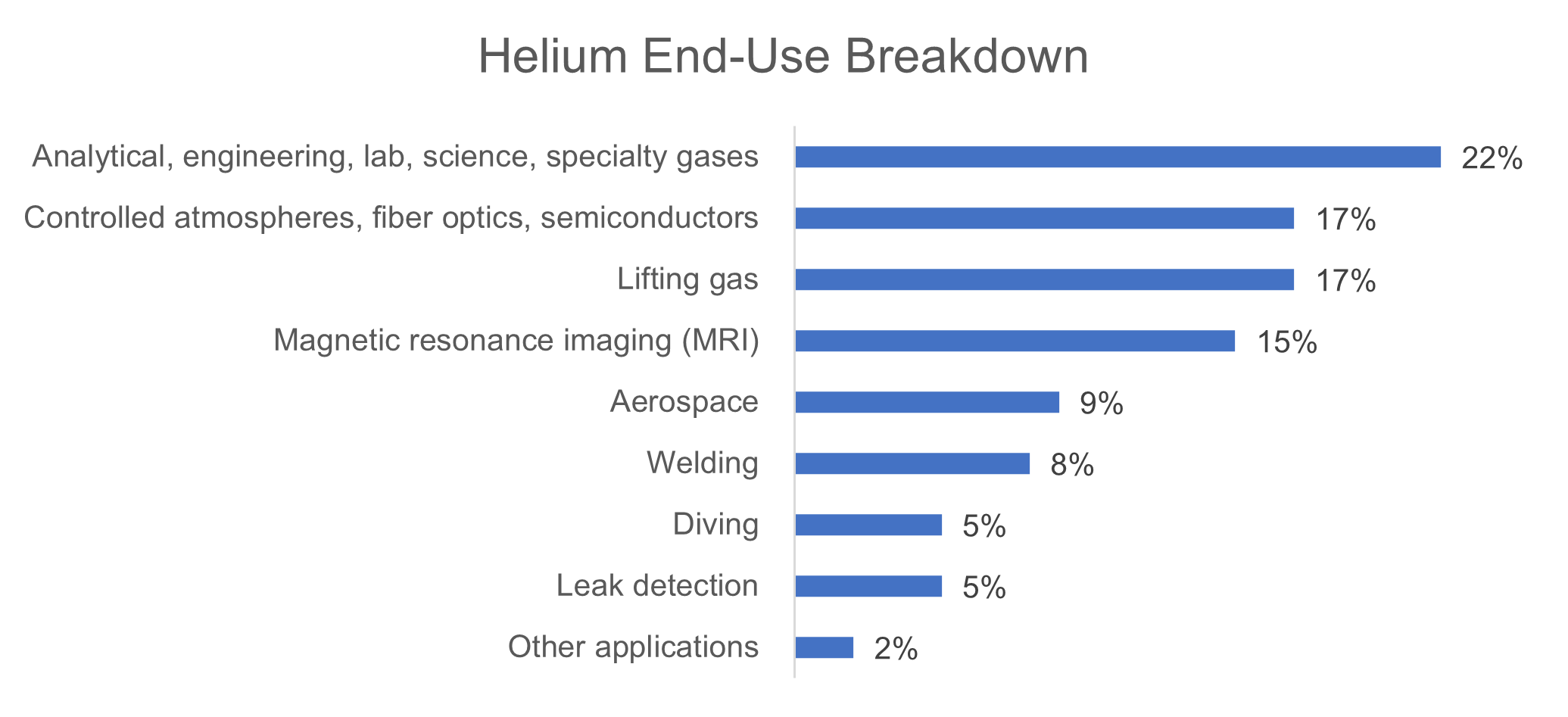
Source: US Geological Survey (2025–26)
Despite this, helium accounts for a very small share of total production cost in most industries. This means demand remains relatively inelastic with companies will continuing to pay for it, even at higher prices.
Pricing, Prioritisation and Market Dynamics
The helium market behaves very differently from most commodities. A large share of supply is tied up in long‑term contracts rather than traded actively in spot markets. As a result, supply disruptions do not immediately show up in prices, creating a lag between stress in the system and visible price signals. That said, early signs are now emerging. Spot prices have risen sharply in recent weeks, with some estimates pointing to near‑doubling in certain markets.
When disruptions persist, supply is not rationed evenly. Suppliers typically prioritise critical end‑use sectors such as healthcare and semiconductors, while lower‑priority applications such as leisure and some industrial uses face sharper cutbacks.
According to Bloomberg Intelligence:
- Chipmakers currently hold ~6 months of helium inventory
- But allocation decisions begin much earlier, even before stockpiles run out
- High-margin AI chips (HBM, server DRAM) are prioritised
- Lower-end chips (smartphones, PCs) face supply cuts
Source: Bloomberg
This tiered allocation system underscores a key reality of the helium market: not all demand is treated equally.
If production constraints are the first challenge, logistics is the second and often the more underestimated one. Unlike oil, helium cannot be stockpiled easily. It requires cryogenic storage at temperatures below –269°C, specialised containers that can cost close to a million dollars each and continuous movement to minimise losses. In the current environment, many containers are stranded along disrupted transit routes. Reallocating them takes months, and storage losses during this period are inevitable.
This combination of rigid logistics and contractual supply explains why helium markets behave so differently from traditional commodities. Price discovery is slow, but when adjustments finally occur, they tend to be sharp and sudden.
Countries in the crosshairs
The nations most exposed are, unfortunately, the ones the world depends on most for chips:
South Korea: 65% of helium imports from Qatar. Home to Samsung and SK Hynix together making two-thirds of the world’s memory chips. Fitch Ratings flagged it as “among the most vulnerable.” The Seoul government has put helium on a watchlist of 14 critical semiconductor materials.
Taiwan: 69% of helium from GCC (Gulf Cooperation Council) nations. Home to TSMC (Taiwan Semiconductor Manufacturing Company Limited), which makes the most advanced logic chips on the planet. They say they’re monitoring the situation. Translation: they’re worried.
Japan and Singapore: Major fab hubs, similarly dependent on Middle Eastern helium. Both are scrambling to assess exposure.
Samsung and SK Hynix reportedly have several months of inventory. But “several months” against a war with no end date isn’t exactly comforting.
Source: Reuters, Fitch Ratings, Forst & Sullivan, South China Morning Post, March 2026
The Indian Perspective
For India, the helium story is less about manufacturing and more about dependency.
The country imports the majority of its helium requirements, with healthcare being a key end-user. Any sustained disruption can lead to higher costs for diagnostic services and increased pressure on medical infrastructure. At the same time, this challenge is also driving innovation.
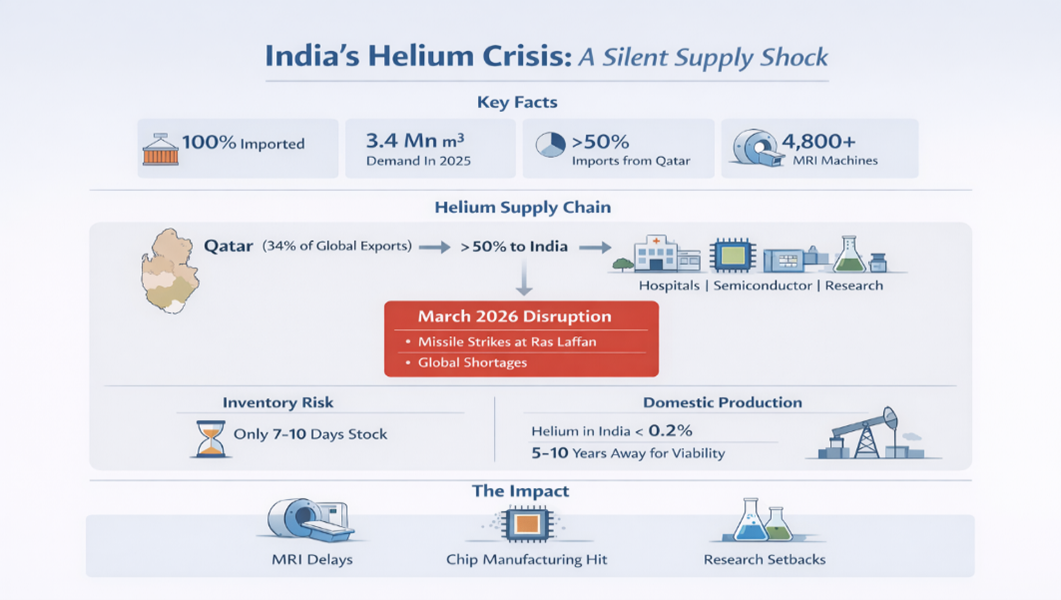
Source: The Hindu, April 2026
Emerging technologies, including low-helium and helium-free MRI systems, are beginning to reshape the landscape. While still evolving, these solutions could gradually reduce long-term dependency.
The Larger Lens
If we step back, helium is not just a commodity story. It is a lens. A lens into how modern economies are increasingly dependent on a narrow set of critical inputs which are often controlled by a limited number of geographies.
From helium to rare earths to semiconductor gases, the pattern is consistent: high importance, low visibility and concentrated supply.
Helium isn’t unique in this. Neon (critical for chip lithography) is concentrated in a few plants. Palladium (catalytic converters) depends heavily on Russia. Bromine (another chipmaking input) comes mostly from Israel and Jordan. Rare earths are dominated by China. The modern economy runs on a handful of obscure materials controlled by a handful of countries.
Supply chain resilience, diversification of resources, technological substitution and geopolitical developments are no longer peripheral themes. They are central to understanding long-term economic shifts.
This is concentration risk at its most extreme is the kind of fragility that hides in plain sight until a geopolitical shock like the current one exposes it overnight.
A Quiet Reminder
Helium will never dominate market headlines the way oil does. But it doesn’t need to.
Because sometimes, the most powerful forces in the economy are the ones that operate silently holding entire systems together without drawing attention to themselves.
Until, of course, something disrupts them.
The helium market had been in oversupply for two years before this crisis. That cushion is the only thing standing between the world and a full-blown shortage. Whether it holds depends on one variable: how long the war lasts. And right now, nobody has an answer.
Arijit Dutta, Vice President, Equity Research at Kotak AMC adds: Helium might be abundant in the Universe, but it's rare and precious on Earth. The helium shortage is emerging as one of the most overlooked choke points in the global healthcare and semiconductor supply chain.
KMAMC is not guaranteeing/offering/communicating any indicative yield/returns on investments. The stocks/sectors mentioned do not constitute any kind of recommendation and are for information purpose only. Kotak Mahindra Mutual Fund may or may not hold position in the mentioned stock(s)/sector(s). Companies mentioned don’t constitute recommendation, brand name affiliation disclaimer & companies mentioned for illustrative purpose only. These materials are not intended for distribution to or use by any person in any jurisdiction where such distribution would be contrary to local law or regulation. The distribution of this document in certain jurisdictions may be restricted or totally prohibited and accordingly, persons who come into possession of this document are required to inform themselves about, and to observe, any such restrictions.
MUTUAL FUND INVESTMENTS ARE SUBJECT TO MARKET RISKS, READ ALL SCHEME RELATED DOCUMENTS CAREFULLY.