30 Apr 2026
In a village in Madhya Pradesh, a woman from a self-help group picks up a remote controller and sends a ₹4 lakh drone, costs less than a second-hand Maruti Swift, over a wheat field. In 15 minutes, it sprays pesticides across an area that would've taken her half a day by hand. Her morning chai hasn't gone cold and the job is done. She uses 30% less chemicals than the manual sprayer would.
Source: Inside FPV, As of June 23, 2025
A few thousand kilometres away, during Operation Sindoor in May 2025, a drone worth more than a South Mumbai apartment slammed into a Pakistani air defence battery near Lahore and destroyed it.
Same technology. Two completely different Indias.
Drones are everywhere today — in Instagram reels, war footage, and government schemes. But what exactly is a drone?
Let's start with the basics
A drone is simply an aircraft with no pilot inside. Someone on the ground flies it with a remote, or it follows a pre-programmed GPS route on its own. Some do both.
But not all drones are the same. There's a massive range, and the range matters because it determines what a drone can do.
| Category | Weight | Use Cases | Regulation Level |
|---|---|---|---|
| Nano The toy on your shelf |
< 250g | Selfies, hobby flying, indoor fun | No registration, no Remote Pilot Licence required (for non-commercial use; complies with height & no-fly zone restrictions) |
| Micro The wedding drone |
250g – 2 kg | Vlogging, real estate photography, small-area mapping | Registration mandatory (UIN on Digital Sky); Remote Pilot Licence required for commercial operations |
| Small The farmer’s best friend |
2 kg – 25 kg | Film shoots, industrial inspection, precision agriculture, surveying | Registration (UIN) + Remote Pilot Licence mandatory; aircraft must comply with Digital Sky permissions and safety norms |
| Medium The surveyor’s eye |
25 kg – 150 kg | Large-farm spraying, heavy cargo transport, border surveillance | Type certification + Airworthiness + Pilot Licence + operational approvals required |
| Large The military drone |
> 150 kg | Defence, strategic surveillance, long-range cargo | Full certification required - Type certification + airworthiness certification + Remote Pilot Licence + operational approvals + defence/security clearances |
Source: DGCA Drone Rules 2021
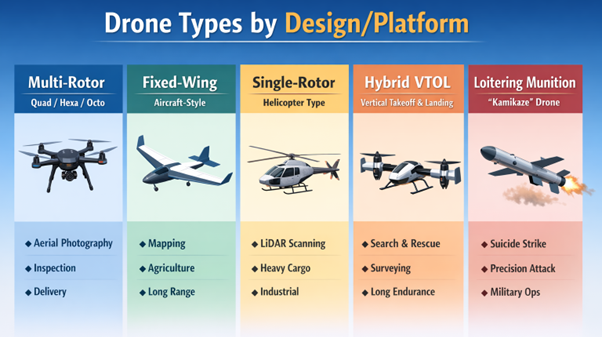
The price spectrum runs from ~₹5,000 to more than ₹100Cr. That's like calling both a bicycle and a Boeing "vehicles." Same word. Entirely different machines.
Source: KMAMC Internal, The Hindu, Smartprix, As per latest data available
As drones scale up in capability, they no longer differ only by weight or price. Their real differentiation lies in how high they fly, how far they travel, and how long they can stay airborne. The visual below maps drones across these three dimensions : altitude, range, and mission showing how the same word “drone” spans everything from last‑mile delivery machines to systems that operate closer to satellites than aircraft.
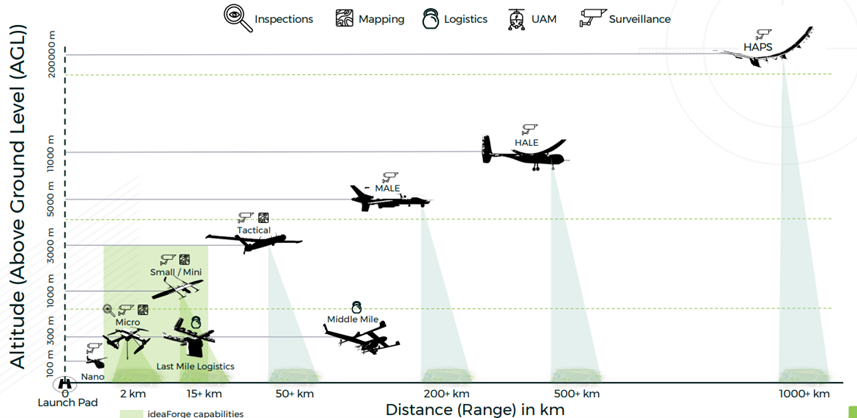
Source: Ideaforge Q1FY24 Presentation, MALE - Medium Altitude Long Endurance, HALE – High Altitude Long Endurance, HAPS – High Altitude Pseudo‑Satellite, UAM – Urban Air Mobility
This spectrum explains why drones show up in such wildly different places and each drone is being used for different use cases.
What's happening on the farm
This is probably the part of India's drone story that affects the most people and the one least covered.
The government's Namo Drone Didi scheme gives drones to Women Self-Help Groups across rural India, trains the women to operate them, and then these Self Help Groups (SHGs) offer crop spraying as a paid service to nearby farmers. As of February 2026, over 1,094 drones have been distributed to women SHGs including 500+ under Namo Drone Didi initiative, enhancing farm productivity and livelihoods. Think about that for a moment, over a thousand women who may have never driven a car are now piloting aircraft over farmland.
Why does this matter? Because manual pesticide spraying is slow, wasteful, and dangerous. Farmers walk through fields with heavy backpack sprayers, inhaling chemicals for hours. A drone does the same job in a fraction of the time, wastes less pesticide, and nobody has to stand in a cloud of chemicals.
The cost to the farmer? As low as ₹300-700 per acre if they hire the service, less than a multiplex movie ticket. No need to buy a drone at all. The government even offers additional subsidies on drone purchases for farmer cooperatives and SHGs.
India has over 140 million farming households. If even 10% shift to drone-based spraying over the next five years, that's 14 million households — more than the entire population of Belgium switching to a new way of farming.
Source: leher.ag, desagri.com, as per latest data available
What's happening on the battlefield
You have seen the headlines. Now here's what actually happened.
During Operation Sindoor in May 2025, India's retaliatory strike after the Pahalgam terror attack, India used drones in combat for the first time at this scale in South Asia. Israeli-made Harop "suicide drones" struck Pakistani air defence systems. Heron Mk-2 surveillance drones watched from above. SkyStriker loitering munitions, made in Bengaluru through a joint venture with Israel's Elbit Systems, hit terror infrastructure.
Pakistan fired back with over 600 drones in a few days, more drones in one burst than most countries own in their entire military. India's air defence intercepted the vast majority.
Meanwhile, the Ukraine-Russia war has become history's largest drone conflict. Russia launches over 1,000 Shahed-type drones per week. Ukraine countered by producing 2 million drones in 2024 — roughly one every 16 seconds, all year long. In one stunning operation, 117 cheap FPV drones destroyed over 40 Russian strategic bombers. That's enough money to build three IIMs wiped out by drones that cost less than a fleet of Activas.
Source: National Security Journal, global.espreso.tv, BBC, As per latest data available
And in the Iran war of 2026, drone attacks near the Strait of Hormuz disrupted 20% of the world's oil supply directly causing the LPG crisis and fuel price spikes that every Indian kitchen felt.
The cost equation is what makes drones terrifying. A $500 FPV drone can kill an air defence system worth millions. A $35,000 Shahed forces the defender to fire a ~$3 million Patriot missile. That's like having to use a car to block a bicycle, every single time.
Source: Reuters, militarywatchmagazine, As per latest data available
India's drone ecosystem: the numbers
India’s drone story is not about one national champion, but a large portfolio of focused players, each attacking a different slice of the value chain. Defence‑grade reliability, agricultural scale, data platforms, and asymmetric warfare systems are emerging in parallel, shaped as much by policy and procurement as by pure technology. The below companies are only a few of the more visible players but India’s broader drone ecosystem spans over 500 companies.
| Company | Core Focus | Primary Use Cases | Key Highlight |
|---|---|---|---|
| ideaForge | Defence-grade drone systems | Border surveillance, ISR, mapping for armed forces & govt | ~50% share of Indian UAS market by value |
| Garuda Aerospace | Scale manufacturing + services | Agricultural spraying, infrastructure inspection, disaster response | ~30% market share in India’s agricultural drone market |
| Asteria Aerospace | ISR platforms + data software | Surveillance, mapping, enterprise & defence | Army surveillance drone contracts; SkyDeck drone data platform |
| NewSpace Research & Technologies (NRT) | Swarms & loitering munitions | Tethered drones, swarm ISR, strike drones | Army contracts for tethered drones and swarm & loitering munition programs |
Swarm ISR - Swarm Intelligence, Surveillance and Reconnaissance, Tracxn as of 11 January 2026
However, India currently imports 50-60% of critical drone components, and the goal is to flip that. This shift is driven various policy incentives and government missions. On manufacturing, the PLI scheme started at ₹120 crore. PLI 2.0, now being finalised, is reportedly over ₹1,000 crore and extends to drone leasing and software. The Ministry of Civil Aviation has also proposed a ₹1,600–1,800 crore, five‑year Mission Drone Shakti to cut India’s dependence on Chinese drone components and localise manufacturing.
Five years ago, flying a commercial drone in India required 72 approvals and 25 forms. Today, it's 4 approvals and 5 forms.
Nearly 90% of Indian airspace is now a "Green Zone" for drone flights up to 400 feet and it's as if the government opened 9 out of 10 roads for drones overnight. GST was slashed from 18-28% to a flat 5%.
Source: phdcci, Drone Rules, 2021, pib
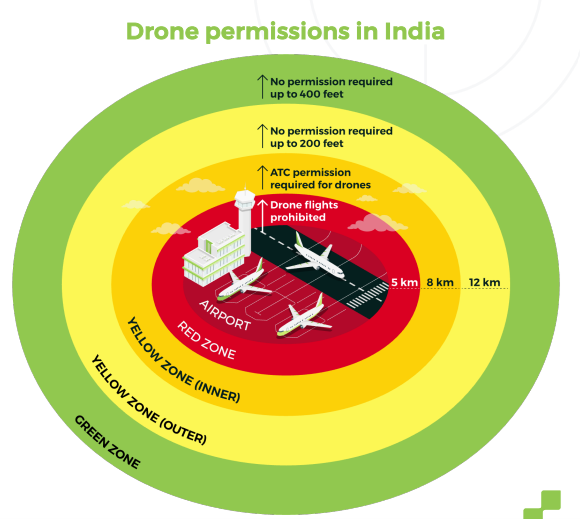
Source: Ideaforge Q1FY24 Presentation
Globally, the pecking order is clear. Israel pioneered military drones. The US builds the most advanced ones but restricts exports. Turkey democratised combat drones with the ~$5 million Bayraktar TB2 does the job of a $32 million Reaper. China dominates the consumer market through DJI approximately at 90% market share. Iran builds cheap loitering munitions that have reshaped how wars are fought.
Source: PIB, drone-warfare, thehindubusinessline, Wikipedia, Mint, As per latest data available
India's bet? Do all of it i.e defence, agriculture, infrastructure, governance, and eventually commerce simultaneously. Most countries pick one or two lanes. India is attempting five.
What's happening on the ground
Here's something most people don't know drones have quietly mapped over 3.28 lakh Indian villages. Under the SVAMITVA scheme (Survey of Villages and Mapping with Improvised Technology in Village Areas), drones fly over rural areas and create precise digital maps of every property. From these surveys, 2.76 crore property cards have been issued across 31 states. A government-verified property card means one can now walk into a bank and use your land as collateral for a loan. Before this, millions of rural Indians had no way to prove they owned their land.
Source: PIB, 17th February 2026
NHAI now mandates monthly drone-video recordings for every highway project. Railways use drones for track inspection. Disaster response teams in the Northeast use specialised drone systems for flood relief. The government has quietly become one of India's largest drone customers.
In fact, just last month, i.e on 21 April 2026 FedEx conducted India's first intra-city drone delivery trials in Bengaluru alongside IIT madras.
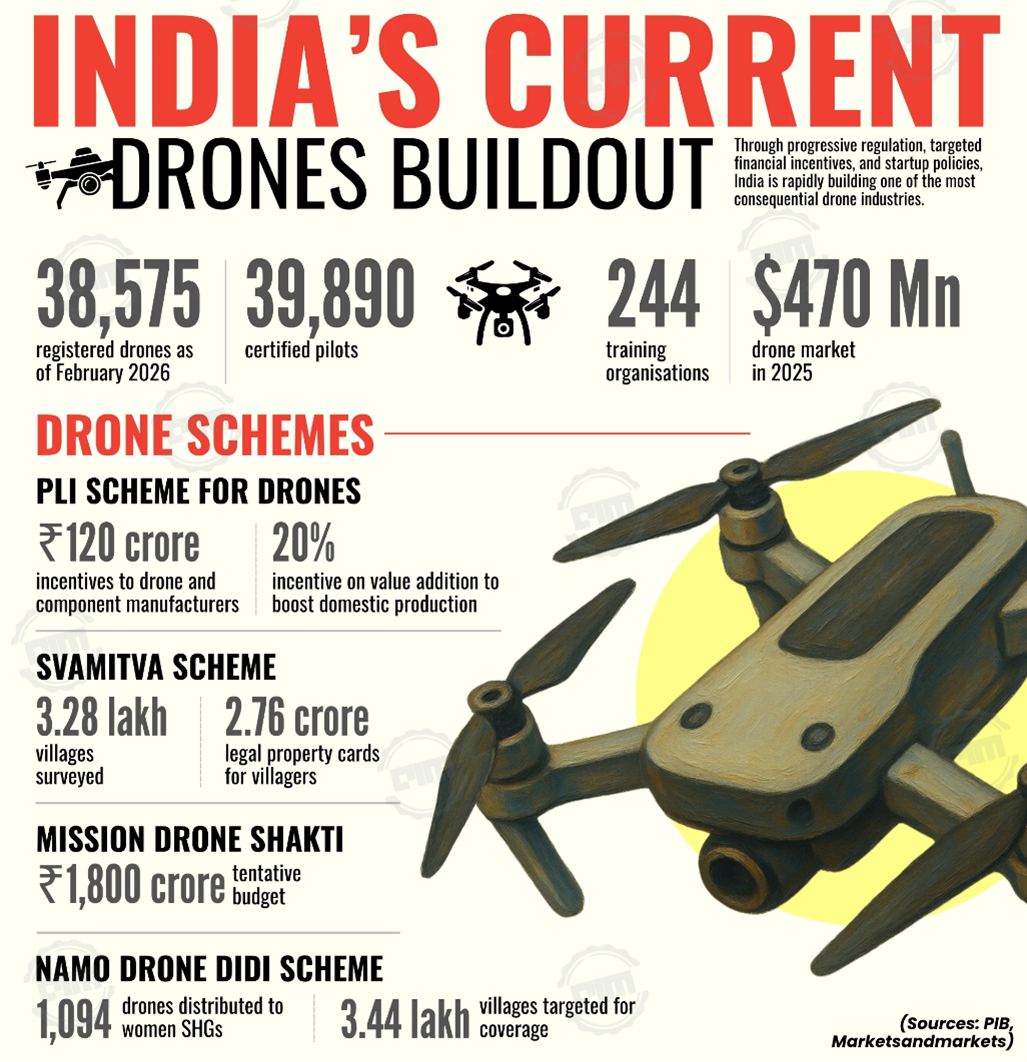
Source: analyticsindiamag.com, PIB, marketsandmarkets (13 April 2026)
The same word "drone" describes a toy and a defence behemoth for carrying missiles. It describes the thing that sprays pesticide on a field in and the thing that destroyed an air defence system in Lahore. It describes what delivers blood in Rwanda and what might, someday deliver your biryani in Bengaluru.
India went from essentially zero regulated drone ecosystem to 38,575 registered drones and 39,890 DGCA certified pilots. From 72 approvals to 4. The drone ecosystem now stands at a different inflection point. The question is no longer whether drones can fly in India but whether India can build the components, software, and scale needed to compete globally.
Dhananjay Tikariha, Senior Vice President, Equity Research states, “Drones are no longer a novelty — they are the invisible backbone of the modern world. From battlefield intelligence to last-mile delivery, from precision agriculture to disaster response, the drone revolution is significantly reshaping industries. Robust local manufacturing ecosystem that reduces import dependence and builds strategic self-reliance will be imperative for Indian Industries to compete globally and flourish. For manufacturers and service providers alike, the sky is not the limit — it is just the beginning.”
Source: pib.gov, As of 17th Feb 2026
The stocks/sectors mentioned do not constitute any kind of recommendation and are for information purpose only. Kotak Mahindra Mutual Fund may or may not hold position in the mentioned stock(s)/sector(s). These materials are not intended for distribution to or use by any person in any jurisdiction where such distribution would be contrary to local law or regulation. The distribution of this document in certain jurisdictions may be restricted or totally prohibited and accordingly, persons who come into possession of this document are required to inform themselves about, and to observe, any such restrictions. Use of the company/ brand names does not imply any affiliation with or endorsement by them or any of its holding companies, subsidiaries or affiliates and are used for illustrative purpose only.
MUTUAL FUND INVESTMENTS ARE SUBJECT TO MARKET RISKS, READ ALL SCHEME RELATED DOCUMENTS CAREFULLY.
SEBI Registered Name - Kotak Mahindra Mutual Fund
SEBI Registered Number - MF/038/98/1