18 Mar 2026
As you read this, there is a good chance you are waiting on a platform or scrolling through your phone inside a train coach. The scene feels familiar. Almost forgettable. Yet this ordinary moment hides a simple fact. India moves because its railways move. Every whistle, delay, and departure shapes how people reach work, how goods reach markets, and how cities stay connected. What feels routine to you is part of a system that carries the weight of a nation, every single day.
Indian Railways can be understood as a systemic enabler of economic growth, not merely a passenger service. Almost every major sector—power, steel, cement, agriculture, manufacturing, and services—depends on railways at some point in its value chain. Unlike roads or ports that serve limited corridors, railways knit together production centres, consumption hubs, and remote regions into a single economic grid.
A Network That Mirrors India’s Economic Ambition
Indian Railways reflects the scale of India’s economic ambitions, moving over 1.6 billion tonnes of freight annually and carrying more than 7 billion passengers through an industrial‑scale network of tracks, trains, power, signalling, and workforce. Demand continues to rise with urbanisation and industrial growth, while modernisation through near‑total electrification, track doubling, station redevelopment, and digital technologies improves safety, reliability, and efficiency. Operating 13,500 passenger and 11,700 freight trains daily, freight generates about 68% of revenue, led by coal at over 40%. With over 96% of the Eastern and Western Dedicated Freight Corridors commissioned and ₹3.02 lakh crore capital support, railways are evolving into a high‑capacity, sustainable national infrastructure platform.
Source: Indian Railways Annual Report & Accounts 2024–25 and IBEF Railways Report dated November 2025
Indian Rail - History
Indian Railways are an emblem of conviction and progress spanning over 164 years. It is owned and operated by the Government of India through the Ministry of Railways. The core of the pressure for building railways in India came from London and they first introduced to India in 1830s for freight purposes.
India's first railway proposals were made in Madras in 1832. The Red Hill Railway, the country's first train, ran from Red Hills to Chintadripet bridge in Madras in 1837. It was hauled by a rotary steam-engine locomotive and was primarily used to transport laterite stone for road-building work in Madras.
First passenger train ran between Bombay's Bori Bunder station and Thane on 16 April 1853,14-carriage train was hauled by three steam locomotives: the Sahib, Sindh, and Sultan, it travelled 34 kilometres carrying 400 people. It was built in 5 ft 6 in broad gauge, which became the country's standard for railways.
The first railway budget was presented in 1925. On 3 February 1925, the first electric passenger train in India ran between Victoria Terminus (VT) and Kurla on 1,500 V DC overhead traction.
(Source: indianrailways.gov.in)
India Railroad Market Size:
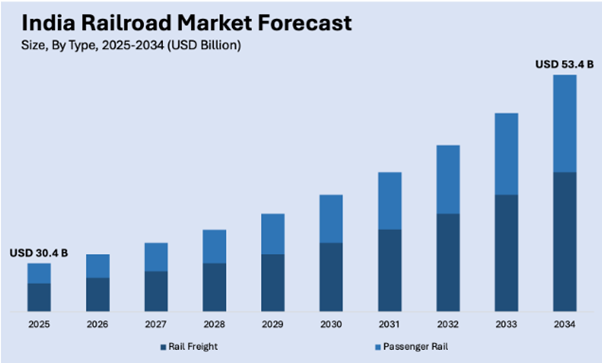
Source: IMARC (The International Market Analysis Research and Consulting) Group
Landmark Projects:
Connecting To Seven Sister States:
In the mist‑clad hills and deep valleys of India’s Northeast, a quiet railway revolution may be unfolding. Once seen as distant and disconnected, the region is now being stitched into the national network through ambitious rail projects that may signal a new era of mobility, commerce, and integration. Over the past decade, long‑pending lines have moved from plans to reality, with new stations opening in states that had none for over a century and capitals finally gaining rail access. The 51‑km Bairabi–Sairang line in Mizoram, with 55 bridges and 45 tunnels, stands as a powerful symbol of the Northeast’s entry into India’s rail‑driven economy.
Once served by isolated stations, the Northeast is now witnessing a railway renaissance, with allocations rising fivefold since 2014 to ₹62,477 crore, including ₹10,440 crore in the current year, and projects worth ₹77,000 crore underway. Capitals across Mizoram, Nagaland, Manipur, and Tripura are being linked to the national grid, while Meghalaya gets its first station and Arunachal Pradesh, Sikkim, and Assam advance new lines, electrification, and doubling works—reshaping connectivity across the region.
Source: Press Information Bureau (PIB)
Strengthening Connectivity For Defence & Civil Purpose:
Udhampur-Srinagar-Baramulla Rail Link (USBRL) witnessed a historic milestone with the successful run of a freight Train, the first exclusive freight train of the Indian Army, from BD Bari to Anantnag. The train carried 753 metric tonnes of Advance Winter Stocking (AWS) loads for Indian Army units and formations in J&K, marking a decisive turning point in the Army's AWS modus operandi. This strategic initiative underscores the Indian Army's ongoing capability development efforts to ensure operational preparedness in challenging Himalayan terrain. This milestone was achieved in close coordination with the Ministry of Railways, reflecting the growing synergy between defence and civilian infrastructure.
Source: The Tribune
Dedicated Freight Corridors (DFCs)
Dedicated Freight Corridors create a clear physical separation between freight and passenger trains. This separation allows goods to move faster without competing for track space with passenger services. Freight trains achieve quicker turnaround times, improving efficiency and reliability. Congestion on busy routes reduces sharply. At the same time, existing passenger routes get used better, leading to smoother schedules and improved punctuality. As of March 2025, around 2,741 km (96.4%) of the DFC network has been commissioned and made operational. The government is deepening capacity through dedicated infrastructure and announced a new East–West Dedicated Freight Corridor from Dankuni (West Bengal) to Surat (Gujarat). Freight volumes on rail are targeted to rise to 3.3 billion tonnes by 2030 from about 1.2 billion tonnes in 2019, supported by rising industrial demand and infrastructure upgrades.
Source: Niti Aayog
Mumbai-Ahmedabad High Speed Rail (MAHSR) Project:
Government of India has sanctioned 508 km Mumbai-Ahmedabad High Speed Rail (MAHSR) Project in December, 2015 which is under execution with technical and financial co-operation from Government of Japan. The progress of the MAHSR project for the period of 2025-26 is as under:-
Physical Progress: Overall physical progress of 55.63% has been achieved as on 30th November 2025.
Financial Progress: Overall financial progress of 69.62% with an expenditure of ₹ 85,801/- crore has been achieved as on 30th November 2025.
Source: North Central Railway
The government has approved seven new bullet train corridors, adding to the ongoing Mumbai–Ahmedabad project. These corridors will connect major economic and population centres such as Mumbai, Pune, Hyderabad, Bengaluru, Chennai, Delhi, Varanasi, and Siliguri. Together, the high-speed rail network is expected to span nearly 4,000 kilometres. The plan involves a long-term investment of around ₹16 lakh crore, signalling a major push towards faster intercity travel and modern rail infrastructure.
Source: IBEF Railways Report dated November 2025
Faster, Safer & Comfortable Travel at Affordable Cost
Vande Bharat Train:
As of 26 December 2025, 164 Vande Bharat train services operate across Indian Railways, with 15 new services introduced in 2025, and the upcoming Vande Bharat Sleeper set to redefine long‑distance overnight travel with enhanced speed, comfort, and modern amenities.
Source: North Central Railway
Amrit Bharat Train:
Amrit Bharat Trains are fully non‑AC services configured with 12 Sleeper Class and 8 General Class coaches, offering improved travel quality for mass passengers. In calendar year 2025, 13 Amrit Bharat Express trains were introduced, taking the total to 30 operational services across the Indian Railways network.
Source: North Central Railway
Namo Bharat Rapid Rail:
Namo Bharat Rapid Rail Services are designed for high‑frequency operations, strengthening short‑ and medium‑distance regional connectivity in high‑demand corridors. Currently, two services are operational, connecting Bhuj–Ahmedabad and Jaynagar–Patna, enhancing fast and efficient regional mobility.
Source: North Central Railway
Electrification:
Electrification of the railway network on Indian Railways (IR) has been taken up in mission mode. So far, about 99.2% of the Broad Gauge (BG) network has been electrified. Electrification in the remaining network has been taken up. This achievement is significantly higher than the electrification levels of the UK (39%), Russia (52%) and China (82%). A total of 14 Railway Zones and 25 States/Union Territories have now achieved 100% electrification.
Source: North Central Railway
Technology and Digitalisation
Technology and digitalisation have become central to improving efficiency, safety, and passenger experience in Indian Railways. Digital platforms such as e‑ticketing, m‑ticketing, and the RailOne app enable unified access to unreserved ticketing, live train tracking, and grievance redressal, handling high passenger volumes efficiently. Operational safety has been strengthened through modern signalling systems and the Kavach indigenous train protection system, while real‑time data analytics support better traffic management. Near‑complete electrification of the broad‑gauge network and deployment of high‑horsepower electric locomotives have reduced fuel consumption and emissions, reinforcing Railways’ shift towards a technology‑driven, efficient, and sustainable transport system.
RailOne App: one-Stop Solution for Passengers
Indian Railways has launched the RailOne App, a comprehensive one-stop solution for passenger services, available on Android and iOS platforms.
Key features include:
- Unreserved UTS ticketing (3% discount via R-Wallet)
- Live train tracking
- Grievance redressal
- E-catering
- Porter booking
- Last-mile taxi services
Safety:
Indian Railways has recorded major improvements in safety. Consequential train accidents fell from 1,711 during 2004–14 (171 annually) to 31 in 2024–25 and further to 11 in 2025–26 (up to November 2025). The safety budget nearly tripled from ₹39,463 crore in FY 2013–14 to ₹1,16,470 crore currently. Fog safety devices increased from 90 in 2014 to 25,939 in 2025, while Centralised Electronic Interlocking and Track Circuiting were completed at 21 stations in the last four months. Kavach 4.0, commissioned over 738 route km, enhances automatic braking, signal accuracy, and interoperability, with large‑scale deployment planned. CCTV systems now cover 1,731 stations and 11,953 coaches.
Source: North Central Railway
Solar-Powered Railway Stations
Indian Railways has taken a major step towards clean and sustainable energy by making 2,626 Railway stations solar-powered nationwide. A total of 898 MW (MegaWatt) of solar power has been commissioned, with approximately 70% utilised for traction purposes. This has strengthened energy security, reduced electricity expenditure, lowered carbon emissions, and promoted eco-friendly Rail operations.
Source: North Central Railway
Indian Railway Plan:
| Aspect | Plan for 2030 | Goals by 2047 |
|---|---|---|
| Network Electrification | 100% electrification of the broad gauge network to cut diesel use and emissions | Fully electrified network with real time digital monitoring across operations |
| Digital Monitoring & Technology | Wider adoption of modern signalling, train protection systems, and centralized traffic control | End to end digitally monitored network with predictive and automated safety systems |
| Train Safety | Fewer accidents through better infrastructure, signalling upgrades, and removal of level crossings | Zero fatalities from train accidents |
| Global Safety Standards | Alignment with global best practices in rail safety and operations | Among the top 3 safest rail networks globally |
| Safety Awareness | Targeted safety campaigns and structured staff training | Universal rail safety education embedded in school curricula |
| Workforce Capability | Skill development for frontline and technical staff | Fully empowered, safety first railway workforce across India |
| Modern Train Fleet | Expansion of premium semi high speed services with modern amenities | Large scale deployment of next generation trains across the network |
| Vande Bharat Expansion | Scale the Vande Bharat fleet to 800 trains by 2030 | Expand the Vande Bharat fleet to 4,500 trains by 2047 |
| Long Term Vision | Build capacity ahead of demand with a focus on reliability and efficiency | A resilient, safe, and future ready railway system for every Indian |
Source: PIB and Academy of Safety & Disaster Management Report
Hyperloop: Future of Trains
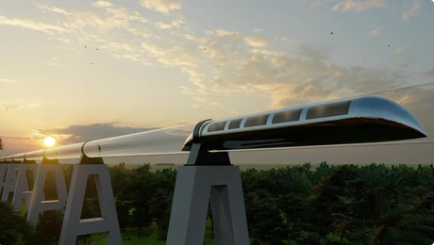
Hyperloop proposes transporting passengers or freight in pods through near‑vacuum tubes at speeds close to aircraft. Low friction and magnetic levitation sharply cut travel time. Energy use and emissions are lower than conventional transport.
India commissioned a 422‑metre hyperloop test track in December 2024, the longest in the world. Avishkar Hyperloop built the facility at IIT Madras with Indian Railways and Larsen & Toubro Construction Limited. TuTr Hyperloop, another IIT Madras incubated deep‑tech startup, partnered with Swisspod Technologies to complete India’s first commercial hyperloop pod test run.
Analysts estimate the global ultra‑high‑speed rail market at $6.6 billion by 2026. The opportunity could scale rapidly if trials succeed. Richard Branson’s Virgin Hyperloop is advancing projects in the US, Saudi Arabia, and Dubai. Hyperloop Transportation Technologies is developing a commercial prototype between Abu Dhabi and Dubai that could cut travel time from 1.5 hours to 12 minutes.
Elon Musk’s Boring Company has built a test tunnel in California and claims travel between Washington DC and New York City could take under 30 minutes. Flights on the same route take about 80 minutes. Canada’s TransPod plans to significantly reduce travel time between Toronto and Montreal. India‑based DGW (Dinclix Ground Works) Hyperloop has completed a feasibility study for a Delhi–Mumbai corridor, targeting a journey of just over an hour.
Source: The Economic Times
Faster links could expand tourism by improving access to distant locations. Widespread adoption will depend on confidence in safety, usefulness, convenience, and cost. Clear proof on these fronts could accelerate uptake, similar to the early evolution of commercial aviation.
Dhananjay Tikariha, Fund Manager & Senior Vice President at Kotak AMC adds –
“Indian Railways is undergoing a structural transformation—modernising infrastructure, improving efficiency, and expanding capacity. As the backbone of India’s logistics and mobility, a stronger railway network lowers freight costs, boosts productivity, and enables inclusive growth. This investment cycle also creates a multi‑year opportunity for Indian companies across manufacturing, engineering, technology, and services to scale capabilities and participate in nation‑building.”
Disclaimers:
KMAMC is not guaranteeing/offering/communicating any indicative yield/returns on investments. The stocks/sectors mentioned in this slide do not constitute any recommendation and Kotak Mahindra Mutual Fund may or may not have any future position in these sectors/stocks. Companies mentioned don’t constitute recommendation, brand name affiliation disclaimer & companies mentioned for illustrative purpose only. Use of the company brand names does not imply any affiliation with or endorsement by them or any of its holding companies, subsidiaries or affiliates and are used for illustrative purpose only.
Mutual Fund investments are subject to market risks, read all scheme related documents carefully.