Infrastructure Investment Trusts (INVITs): Bridging India’s Infrastructure Ambition with Investor Capital
10 Jun 2026
SEBI Registered Name - Kotak Mahindra Mutual Fund
SEBI Registered Number - MF/038/98/1
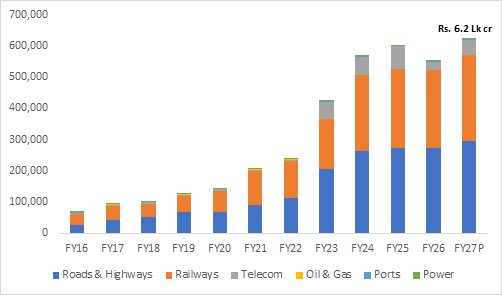
Every time you drive on a national highway, stream a video, or switch on a light, you’re using infrastructure that was built with huge amounts of capital. India is undergoing a large-scale infrastructure build-out across roads, power, renewables, logistics, and digital sectors. Government spending has steadily scaled up over the years, as the chart below shows, reflecting a clear shift towards infrastructure-led growth.
Government Capex on Infrastructure
Source: Union Budget Documents, DRHP – RAAJMARG INVIT
At the same time, the way this infrastructure is financed is also evolving. Policy initiatives like the National Monetisation Pipeline (NMP) have focused on unlocking value from existing, operational assets, channelling them into market-linked structures to free up capital for new projects. INVITs sit right at the centre of this shift. Between FY22 and FY25 alone, NHAI has mobilised ₹43,600 crore through INVITs, underlining how these vehicles are increasingly becoming a key tool in India’s infrastructure monetisation playbook.
Source: NHAI, Knight Frank Research
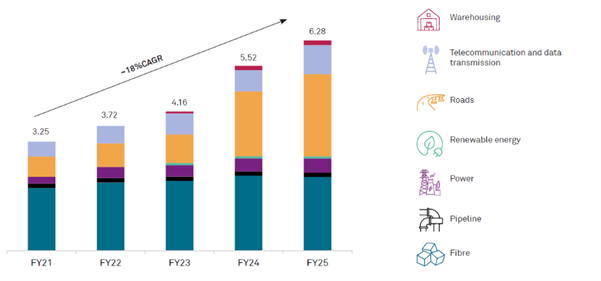
INVIT essentially take the cash flows generated by infrastructure assets and convert them into stable, investable income streams, opening up what was once locked within physical assets to a broader set of investors. Today, INVITs already manage assets worth ~₹6.3 lakh crore, and this figure could expand to nearly ₹21 lakh crore by 2030. InvITs are emerging as a crucial bridge between capital markets and India’s long-term infrastructure financing needs.
Source: SEBI | Crisil Intelligence estimates
INVIT aims to provide consistent income generation, diversification, and relatively lower volatility, making InvITs an increasingly attractive allocation for long-term investors.
So, what exactly are InvITs?
At a basic level, InvITs are a way to pool money from investors and invest it into infrastructure assets that are already up and running things like highways, power transmission lines, or telecom networks. These assets generate steady cash every year, and that cash gets distributed back to investors. In simple terms, they take something as physical and illiquid as infrastructure and turn it into something you can invest in, much like a stock.
INVITs may provide regular income distributions as they are required to distribute at least 90% of their net distributable cash flows to investors, There is also a possibility of capital appreciation depending on growth in asset class.
Source: SEBI (Infrastructure Investment Trusts) Regulations, 2014
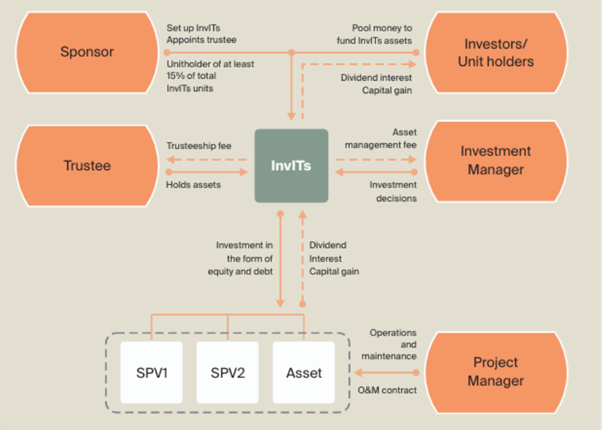
Structure of an INVIT
INVITs are Structured like a trust. The Sponsor is the original owner (like a road or power company) who sets up the INVIT and transfers assets into it. The Trustee ensures that everything is done in investors' interest. The Investment Manager is the decision-maker who runs the INVIT and decides how the assets are managed. The Project Manager maintain the assets (roads, power lines, etc.)
Source: SEBI, KnightFrank Research
The regulatory framework governing INVITs is designed to prioritise stability and income visibility. A significant portion of the portfolio at least 80%, must be invested in operational, revenue-generating assets, ensuring that cash flows are already established rather than speculative. Exposure to under-construction or higher-risk assets is capped at 20%, which limits execution risk.
Currently there are multiple INVITs in India across roads, power, logistics and telecom sector.
| Name | Sector |
|---|---|
| Anantam Highways Trust, Capital Infra Trust, Cube Highways Trust, Indus Infra Trust, Interise Trust, IRB InvIT Fund, Maple Infrastructure Trust, National Highways Infra Trust, Nxt-Infra Trust, RAAJMARG INFRA INVESTMENT TRUST, Roadstar Infra Investment Trust, Shrem Invit, Vertis Infrastructure Trust, Citius TransNet Investment Trust | Road |
| Anzen India Energy Yield Plus Trust, Energy Infrastructure Trust, IndiGrid Infrastructure Trust, POWERGRID Infrastructure Investment Trust, Sustainable Energy Infra Trust | Power |
| Intelligent Supply Chain Infrastructure Trust, NDR INVIT Trust, TVS Infrastructure Trust | Logistics |
| Altius Telecom Infrastructure Trust, Digital Fibre Infrastructure Trust | Telecom/Fibre |
These INVITs are split across multiple sectors.
Sector-wise AUM split for InvITs
Source: Annual report, valuation report, Crisil Intelligence, Data as on March 31, 2025, AUM In Rs lakh crore
Deep Dive into Key Sectors within InvITs
Roads: The Engine Behind InvIT Expansion
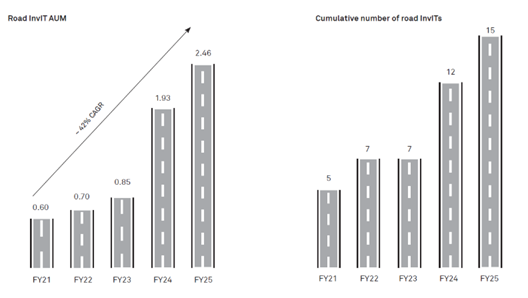
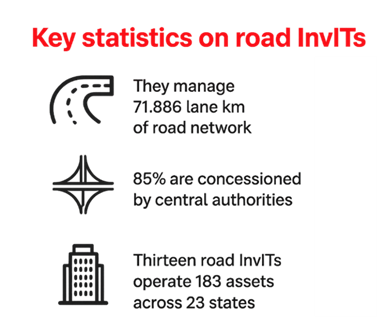
The road sector is a prominent segment for INVITs in India as it has emerged as the largest contributor to the INVIT landscape (~40% of the AUM and growing). There were 26 INVITs registered with SEBI, of which 15 were road INVITs. Of these 15 INVITs, 13 were listed. The AUM for road INVITs has increased to Rs 2.46 lakh crore in fiscal 2025, from Rs 0.60 lakh crore in fiscal 2021, clocking a CAGR of ~42%. The number of road INVITs has tripled in the last 5 years and more than doubled in past 3 years.
Date: 31st March 2025, Source: Crisil Intelligence; SEBI
Road INVITs have grown faster than others
Source: Annual report, valuation report, Crisil Intelligence, Data as on March 31, 2025, AUM in Rs Lakh Crore
Power & Energy: The Next Leg of Growth
If roads are the present, the power and energy sector is where the next wave of INVIT growth is building.
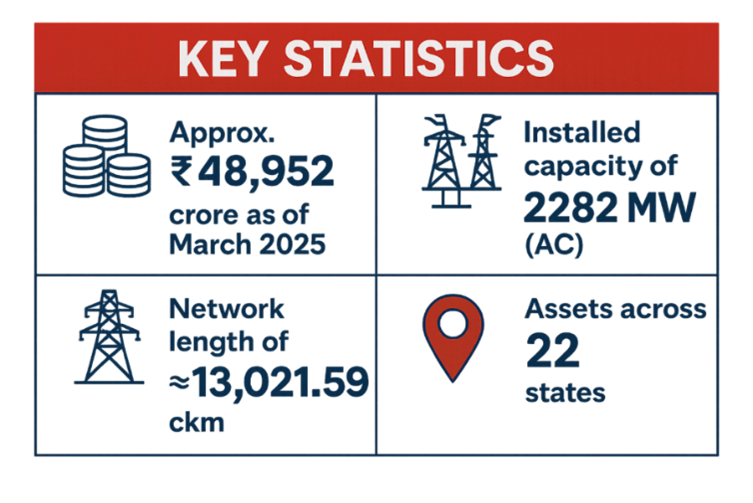
Currently, the sector accounts for a smaller share, about ~8% of total INVIT AUM, with assets worth nearly ₹49,000 crore. But that number doesn’t fully capture its significance.
Source: Crisil Intelligence; Company Filings
This is a sector undergoing a structural transformation. India’s infrastructure expansion is increasingly tied to energy transition: renewables, grid expansion, and electrification.
INVITs here operate across both transmission and generation assets, typically backed by long-term contracts such as:
- Transmission Service Agreements (TSAs)
- Power Purchase Agreements (PPAs)
These contracts often span 20–30 years or more, providing predictable and regulated revenue streams that are largely insulated from demand volatility.
Another important shift is toward renewable energy. With India targeting large-scale capacity additions in solar and wind, a growing pool of operational renewable assets is expected to move into INVIT structures.
Put simply, energy INVITs combine two powerful themes:
- Stable yields (like traditional infrastructure)
- Secular growth (from the energy transition)
That combination makes this segment particularly compelling for long-term investors.
Fibre, Telecom & Digital Infrastructure: Silent Enablers
While less discussed, digital infrastructure, fibre and telecom, already forms a significant part of the INVIT universe. In fact, fibre accounts for around 35% of INVIT AUM, second only to roads, while telecom and data transmission contribute another meaningful share. As data consumption, 5G rollout, and digitalisation deepen, these assets are becoming the new-age equivalent of highways, just for data instead of goods.
Other emerging sector within INVITs is warehousing and logistics, a segment that mirrors India’s evolving consumption and supply chain dynamics.
Today, the share is still small, about ~2.3% of total INVIT AUM. But the growth drivers are compelling:
- E-commerce expansion
- Formalisation of logistics
- Policy support through Gati Shakti and National Logistics Policy
Source: Crisil Intelligence
The Bigger Picture: Still a Concentrated Market
India’s INVIT story is no longer just a structural idea, it is becoming an investable reality, powered by a multi-decade infrastructure capex cycle, an aggressive asset monetisation roadmap, and rising global demand for predictable, yield-oriented assets. With significant under-penetration across key sectors such as renewables, logistics, and transportation, the runway for growth remains substantial. In fact, as per Crisil the INVITs Market opportunity by 2030 would increase to INR 21 Lakh crores from the existing AUM.
From an investor’s lens, INVITs offer a differentiated proposition positioned between fixed income and high-growth equities. they provide high-visibility cash flows, backed by real assets and disciplined structures.
INVITs may not dominate headlines like equities but as India’s infrastructure story unfolds, they are quietly positioning themselves as a cornerstone of investor portfolios and a key enabler of economic growth.
Indian InvITs have evolved into a credible institutional asset class, supported by a maturing regulatory framework and a steadily expanding opportunity set across roads, power transmission, renewable energy and digital infrastructure. From an investor’s perspective, the key attraction lies in the combination of visible cash flows from operating assets, portfolio scale, and the ability to participate in India’s infrastructure build-out through a listed yield vehicle
Hare Krishna, Chief Executive Officer, Capital Infra Trust adds - INVIT are rewiring how India finances its infrastructure. And at the heart of this transformation are assets that rarely makes front-page news but quietly power the economy. Enter the Infrastructure Investment Trust a SEBI-regulated vehicle designed to channel long-term, patient capital from investors into operational infrastructure assets. Modelled closely on REITs (Real Estate Investment Trusts) framework, INVIT allow retail and institutional investors to own a slice of real infrastructure roads, power lines, pipelines and receive a share of the revenue these assets generate.
Vihag Mishra, Vice President, Fund Manager – Debt adds - The sector is moving from a niche product to a strategic allocation bucket for long-term capital. However, allocation to INVIT must be anchored in rigorous assessment of asset quality, concession profile, leverage, governance standards, and sponsor alignment
Disclaimers
Usage of brand names/ company names in generic content/non-scheme related content - Use of the company/ brand names does not imply any affiliation with or endorsement by them or any of its holding companies, subsidiaries or affiliates and are used for illustrative purpose only. The stocks/sectors mentioned do not constitute any kind of recommendation and are for information purpose only. Kotak Mahindra Mutual Fund may or may not hold position in the mentioned stock(s)/sector(s). These materials are not intended for distribution to or use by any person in any jurisdiction where such distribution would be contrary to local law or regulation. The distribution of this document in certain jurisdictions may be restricted or totally prohibited and accordingly, persons who come into possession of this document are required to inform themselves about, and to observe, any such restrictions
Mutual Fund investments are subject to market risks, read all scheme related documents carefully.