18 Jun 2026
SEBI Registered Name - Kotak Mahindra Mutual Fund
SEBI Registered Number - MF/038/98/1
Imagine stopping at a roadside tapri for a quick cutting chai before work. You scan a QR code, tap ‘Pay’, and within seconds the transaction is complete.
Simple, isn’t it?
But, what you don't see is the journey that this simple transaction takes. In those few seconds, data travels through telecom networks, bank servers, cloud platforms and data centres before the confirmation reaches your phone.

And it's not just UPI. The same invisible network powers your video calls, online classes, OTT streams and even the AI tools that can answer questions or create images in seconds.
At the heart of this digital world is optical fibre; hair-thin strands of glass that carry information using pulses of light. Hidden beneath our roads, across cities and even under oceans, these cables quietly move vast amounts of data every second, making modern life faster, smarter and more connected than ever before.
From India's UPI revolution to the global AI boom, this optical fibre is quietly powering the future.
But what does one really understand by Optical Fibre?

Optical fibre is a thin, flexible strand of glass or plastic that transmits information through light signals from one end to the other. For decades, communication networks relied on copper cables, which transmitted data using electrical signals. While effective, copper has limitations.
| Copper Cable | Optical Fibre |
|---|---|
| Electrical signals | Pulses of light |
| Slower speeds | Terabit speeds |
| Signal weakens quickly | Long-distance transmission |
| Easier to tap | Highly secure |
| Faces interference | Immune to Electromagnetic Interference |
Optical fibre can support the rising data needs of millions of users simultaneously, which is essential in an economy where broadband connections have surged from 6.1 crore in 2014 to nearly 100 crore in 2025 and average monthly wireless data consumption per subscriber has risen dramatically over the last decade. As digital usage deepens, fibre provides the scalable backbone that keeps networks stable and responsive.
Because of these advantages, fibre networks form the foundation of modern telecommunications, broadband internet, cloud computing, and data centres
(Source: Press Information Bureau as on 19th December 2025)
As our digital world grows, so does the need for energy-efficient technology. Optical fibre helps here too. Since it carries data through light instead of electrical signals, it uses less power than traditional copper cables. It also generates less heat, reducing cooling needs in data centres. As AI and digital usage expand rapidly, fibre is becoming important not just for speed, but also for sustainability.
Optical Fibre Powers More of Your Day Than You Realise
Whether it is a UPI payment at a kirana store, a Social Media video streaming without buffering or a doctor consulting a patient online, fibre infrastructure quietly keeps everything running. Hidden beneath our roads and cities, optical fibre quietly powers the digital experiences we use every day.
UPI Payments: Instant money transfers in seconds
Video Streaming: Smooth HD and 4K streaming without buffering
Video Calls & Remote Work: Clearer and more stable online meetings
AI Tools: Fast responses powered by massive data movement
Cloud Storage: Quick uploads, downloads and file sharing
Food Delivery & Ride Apps: Live tracking and faster app performance
UPI is a good example of how digital convenience depends on network infrastructure. When someone scans a QR code, the payment request travels through telecom networks, banking systems and NPCI infrastructure before confirmation reaches both customer and merchant.
India today has one of the world’s largest real-time digital payment ecosystems. During festive sales, cricket tournaments and shopping events, millions of transactions happen almost simultaneously. Fibre networks help support this scale.
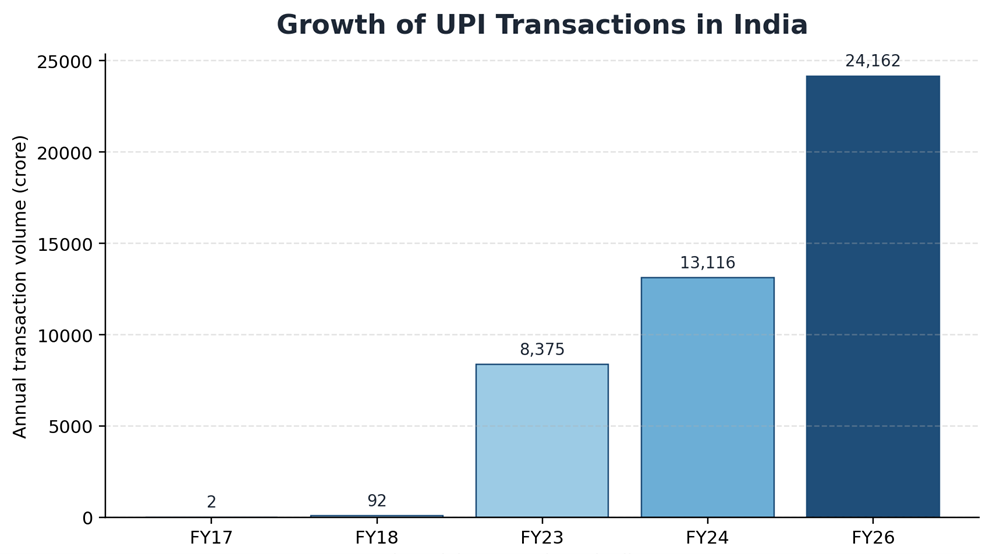
Source: PIB/Ministry of Finance, May 2026
PIB, citing NPCI data, reported that UPI annual transaction volume expanded from just 2 crore transactions in FY17 to ~24,162 crore transactions in FY26. The annual transaction value crossed Rs. 314 lakh crore in FY26, and more than 700 banks were onboarded on UPI. (Source: PIB)
Although UPI feels instant and wireless, the journey of a payment request to actual payment confirmation travels through a complex digital network supported by high-speed fibre infrastructure as shown below.

The AI boom is increasing the need for optical fibre more than ever. Every interaction with an AI chatbot or image generator involves huge amounts of data moving between devices, cloud platforms and data centres. This is why technology companies and telecom operators around the world are investing heavily in fibre networks and data centres.
This rising demand is creating opportunities for companies like Sterlite Technologies Ltd (STL), with STL recently winning a $1.11 billion optical fibre contract.

Source: Business Standard
The growing demand for data is also driving the expansion of 5G. While 5G is often seen as a wireless technology, it relies on fibre connections behind the scenes. Mobile towers need high-capacity fibre links to carry data back to the main network and deliver the speed and low latency that users expect.
Optical fibre is also helping extend digital connectivity beyond cities. Through initiatives such as BharatNet, broadband access is reaching villages and rural communities across India. According to PIB updates, nearly 97% of the targeted Gram Panchayats had been connected by January 2026, supported by close to 7 lakh kilometres of optical fibre. India's overall fibre network has also expanded significantly, growing from 19.35 lakh route kilometres in 2019 to 42.36 lakh route kilometres in 2025.
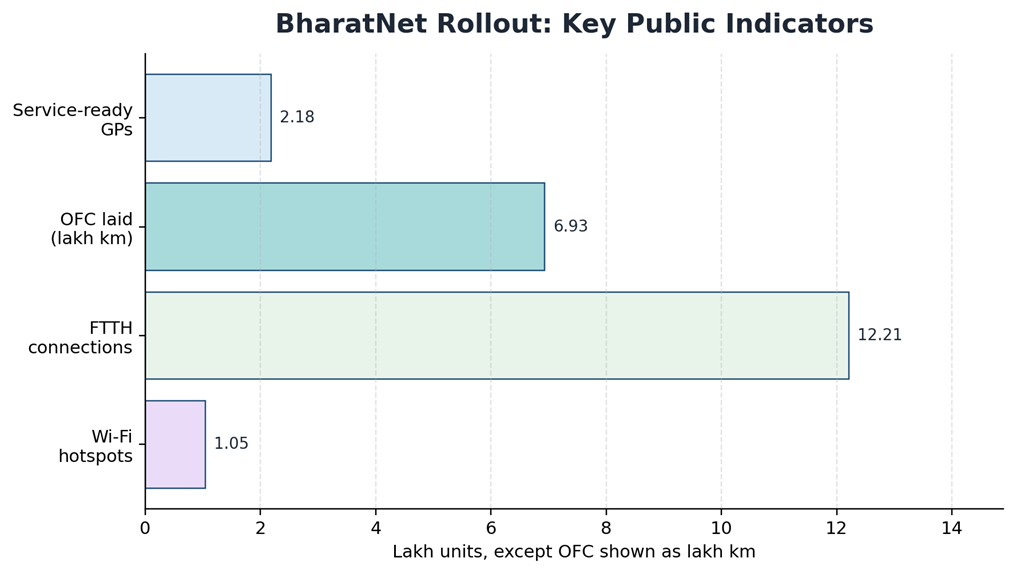
(Source: PIB, January 2026, As per latest data available)
Whether it is powering AI, supporting 5G or connecting rural India, optical fibre is quietly becoming the backbone of the country's digital future.
India's data-centre industry is expanding rapidly to support this demand. PIB reported in March 2026 that India’s total data-centre capacity had grown from about 375 MW in 2020 to around 1,500 MW by 2025. It also noted that 38,231 GPUs had been onboarded through empanelled service providers and data centres under the AI compute capacity framework.
This highlights an important reality:
AI may look like software, but AI needs data, data needs data centres and data centres need fibre connectivity.
The optical fibre ecosystem is not one single industry. It includes companies that manufacture fibre and cables, operators that deploy networks, equipment providers that build optical systems, infrastructure companies that support rollout and data centre or cloud players that consume large amounts of capacity.
From Sand to Optical Fibre
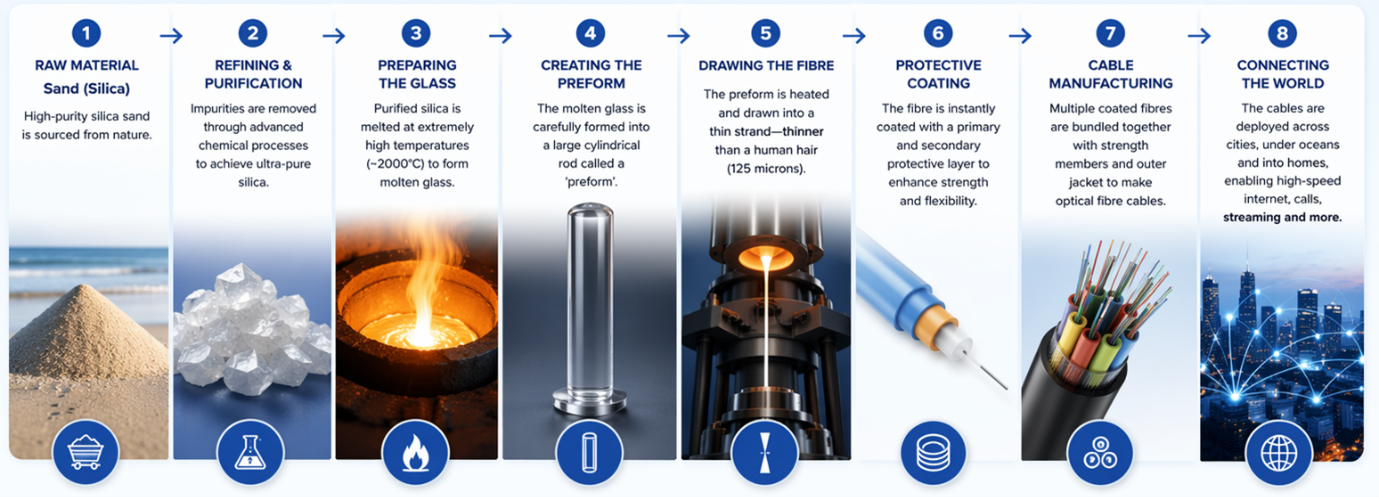
Source: Sterlite Technologies Ltd
| Who? | What do they do? | Examples |
|---|---|---|
| Fibre makers | Make the fibre cables that carry data. | Sterlite Technologies Ltd, Himachal Futuristic Communication Ltd, Polycab India Ltd, Corning Incorporated |
| Telecom companies | Use fibre to connect mobile towers, homes and businesses. | Reliance Jio Infocomm Limited, Bharti Airtel Limited, Bharat Sanchar Nigam Limited (BSNL), Vodafone Idea Limited |
| Equipment providers | Supply the technology that helps fibre networks run smoothly. | Tejas Networks Limited, Cisco Systems Inc., Nokia Corporation |
| Infrastructure providers | Build and maintain the networks that carry fibre across long distances. | Indus Towers Ltd., RailTel Corporation of India Limited, PowerGrid Teleservices Limited |
| Cloud and data centre companies | Use fibre to power cloud services, AI and data storage. | Amazon Web Services (AWS), Microsoft Azure, Google Cloud, CtrlS Datacentres Ltd, Yotta Data Services Private Ltd |
While fibre is powerful, deploying it is not easy.
Building fibre networks involves significant investment and coordination.
Some of the biggest challenges include:
- High deployment costs
- Right-of-way permissions
- Trenching and civil works
- Fibre cuts during construction
- Maintenance requirements
- Connectivity in remote regions
Successful fibre rollout often requires coordination between telecom operators, local authorities, infrastructure providers and government agencies.
As countries compete to build digital economies, fibre infrastructure will increasingly be viewed as a strategic national asset.
Let's go back to that cup of chai.
A quick scan. A tap on your phone. Payment done.
Simple for us. Remarkable behind the scenes.
Every day, billions of messages, payments, searches and ideas travel through a vast network of optical fibre that most of us will never see. Hidden beneath roads, across cities and under oceans, these strands of glass quietly keep the digital world moving.
The technologies may change. Today's UPI and AI will eventually give way to something new. But one thing is unlikely to change anytime soon: our need to stay connected.
And increasingly, those connections travel at the speed of light.
Dhananjay Tikariha, Fund Manager, Equity, Kotak AMC says, “In the same way that roads powered industrial growth, optical fibre is powering the digital age. With 5G densification, hyperscale data centres and AI workloads driving unprecedented data traffic, fibre deployment is set to remain one of the most structurally attractive infrastructure themes globally.”
Disclaimers:
KMAMC is not guaranteeing/offering/communicating any indicative yield/returns on investments. The stocks/sectors mentioned in this slide do not constitute any recommendation and Kotak Mahindra Mutual Fund may or may not have any future position in these sectors/stocks. Companies mentioned don’t constitute recommendation, brand name affiliation disclaimer & companies mentioned for illustrative purpose only. Use of the company brand names does not imply any affiliation with or endorsement by them or any of its holding companies, subsidiaries or affiliates and are used for illustrative purpose only.
Mutual Fund investments are subject to market risks, read all scheme related documents carefully.