10 Apr 2026
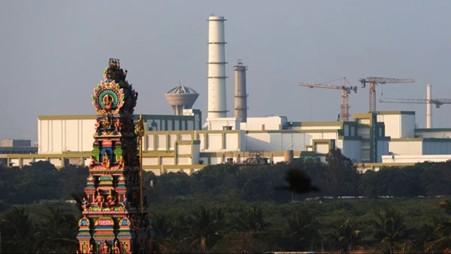
The attainment of criticality at the Prototype Fast Breeder Reactor (PFBR), Kalpakkam, on April 6th, 2026, marks a pivotal moment in India’s civil nuclear programme. More than a technological milestone, it represents a structural advancement in India’s pursuit of Atmanirbhar Bharat in a strategically critical sector.
The PFBR is a 500 MWe sodium‑cooled fast breeder reactor, designed by Indira Gandhi Centre for Atomic Research (IGCAR) and built by Bharatiya Nabhikiya Vidyut Nigam Limited (BHAVINI), both operating under the Department of Atomic Energy (DAE).
Conceived decades ago and realised through sustained national effort, the PFBR operationalises Stage II of India’s three‑stage nuclear strategy, a programme designed to address India’s long‑standing resource constraints through scientific foresight and policy continuity. This transition reflects a deliberate shift from dependence on finite resources to a model built on efficiency, resilience and long‑term sustainability.
Source: The Indian Express
From Resource Constraints to Strategic Capability
India’s nuclear roadmap has always been shaped by a fundamental reality: limited domestic uranium reserves and an over‑dependence on external fuel sources. The fast breeder programme was designed as a response to this constraint.
Unlike conventional nuclear reactors that slowly use up their fuel, fast breeder reactors are designed to make new fuel while they generate electricity. In simple terms, they do not just consume fuel, they also help create more of it for future use. This makes nuclear fuel last much longer and allows far more energy to be produced from limited resources.
With the Kalpakkam reactor achieving criticality, India has moved from merely planning this technology to actually putting it into operation. This is a key step toward long‑term energy self‑reliance, reducing dependence on fuel imports, and building a more sustainable energy system for the future.
Mastering fast breeder technology would allow India to unlock energy from U238 which is 99.3% of the natural Uranium, increasing the amount of electricity which can be generated about 60 times more than conventional Nuclear reactors.
(Source: IAEA, Status of Fast Reactor Research and Technology Development)
India has one of largest reserves of Thorium, ability to harness it for electricity generation could meet India’s energy needs potentially for thousands of years.
The bigger picture: India’s three-stage nuclear vision
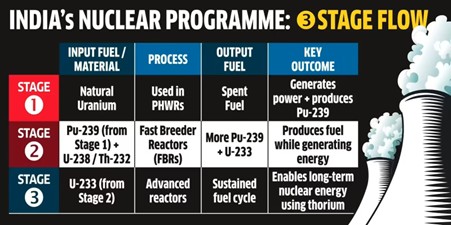
India’s nuclear strategy is unique and resource‑driven:
Stage I (The baseline)
Pressurised Heavy Water Reactors (PHWRs) using natural uranium to generate electricity and yield plutonium as by product.
Stage II (The catalyst)
Fast Breeder Reactors like PFBR to produce more plutonium from U238 initially and to convert thorium into U-233 eventually. (Fast Breeder Reactors like the PFBR do two jobs at once. They generate electricity and create additional nuclear fuel in the process.)
Stage III (The Ultimate Goal)
Transitioning to Advanced Heavy Water Reactors (AHWRs) which will use U-233 to generate power and use thorium to breed more U233.
With PFBR’s criticality, Stage II has moved from theory to reality.
Source: https://img.etimg.com/
Fast Breeder Technology as a National Asset
The Kalpakkam PFBR is a 500 MWe, pool‑type, sodium‑cooled fast breeder reactor, designed and built indigenously by Indian scientific and engineering institutions. Its strategic value lies in three areas:
- Energy Security: By helping India get much more energy from the same limited uranium, the PFBR strengthens India’s ability to meet future energy demand with reduced import dependence.
- Thorium Enablement: Fast breeder reactors form the essential bridge to India’s thorium‑based Stage III programme—leveraging one of the country’s most abundant yet underutilised natural resources.
- Closed Fuel Cycle: Instead of discarding nuclear fuel after one use, the PFBR allows fuel to be processed and reused. This reduces long‑term nuclear waste and ensures that valuable resources are used more efficiently and sustainably.
Globally, only a handful of nations like Russia, have successfully deployed fast breeder reactors at commercial scale. With Kalpakkam, India enters this select group through an entirely indigenous effort.
Atmanirbhar Bharat and Make in India in Action
The PFBR is a tangible outcome of Atmanirbhar Bharat and Make in India in sectors where self‑reliance is not optional, but essential. The reactor has been designed, constructed and commissioned domestically, underscoring India’s growing capabilities in advanced materials, complex engineering and nuclear systems integration.
Equally important is the continuity of government policy that enabled the project’s completion—demonstrating the value of long‑term institutional commitment in nationally strategic programmes.
What happens next?
The reactor will now undergo:
- Low Power Physics Experiments
- Gradual power escalation
- Extended safety and stability tests
The Kalpakkam PFBR has entered a critical testing phase and will take a few months to reach full power generation. During this time, low‑power experiments will be conducted and reviewed by the Atomic Energy Regulatory Board before commercial operations begin.
Building for the Long Term
As India’s economy expands, the demand for reliable, clean baseload power will increase alongside renewable energy deployment. Nuclear power—particularly breeder and thorium‑based systems—offers a stable complement to intermittent sources while supporting low‑carbon growth.
The Kalpakkam PFBR is therefore not merely a reactor achieving criticality. It is India’s long‑term investment in energy resilience, scientific depth and inter‑generational sustainability, rooted in self‑reliance and executed through indigenous capability.
It stands as a quiet but powerful assertion of national confidence: building today what will secure India’s energy future for generations to come.
Source – https://pmindia.gov.in/, https://thehindu.com/, https://economictimes.indiatimes.com/
Disclaimers:
These materials are not intended for distribution to or use by any person in any jurisdiction where such distribution would be contrary to local law or regulation. The distribution of this document in certain jurisdictions may be restricted or totally prohibited and accordingly, persons who come into possession of this document are required to inform themselves about, and to observe, any such restrictions.
The document includes statements/opinions which contain words or phrases such as "will", "believe", "expect" and similar expressions or variations of such expressions, that are forward looking statements. Actual results may differ materially from those suggested by the forward looking statements due to risk or uncertainties associated with the statements mentioned with respect to but not limited to exposure to market risks, general and exposure to market risks, general economic and political conditions in India and other countries globally, which may have an impact on our services and/or investments, the monetary and interest policies of India, inflation, deflation, unanticipated turbulence in interest rates, foreign exchange rates, equity prices or other rates or prices etc.
The stocks/sectors mentioned do not constitute any kind of recommendation and are for information purpose only. Kotak Mahindra Mutual Fund may or may not hold position in the mentioned stock(s)/sector(s). Kotak Mahindra Asset Management Company Limited (KAMAMC) is not guaranteeing or promising any returns/futuristic returns.
MUTUAL FUND INVESTMENTS ARE SUBJECT TO MARKET RISKS, READ ALL SCHEME RELATED DOCUMENTS CAREFULLY.