17 Jun 2026
Evaluating an investment based only on returns does not always provide the full picture. Investors also need to understand the risk involved in generating those returns, especially the risk of losses. The Sortino ratio is a risk-adjusted performance metric that helps measure how efficiently an investment delivers returns relative to its downside risk. By focusing only on negative volatility rather than total market fluctuations, the Sortino ratio provides a clearer view of how well an investment performs while controlling potential losses. Understanding its meaning, formula and calculation can help investors better compare funds and assess risk-adjusted performance.
Key Takeaways
- The Sortino ratio measures investment performance relative to downside risk rather than total volatility.
- It focuses only on negative returns, providing a clearer view of harmful fluctuations.
- A higher Sortino ratio indicates better risk-adjusted returns with lower downside volatility.
- The ratio is useful for comparing mutual funds, evaluating portfolio strategies, and analysing risk adjusted performance.
- It should be used together with other metrics such as Sharpe ratio, alpha, beta and information ratio for a comprehensive investment analysis.
What is Sortino Ratio?
The Sortino ratio is a risk-adjusted performance metric that evaluates an investment’s returns relative to its downside risk, focusing only on negative volatility rather than total volatility. Understanding the sortino ratio meaning helps investors assess how efficiently an investment generates returns while limiting exposure to losses. Calculated as the difference between the investment’s return and a minimum risk-free rate divided by the downside deviation, the Sortino ratio provides a clearer assessment of performance, with a higher ratio indicating superior returns per unit of downside risk.
Sortino Ratio Formula
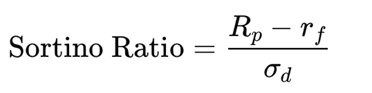
Where:
Rp = Portfolio return
Rf = Risk-free rate or minimum acceptable return
σd = Downside deviation (standard deviation of negative returns)
Key Terms in Sortino Ratio
The key terms in sortino ratio are as follows:
1. What is Downside Deviation?
Downside deviation measures the volatility of returns that fall below a target return. Unlike standard deviation, it focuses only on negative fluctuations, helping assess the risk of losses in an investment.
2. What is MAR (Minimum Acceptable Return)?
Minimum Acceptable Return (MAR) is the minimum return an investor expects from an investment. In the Sortino Ratio, only returns below the MAR are used to calculate downside risk.
How to Calculate Sortino Ratio?
Calculating the Sortino ratio involves the following steps
Step 1 - Determine the portfolio return
Compute the average return of the investment or mutual fund over the relevant period.
Step 2 - Identify the minimum acceptable return (MAR)
This could be a risk-free rate such as government bond yields.
Step 3 - Calculate the downside deviation
Measure the standard deviation of returns that fall below the MAR. This captures only negative volatility.
Step 4 - Apply the Sortino formula
Subtract the MAR from the portfolio return, then divide the result by the downside deviation.
The resulting value indicates how much excess return the investment generates for each unit of downside risk, providing a clearer view of risk-adjusted performance.
Sortino Ratio Calculation Example
Suppose two mutual funds generate different average returns but have different downside risk.
| Fund | Average Return | Downside Deviation | Sortino Ratio |
|---|---|---|---|
| Fund A | 11% | 8% | 0.38 |
| Fund B | 10% | 5% | 0.50 |
Even though Fund A offers a higher return (11%), Fund B has a higher Sortino ratio due to lower downside volatility. This means Fund B delivers better risk adjusted returns, making it more attractive from a downside risk perspective.
What Does the Sortino Ratio Tell You?
The Sortino ratio helps investors evaluate whether an investment is providing adequate returns for the risk of negative performance. Unlike traditional risk measures that consider all volatility, it focuses only on downside deviation ignoring upside movements that are generally beneficial.
Key insights the ratio provides include:
- Efficiency of returns relative to downside risk
- Stability of investment performance
- Effectiveness of a portfolio manager in controlling losses
How to Interpret Sortino Ratio?
The Sortino ratio measures return per unit of downside risk, helping investors assess risk adjusted performance more realistically than standard metrics.
Key points for interpretation:
- Higher Sortino ratio - Indicates the investment generates better returns relative to the downside risk taken. A higher ratio generally reflects efficient performance with controlled losses.
- Lower Sortino ratio - Suggests the investment has higher downside volatility relative to returns, signalling less favourable risk-adjusted performance.
- Comparison tool - When comparing funds or portfolios with similar returns, the Sortino ratio helps identify the option with lower exposure to negative returns, even if absolute returns are slightly lower.
In short, a higher Sortino ratio means the investment is rewarding investors more for each unit of bad risk, providing a clearer picture of downside risk efficiency.
What is a Good Sortino Ratio?
A higher Sortino Ratio generally indicates better risk-adjusted performance, as it reflects higher returns relative to downside risk.
In practice, investors often compare the Sortino Ratio of a fund with similar funds, benchmarks or across different time periods to understand its performance. Since market conditions, asset classes and investment strategies differ, the interpretation of a good Sortino Ratio may vary depending on the context.
Sortino Ratio in Mutual Funds
The Sortino ratio in mutual funds is commonly used by analysts and investors to assess a fund’s performance by focusing specifically on downside risk. Since mutual fund returns can fluctuate with changing market conditions, this metric helps evaluate how effectively a fund generates returns while limiting potential losses.
It helps investors understand
- Whether the fund manager is managing downside risk effectively
- Whether the fund is delivering returns with controlled negative volatility
In general, a higher Sortino ratio suggests that the fund is generating better returns relative to the downside risk taken, indicating efficient risk adjusted performance.
Sortino Ratio vs Sharpe Ratio
Both the Sortino ratio and the Sharpe ratio are widely used risk adjusted performance metrics, but they differ in how they measure risk.
The Sharpe ratio considers overall volatility and treats positive and negative fluctuations equally.
In contrast, the Sortino ratio focuses only on downside volatility, which represents the risk of negative returns. Because it isolates downside fluctuations, the Sortino ratio can provide a more targeted view of downside risk. This makes it particularly useful for investors who want to evaluate investments based on the risk of losses rather than overall market movements.
Sortino Ratio vs Information Ratio
The sortino ratio vs information ratio comparison helps investors understand different aspects of risk-adjusted performance.
| Metric | Risk used | Best for |
|---|---|---|
| Sortino Ratio | Downside deviation (focuses only on negative volatility) | Evaluating performance when the focus is on downside risk |
| Sharpe Ratio | Standard deviation (considers total volatility) | Comparing overall risk-adjusted returns across investments |
When Should You Use Sortino Ratio?
The Sortino ratio is especially useful when the focus is on downside risk rather than overall volatility. It helps investors evaluate how effectively an investment generates returns while limiting potential losses.
It is commonly used in the following situations:
- Comparing mutual funds with similar returns to identify which fund manages downside risk more effectively
- Evaluating portfolio performance over time, particularly during periods of market fluctuations
- Analysing strategies focused on downside protection such as conservative or risk managed portfolios
- Assessing risk-adjusted performance in volatile markets, where negative returns can significantly impact investors
In practice, investors and analysts often use the Sortino ratio alongside other performance metrics such as information ratio, alpha, beta and rolling returns to gain a more comprehensive understanding of investment performance.
Limitations of Sortino Ratio
1) Requires sufficient historical data
To calculate downside deviation accurately, the investment must have a reasonable history of returns. If the dataset is small or the investment is relatively new, the Sortino ratio may not provide a reliable measure of risk.
2) Limited focus on downside deviation only
While focusing on negative volatility is useful, the Sortino ratio ignores overall volatility and other risk factors. Some investments may have irregular return patterns that are not fully captured by downside deviation alone.
3) May not fully reflect extreme market events
The ratio is based on historical data and typical fluctuations. However, rare but severe market shocks, such as sudden crashes or liquidity events may not be adequately reflected in the calculation.
4) Not a standalone performance metric
The Sortino ratio provides insight into downside risk, but it should be used alongside other metrics such as Sharpe ratio, information ratio, rolling returns, alpha and beta. Combining multiple measures helps investors develop a more complete understanding of an investment’s risk and performance profile.
Common Mistakes While Using Sortino Ratio
- Comparing across unrelated assets: Comparing Sortino Ratios of investments with different risk profiles, asset classes,or time periods may lead to misleading conclusions.
- Using it as the only performance metric: Relying solely on the Sortino Ratio may overlook other important factors such as overall volatility, liquidity and market conditions.
- Ignoring data period: The time period used for calculation can influence the ratio. Short or unusual market periods may not reflect long-term performance.
- Misinterpreting high ratios: A high Sortino Ratio does not always guarantee consistent performance. It should be evaluated along with other risk-adjusted metrics and qualitative factors.
Conclusion
The Sortino ratio is a risk-adjusted performance metric that evaluates how efficiently an investment generates returns relative to its downside risk. By focusing only on negative volatility, it provides a clearer view of the risk that investors are most concerned about.
It is useful for comparing funds, assessing portfolio performance and analysing strategies focused on downside protection. However, it should be used along with other metrics such as Sharpe ratio, alpha, beta and information ratio to gain a complete understanding of investment performance.
FAQs
1) What is a Sortino ratio in mutual funds?
The Sortino ratio in mutual funds measures how effectively a fund generates returns relative to the downside risk it takes, helping investors evaluate performance by focusing only on negative volatility.
2) How do you calculate the Sortino ratio?
The Sortino ratio is calculated by subtracting the minimum acceptable return from the portfolio return and dividing the result by downside deviation.
3) What is downside deviation in the Sortino ratio?
Downside deviation measures the variability of returns that fall below the minimum acceptable return, capturing only harmful volatility.
4) What is MAR (Minimum Acceptable Return) in Sortino ratio?
MAR represents the minimum return an investor expects from an investment and is used as a benchmark when calculating downside risk.
5) Can Sortino ratio be used for SIP mutual fund evaluation?
Yes, the Sortino ratio can be used to analyse mutual funds in which investors invest through systematic investment plans because it helps assess downside risk in the underlying fund.
6) Should you rely only on Sortino ratio to pick a fund?
No, investors should evaluate funds using multiple metrics such as the Sharpe ratio, alpha, beta and rolling returns instead of relying solely on the Sortino ratio.
Disclaimers
Investors may consult their Financial Advisors and/or Tax advisors before making any investment decision.
These materials are not intended for distribution to or use by any person in any jurisdiction where such distribution would be contrary to local law or regulation. The distribution of this document in certain jurisdictions may be restricted or totally prohibited and accordingly, persons who come into possession of this document are required to inform themselves about, and to observe, any such restrictions.
MUTUAL FUND INVESTMENTS ARE SUBJECT TO MARKET RISKS, READ ALL SCHEME RELATED DOCUMENTS CAREFULLY.