12 Feb 2026
An arbitrage fund is a type of mutual fund that aims to benefit from the price difference of the same security in two markets. These funds typically buy a stock in the cash (spot) market and simultaneously sell the same stock in the futures market. By taking equal and opposite positions the fund seeks to capture the price spread rather than depend on stock price movement. Positions are usually held till the expiry of the derivatives contract. Returns from arbitrage strategies depend on the availability of price differences, market volatility and prevailing market conditions. Arbitrage funds are generally used by investors looking for hybrid schemes with a hedged strategy and relatively low sensitivity to directional equity movements.
Key Takeaways
Arbitrage funds aim to earn from price differences between the cash (spot) and futures markets rather than relying on stock price movements
- They are hybrid funds with hedged positions, generally offering lower volatility compared to regular equity funds
- Suitable for short to medium term investors seeking balanced risk and potential returns
- Returns are not guaranteed and may depend on market inefficiencies, liquidity, and available arbitrage opportunities
- Investors should review the SID, check expense ratios and consider exit loads before investing
How Do Arbitrage Funds Work?
Arbitrage funds try to benefit from the price difference of the same stock in two markets at the same time the cash (spot) market and the futures market. The fund buys in one market and sells in the other simultaneously, aiming to capture the price gap.
Example
Suppose the following prices exist for the same stock, XYZ Ltd.
- Cash market price: 144.40
- Futures market price: 145.70
What the fund manager does:
- Buys 10,000 shares of XYZ Ltd. in the cash market at 144.40
- Sells 10,000 shares of XYZ Ltd. in the futures market at 145.70
So the price difference = 145.70 − 144.40 = 1.30 per share
This difference is the arbitrage spread the fund aims to capture, subject to costs and regulations.
At expiry of the futures contract:
- the cash and futures prices usually converge
- both positions are closed
- the locked in price difference is realized
Even if the price moves up or down before expiry, the buy and sell positions generally offset each other while the price gap remains the focus.
If similar opportunities continue in the next month, the position may be rolled over, if not it may be closed as per the scheme’s investment strategy in the Scheme Information Document (SID).
Key Features of Arbitrage Funds
- Arbitrage funds are classified as Hybrid Funds under SEBI Categorisation
- Primarily invest in Equity and equity related instruments including derivatives
- Follow hedged strategies instead of relying on market direction
- Returns depend on available price differences (arbitrage opportunities)
- May invest in money market or short term debt instruments when arbitrage options are limited
- Generally suitable for short term to medium term investment horizons
Benefits of Arbitrage Funds
- Provides equity market exposure with hedged positions, reducing sensitivity to market swings
- Generally experiences lower volatility compared with regular equity funds
- May offer tax treatment similar to equity funds subject to current regulations
- Can be used to park surplus funds for short term periods
- Professionally managed by fund managers who monitor market price differences and arbitrage opportunities
Risks in Arbitrage Funds
While arbitrage funds aim to capture price differences, they are not risk free. Key risks include
- Returns depend on the availability of arbitrage opportunities
- Short term fluctuations in price spreads may occur
- Changes in market liquidity can affect execution
- The scheme does not guarantee or assure returns
Who Should Consider Arbitrage Funds?
Arbitrage funds may be suitable for investors who
- Prefer lower risk equity exposure as the fund hedges positions to reduce market volatility
- Are conservative investors seeking relatively stable returns without taking large equity risks
- May be considered for short term parking where suitable returns depend on spreads and market conditions and are not guaranteed.
- Are seeking tax benefits as these funds are generally treated as equity funds for taxation purposes
Difference Between Arbitrage Fund and Equity Fund
| Parameter | Arbitrage Fund | Equity Fund |
|---|---|---|
| Strategy | Hedged arbitrage strategy | Unhedged, market-linked strategy |
| Return Driver | Price differences across cash and derivative markets | Market movements and equity price appreciation |
| Volatility | Relatively lower volatility under normal market conditions | Higher volatility due to market fluctuations |
| Tax Treatment | Taxed as equity (as per prevailing tax regulations) | Taxed as equity (as per prevailing tax regulations) |
Things to Consider Before Investing in Arbitrage Funds
- Returns can fluctuate depending on available price differences in the market
- These funds are not guaranteed or fixed return products
- Check expense ratios and any exit loads before investing
- Always read the Scheme Information Document (SID) and understand the risk factors
Conclusion
Arbitrage funds offer a strategic way to invest in equities with lower risk by capitalizing on price differences between cash and futures markets. They are suitable for investors seeking short to medium term investment options, possibly relatively stable returns and potential tax benefits. While not risk free these funds provide a professionally managed, hedged equity exposure suitable for cautious investors.
FAQ
1) What is an arbitrage fund?
An arbitrage fund is a mutual fund that earns from price differences of the same stock in the cash and futures markets taking hedged positions to reduce market risk.
2) Who should invest in arbitrage funds?
Investors who want lower risk equity exposure, short to medium term investment and equity taxation may consider arbitrage funds.
3) Are arbitrage funds risk free?
No. While they are relatively safer than regular equity funds, returns depend on the availability of arbitrage opportunities, market liquidity and short term fluctuations.
4) Can arbitrage funds be used for short-term investments?
Yes, they are suitable for short term to medium term horizons and can also be used to park surplus funds temporarily.
5) Are arbitrage funds risky or are they fully safe?
Arbitrage funds are not fully safe or guaranteed but they are generally considered relatively low risk compared to other equity oriented mutual funds. Since the equity positions are typically hedged the strategy aims to reduce market direction risk. However investors should remember that all mutual fund investments carry some level of risk.
6) What is the ideal holding period for arbitrage funds?
Arbitrage funds are generally suitable for a short to medium term investment horizon, typically 3 months to 12 months or more. Staying invested for this period may help improve the return experience and tax efficiency.
Disclaimers
Kotak Arbitrage Fund
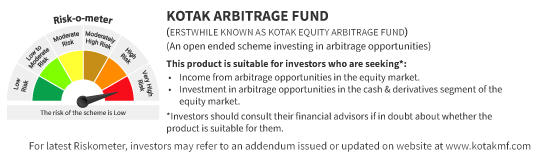
Investors may consult their Financial Advisors and/or Tax advisors before making any investment decision.
These materials are not intended for distribution to or use by any person in any jurisdiction where such distribution would be contrary to local law or regulation. The distribution of this document in certain jurisdictions may be restricted or totally prohibited and accordingly, persons who come into possession of this document are required to inform themselves about, and to observe, any such restrictions.
MUTUAL FUND INVESTMENTS ARE SUBJECT TO MARKET RISKS, READ ALL SCHEME RELATED DOCUMENTS CAREFULLY.